12 Results for "

nematode species

" in MedChemExpress (MCE) Product Catalog:
Products (12)

12 Results for "nematode species" in MCE Product Catalog:

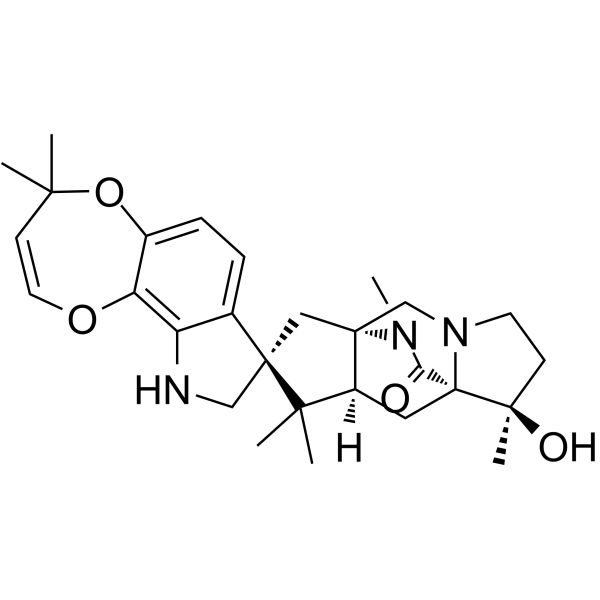
Cat. No.: HY-125159
CAS No.: 187865-22-1
Synonyms: PF-00520904
Target:  

Parasite nAChR

Research Areas:  

Infection

Derquantel, a spirocyclic anthelmintic, is a competitive, orally active nicotinic acetylcholine receptor (nAChR) antagonist. Derquantel inhibits ACh-induced depolarization with an IC50 of 0.22 μM. By selectively antagonizing nAChRs on the somatic muscles of nematodes, Derquantel causes flaccid paralysis of muscles, thereby dislodging parasites from the host's gastrointestinal tract. Derquantel is applicable to research related to Haemonchus contortus infection and Ascaris suum infection .
loading...
    loading...
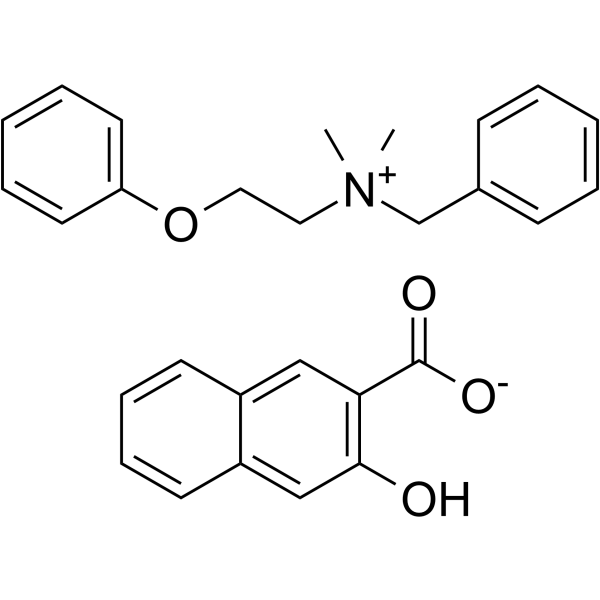
Cat. No.: HY-12639A
CAS No.: 3818-50-6
Purity:  99.92%
Target:  

Parasite

Research Areas:  

Infection

Bephenium hydroxynaphthoate is an orally active anthelmintic with anthelmintic activity against hookworms and roundworms. Bephenium hydroxynaphthoate reduces egg counts, promotes worm expulsion, and most expelled roundworms die at approximately 24 h, while the rest show weakened activity. Bephenium hydroxynaphthoate can be used in research related to ascariasis, hookworm infection, and roundworm infection .
loading...
    loading...
Cat. No.: HY-178239
CAS No.: 276680-63-8
DX-8951 Hydroxy-acid is a prodrug of phosphoramide. ProAX can effectively increase intracellular ATP levels. DX-8951 Hydroxy-acid activates the AMPK signaling pathway by increasing the AMP/ATP ratio. DX-8951 Hydroxy-acid can enhance mitochondrial function and antioxidant capacity while reducing reactive oxygen species (ROS) levels. DX-8951 Hydroxy-acid has shown significant anti-aging and longevity effects in both human fibroblast and nematode models .
loading...
    loading...
Cat. No.: HY-N8392
CAS No.: 1186217-42-4
Target:  

Parasite

Research Areas:  

Infection

Ascr#9 is a small-molecule pheromone belonging to the ascaroside family, and it is widely present in nematodes. Ascr#9 promotes dispersal or elicits avoidance behavior in various nematode species (such as Caenorhabditis elegans and entomopathogenic nematodes), suggesting that individuals evacuate from adverse environments. Ascr#9 exhibits repellent potential in Meloidogyne incognita .
loading...
    loading...
Cat. No.: HY-178239A
DX-8951 Hydroxy-acid sodium is a prodrug of phosphoramide. DX-8951 Hydroxy-acid sodium can effectively increase intracellular ATP levels. DX-8951 Hydroxy-acid sodium activates the AMPK signaling pathway by increasing the AMP/ATP ratio. DX-8951 Hydroxy-acid sodium can enhance mitochondrial function and antioxidant capacity while reducing reactive oxygen species (ROS) levels. DX-8951 Hydroxy-acid sodium has shown significant anti-aging and longevity effects in both human fibroblast and nematode models .
loading...
    loading...
Cat. No.: HY-W420337
CAS No.: 1309859-39-9
Synonyms: LH2010A
Research Areas:  

Infection

Fluopimomide (LH2010A) is a potent pesticide, widely used for agricultural pest management. Fluopimomide adversely affects the nematodes growth, locomotive behaviors, reproduction, and lifespan, accompanying with enhanced of reactive oxygen species (ROS) generation, lipid and lipofuscin accumulation, and malondialdehyde content. Fluopimomide inhibits antioxidant systems in the nematodes .
loading...
    loading...
Cat. No.: HY-158423
CAS No.: 615281-26-0
Research Areas:  

Infection

NPD8790 is a species selective mitochondrial respiratory complex I inhibitor with an IC50 of 2.4 µM for C. elegans complex I. NPD8790 is more selective for nematode species mitochondria than human, bovine, and mouse mitochondria. NPD8790 is an anthelmintic that kills adult soil-transmitted helminths .
loading...
    loading...
Cat. No.: HY-12639AR
CAS No.: 3818-50-6
Research Areas:  

Infection

Bephenium hydroxynaphthoate (Standard) is the analytical standard of Bephenium hydroxynaphthoate (HY-12639A). This product is intended for research and analytical applications. Bephenium hydroxynaphthoate is an orally active anthelmintic with anthelmintic activity against hookworms and roundworms. Bephenium hydroxynaphthoate reduces egg counts, promotes worm expulsion, and most expelled roundworms die at approximately 24 h, while the rest show weakened activity. Bephenium hydroxynaphthoate can be used in research related to ascariasis, hookworm infection, and roundworm infection .
loading...
    loading...
Cat. No.: HY-183949
Insecticidal agent 33 is an AChE inhibitor with nematicidal activity. Insecticidal agent 33 impairs locomotor activity of Caenorhabditis elegans, and induces oxidative damage in Caenorhabditis elegans, including elevated reactive oxygen species (ROS) levels, lipofuscin accumulation, lipid deposition, and disrupted cellular homeostasis. Insecticidal agent 33 can be used for the research of plant-parasitic nematode infection .
loading...
    loading...
Cat. No.: HY-170775
CAS No.: 2828439-12-7
Target:  

Cholinesterase (ChE)

Research Areas:  

Others

AChE-IN-83 (compound f1) is an inhibitor of AChE that inhibits the growth of nematodes and acetylcholinesterase in rice seeds and is safe for rice seeds. AChE-IN-83 targets Aphelenchoides oryzae with an LC50 value of 19.0 μg/mL (48 hr). AChE-IN-83 can inhibit the population and behavior of rice nematodes in rice seeds, destroy the nematode cuticle, and lead to the production of reactive oxygen species, lipofuscin, and lipids in the nematodes .
loading...
    loading...
Cat. No.: HY-W036015
CAS No.: 146955-45-5
Target:  

Parasite

Research Areas:  

Infection

(Z)-7-Tetradecen-2-one acts as a species-specific nematicide. (Z)-7-Tetradecen-2-one induces terminal embryogenesis, morphological abnormalities, irreversible developmental arrest and increases eggshell permeability in *Pristionchus pacificus* embryos. (Z)-7-Tetradecen-2-one exerts olfactory attraction toward *Pristionchus pacificus*. (Z)-7-Tetradecen-2-one can be used to study the symbiotic relationship between hosts and nematodes .
loading...
    loading...
Cat. No.: HY-W102893
CAS No.: 99910-50-6
4,6-Dibromo indole is a natural product found in the adipose tissue of bottlenose dolphins, algae, and invertebrates including species of the genus Tubastrea, with multiple activities such as nematicidal and antifungal properties. 4,6-Dibromo indole inhibits the motility of Caenorhabditis elegans and induces a multi-stage nematicidal effect. 4,6-Dibromo indole inhibits the growth, biofilm formation, and yeast-hypha transition of Candida, induces ROS accumulation, disrupts hyphal networks, and reduces biofilm biomass. 4,6-Dibromo indole can be used in studies on crop damage related to nematode infestation and Candida infection .
loading...
    loading...
  • 1

