33 Results for "

phenolic flavonoid

" in MedChemExpress (MCE) Product Catalog:
Products (33)

33 Results for "phenolic flavonoid" in MCE Product Catalog:

Cat. No.: HY-Y1885
CAS No.: 7722-88-5
Tetrasodium pyrophosphate is a water-soluble inorganic salt commonly used as a buffering agent, emulsifier, and sequestrant. Tetrasodium pyrophosphate is an antimicrobial agent that can reduce microbial colonization. Tetrasodium pyrophosphate blocks IPP translocation, enhances astaxanthin, phenol, flavonoid, and H2O2 levels, activates PAL and DPPH scavenging activity. Tetrasodium pyrophosphate can be used for the research of alleviating symptoms post COVID-19 .
loading...
    loading...
Cat. No.: HY-W115789
CAS No.: 1344-09-8
Sodium silicate is a water-soluble silicate. Sodium silicate is widely used as a binder, particularly in the production of detergents, soaps, and cleaners. Sodium silicate promotes the deposition of suberin polyphenols and lignin at wound sites of potato tubers, accelerates callus structure formation, enhances ROS production, and induces the synthesis of total phenols and flavonoids. Sodium silicate reduces the weight loss rate and disease index of wounded potato tubers during storage .
loading...
    loading...
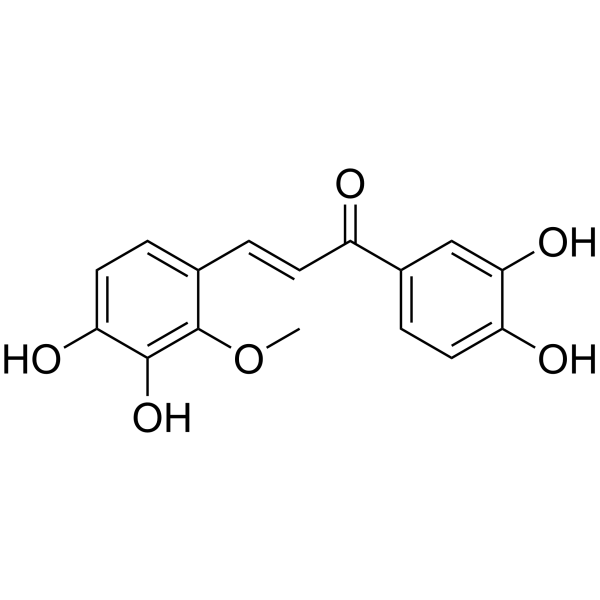
Cat. No.: HY-N9334
CAS No.: 197227-39-7
Tetrahydroxymethoxychalcone is a phenolic and flavonoid compound. Tetrahydroxymethoxychalcone is found to enhance myoblast proliferation and differentiation. Tetrahydroxymethoxychalcone plays important roles in myogenesis and muscle regeneration .
loading...
    loading...
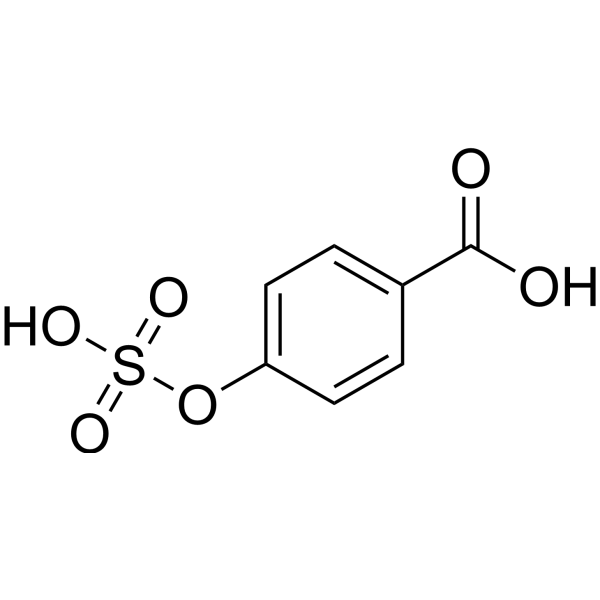
Cat. No.: HY-162297
CAS No.: 3233-38-3
Target:  

Drug Metabolite

Research Areas:  

Others

4-(Sulfooxy)benzoic acid is a sulfated phenolic acid found in C. elegans. 4-(Sulfooxy)benzoic acid is a metabolite of ethyl para-hydroxybenzoate and several flavonoids .
loading...
    loading...
Cat. No.: HY-N8618
CAS No.: 135820-77-8
Erythro-guaiacylglycerol-β-O-4'-dihydroconiferyl alcohol was identified as one of the phenolic compounds isolated from Canadian maple syrup (MS-BuOH). It exhibited antioxidant properties along with other phenolic compounds and coumarins isolated from the syrup. These compounds showed varying degrees of antioxidant activity, with phenolic derivatives and coumarins showing superior activity, more so than lignans and flavonoids. This study marks the first time that 16 of the 23 phenolic compounds, including Erythro-guaiacylglycerol-β-O-4'-dihydroconiferyl alcohol, have been identified in maple syrup .
loading...
    loading...
Cat. No.: HY-N13205
Mulberry fruit Extract is a mulberry extract, and its components include: Anthocyanidins. Mulberry fruit Extract regulates sugar and lipid metabolism, lowers blood sugar and increases insulin secretion. Its blood sugar regulating effect may be attributed to the phytochemicals it contains, mainly 1-deoxynojirimycin, flavonoids, phenolic compounds and polysaccharides. .
loading...
    loading...
Cat. No.: HY-N13040
CAS No.: 50307-26-1
Isoscoparin-7-O-glucoside is a flavonoid compound found in barley leaves. The total phenolic content (TPC) of isoscoparin-7-O-glucoside is positively correlated with COX-2 inhibitory activity, indicating anti-inflammatory activity. Isoscoparin-7-O-glucoside can be used in the study of inflammation .
loading...
    loading...
Cat. No.: HY-W746884
CAS No.: 118971-61-2
Category:  

Animals Phenols Polyphenols

Target:  

Cholinesterase (ChE)

2-Methyl-2-butenyl (E)-Caffeate is a type of caffeic acid ester compound. The petroleum ether and chloroform extracts containing 2-Methyl-2-butenyl (E)-Caffeate have inhibitory effects on acetylcholinesterase (AChE) and butyrylcholinesterase (BChE). The ether extract containing 2-Methyl-2-butenyl (E)-Caffeate exhibits strong antioxidant properties. 2-Methyl-2-butenyl (E)-Caffeate can be used in the research of Alzheimer's disease .
loading...
    loading...
Cat. No.: HY-N18698
CAS No.: 84082-54-2
Ivy, hedera helix extract is extracted from the hedera helix and is rich in bioactive components such as saponins, flavonoids and phenolic acids, which give it beauty benefits.
loading...
    loading...
Cat. No.: HY-L021
5,056 compounds

Natural products are small molecules produced naturally by any organism including primary and secondary metabolites. Natural sources may lead to basic research on potential bioactive components for commercial development as lead compounds in drug discovery.

Nature has been a source of medicinal agents for thousands of years, and an impressive number of modern drugs have been isolated from natural sources, many based on their use in traditional medicine. With the development of new molecular targets, there is an increasing demand for novel molecular diversity for screening. Natural products will play a crucial role in meeting this demand through the continued investigation of world’s bio-diversity, much of which remains unexplored.

MCE provides a unique collection of 5,056 natural compounds that contain Saccharides and Glycosides, Phenylpropanoids, Quinones, Flavonoids, Terpenoids and Glycosides, Steroids, Alkaloid, Phenols, Acids and Aldehydes. Natural Product Library is a useful tool for drug discovery that can be used for high throughput screening (HTS) and high content screening (HCS).

Cat. No.: HY-N18730
CAS No.: 91845-35-1
Category:  

Extract

Target:  

Bacterial

The main active ingredients of Ocimum sanctum extract include ursolic acid, eugenol, rosmarinic acid, flavonoids, and phenolic compounds, which endow it with adaptogenic, anti-inflammatory, antioxidant, and antibacterial effects.
loading...
    loading...
Cat. No.: HY-N18770
CAS No.: 91771-32-3
Category:  

Extract

Target:  

Bacterial

Bambusa arundinacea extract is rich in various bioactive compounds, including flavonoids, phenolic acids, and lignans. Bambusa arundinacea extract possesses antioxidant, anti-inflammatory, and antibacterial properties.
loading...
    loading...
Cat. No.: HY-N19074
Category:  

Extract

Target:  

Bacterial

Psidium guajava extract is rich in flavonoids (such as quercetin and kaempferol), tannins, vitamin C, carotenoids, and phenolic acids, which give it antioxidant, anti-inflammatory, antibacterial, and antiviral properties.
loading...
    loading...
Cat. No.: HY-L021M
5,101 compounds

From the discovery of traditional Chinese medicine to modern antibiotics, natural products have played an important role in the drug development process. A review of all FDA-approved drugs shows that natural products and natural product-like compounds account for more than one-third of all approved drugs. Nearly half of that came from mammals, a quarter from microbes, and a quarter from plants. Over time, the proportion of microbial natural products and natural product derivatives in approved drugs has increased. Natural products have natural advantages in drug development and can be used as lead compounds in drug discovery for drug identification and mechanism research.

MCE provides a unique collection of 5,101 natural compounds and natural product-like compounds that contain saccharides and glycosides, phenylpropanoids, quinones, flavonoids, terpenoids and glycosides, steroids, alkaloid, phenols, acids and aldehydes. Natural product and natural product-like compounds library is a useful tool for drug discovery that can be used for high-throughput screening (HTS) and high-content screening (HCS).

Cat. No.: HY-N19061
Category:  

Extract

Target:  

Bacterial

Caelsalpinia sappan extract contains a variety of bioactive compounds, including brassinolide, hematoxylin, phenolic compounds, and flavonoids. Caelsalpinia sappan extract exhibits antioxidant, anti-inflammatory, and antibacterial properties.
loading...
    loading...
Cat. No.: HY-N18765
CAS No.: 90028-12-9
Category:  

Extract

Target:  

Bacterial

Dragons blood extract contains a variety of bioactive compounds, including alkaloids, flavonoids, phenolic acids, and chalcone derivatives, which have antibacterial, anti-inflammatory, antioxidant, and wound-healing effects.
loading...
    loading...
Cat. No.: HY-L021P
6,305 compounds

Natural products are small molecules produced naturally by any organism including primary and secondary metabolites. Natural sources may lead to basic research on potential bioactive components for commercial development as lead compounds in drug discovery.

Nature has been a source of medicinal agents for thousands of years, and an impressive number of modern drugs have been isolated from natural sources, many based on their use in traditional medicine. With the development of new molecular targets, there is an increasing demand for novel molecular diversity for screening. Natural products will play a crucial role in meeting this demand through the continued investigation of world’s bio-diversity, much of which remains unexplored.

MCE provides a unique collection of 6,305 natural compounds that contains Saccharides and Glycosides, Phenylpropanoids, Quinones, Flavonoids, Terpenoids and Glycosides, Steroids, Alkaloid, Phenols, Acids and Aldehydes. Natural Product Library Plus, with more powerful screening capability, further complements Natural Product Library (HY-L021) by adding some compounds with low solubility or solution stability (Part B) to this library. All those supplementary are supplied in powder form.

Cat. No.: HY-N19072
Category:  

Extract

Target:  

Bacterial

Murraya koenigii extract is derived from the Murraya koenigii tree. Its active ingredients include alkaloids, flavonoids, terpenoids, and phenolic acids, which give it antioxidant, anti-inflammatory, and antibacterial properties.
loading...
    loading...
Cat. No.: HY-N18779
CAS No.: 90027-90-0
Category:  

Extract

Target:  

Bacterial

Phoenix dactylifera extract is rich in dietary fiber, phenols, tocopherols, carotenoids, and flavonoids, among other bioactive compounds, offering significant health and beauty benefits. It also possesses antioxidant, anti-inflammatory, antibacterial, and antiviral properties.
loading...
    loading...
Cat. No.: HY-N18777
CAS No.: 93165-54-9
Category:  

Extract

Target:  

Bacterial

Moringa oleifera extract contains a variety of active ingredients, including vitamins (A, C, E and various B vitamins), minerals (calcium, iron, potassium, magnesium), flavonoids, phenolic acids and alkaloids, which have antioxidant, anti-inflammatory, antibacterial and antiviral properties.
loading...
    loading...

