8 Results for "

photoluminescence

" in MedChemExpress (MCE) Product Catalog:
Products (8)

8 Results for "photoluminescence" in MCE Product Catalog:

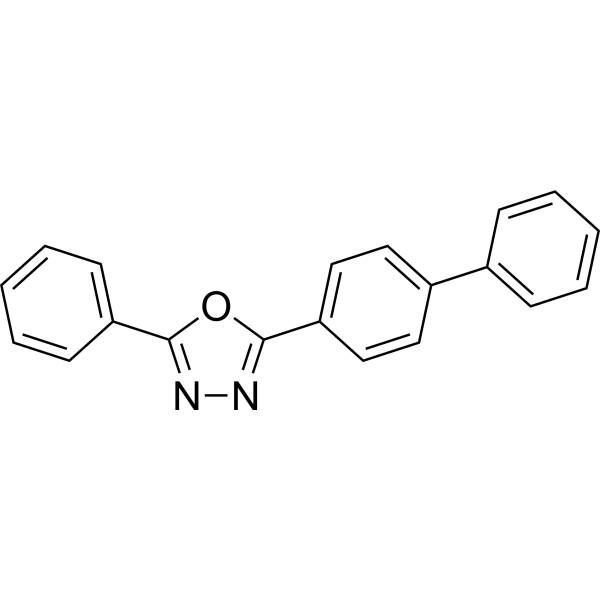
Cat. No.: HY-59021
CAS No.: 852-38-0
2-(4-Biphenylyl)-5-phenyl-1,3,4-oxadiazole is a laser dyes with high photoluminescence (PL) quantum efficiency .
loading...
    loading...
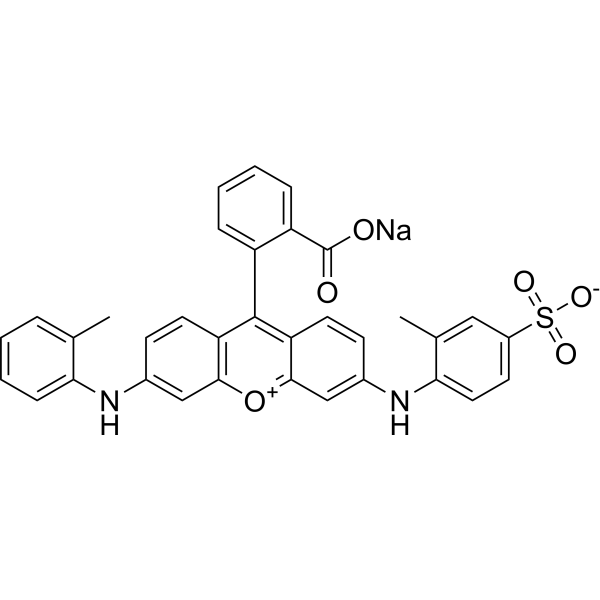
Cat. No.: HY-D1545
CAS No.: 6252-76-2
Synonyms: Acid Violet 9
Violamine R (Acid Violet 9) is a potent fluorophore. Violamine R shows environment and temperature-dependent photoluminescence (PL) intermittency in poly(vinyl alcohol) (PVOH) and potassium acid phthalate (KAP). Violamine R can be used to measure the temperatures spanning the glass-transition temperature (Tg) of the polymer host by the fluorescence intermittency or blinking in poly(vinyl alcohol) (PVA) .
loading...
    loading...
Cat. No.: HY-W096906
CAS No.: 92-24-0
Synonyms: Benz[b]anthracene
Research Areas:  

Others

Naphthacene (Benz[b]anthracene) is a fused polycyclic aromatic compound exhibiting an electron field-effect mobility of approximately 10 cm2/Vs; it is an ethylnylated acene that functions as a conducting polymer, making it suitable for use as a donor material. Its exceptional photoluminescence and quantum yield position naphthacene as a highly promising candidate for the advancement of single crystal electronic materials.
loading...
    loading...
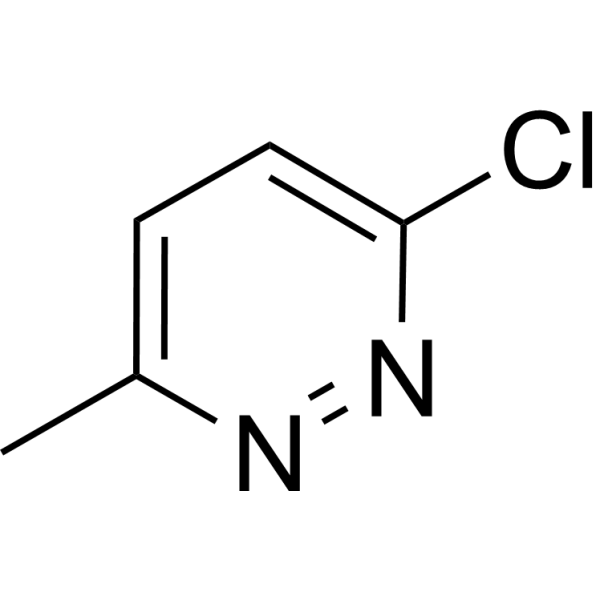
Cat. No.: HY-W001297
CAS No.: 1121-79-5
3-Chloro-6-methylpyridazine is a substituted pyridazine derivative containing an electron-withdrawing chlorine atom and an electron-donating methyl group. Pyridazine compounds generally possess pharmacological activities such as antibacterial and anti-inflammatory properties. 3-Chloro-6-methylpyridazine can serve as an organic ligand for constructing organic-inorganic hybrid chloroantimonate materials with semiconducting behavior. 3-Chloro-6-methylpyridazine can be used in studies related to optoelectronic devices, photodetectors, and photocatalysis .
loading...
    loading...
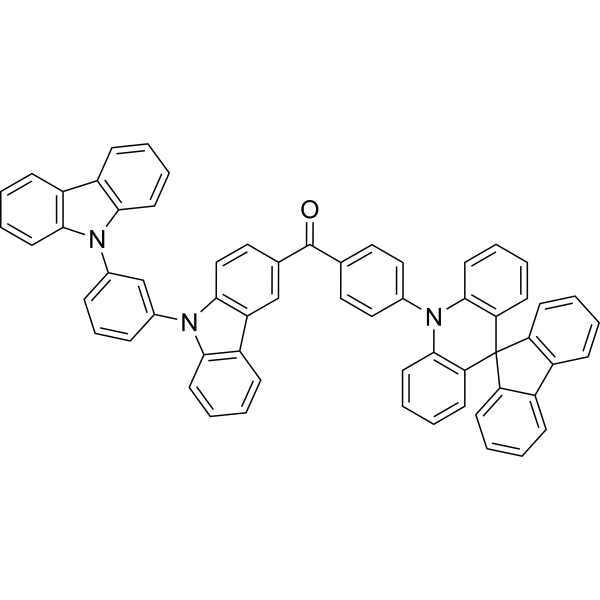
Cat. No.: HY-D1419
Target:  

Fluorescent Dye

Research Areas:  

Others

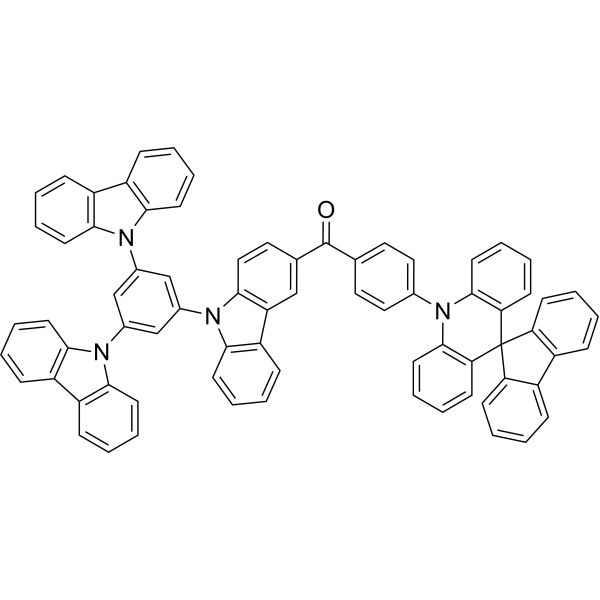
mCP-BP-SFAC is a luminogenic molecule. mCP-BP-SFAC exhibits strong sky-blue delayed fluorescence in neat films, with photoluminescence (PL) peaks at ~483 nm and delayed fluorescence lifetimes of 5.4 to 5.7 μs .
loading...
    loading...
Cat. No.: HY-D1420
Target:  

Fluorescent Dye

Research Areas:  

Others

TCP-BP-SFAC is a luminogenic molecule. TCP-BP-SFAC exhibits strong sky-blue delayed fluorescence in neat films, with photoluminescence (PL) peaks at ~483 nm and delayed fluorescence lifetimes of 5.4 to 5.7 μs .
loading...
    loading...
Cat. No.: HY-W134228
CAS No.: 12179-04-3
Sodium tetraborate pentahydrate is an inorganic boron compound. Sodium tetraborate pentahydrate is also a high-performance nonlinear optical crystal material applicable in the optoelectronic field .
loading...
    loading...
Cat. No.: HY-184607
Nanoclusters are essentially ultrasmall nanomaterials, typically with diameters between 1 and 10 nm, composed of a specific number of metal atoms (approximately 10 to several hundred) and ligands. This structure places their size between that of small molecules and traditional nanoparticles, exhibiting quantum effects. When the size of the metal core approaches the Fermi wavelength of electrons, its band structure transitions from a continuous state to discrete energy levels, thus exhibiting molecular-like properties such as single-electron transitions, multiple absorption bands, and strong photoluminescence. Iron nanoclusters (FeNCs) are a class of ultrasmall fluorescent nanomaterials composed of several to tens of iron atoms. Synthesized using bovine serum albumin (BSA) as a template and protectant via a chemical reduction method, these materials possess excellent optical properties and biocompatibility. Furthermore, they can be functionalized through surface modification, leading to their wide application in fields such as bioanalysis, environmental monitoring, and disease diagnosis.
loading...
    loading...

