1. Search Result
Search Result
Results for "

polyethylene oxide

" in MedChemExpress (MCE) Product Catalog:

9

Inhibitors & Agonists

6

Biochemical Assay Reagents

1

Oligonucleotides

Targets Recommended:
Cat. No. Product Name Target Research Areas Chemical Structure
  • HY-W250168

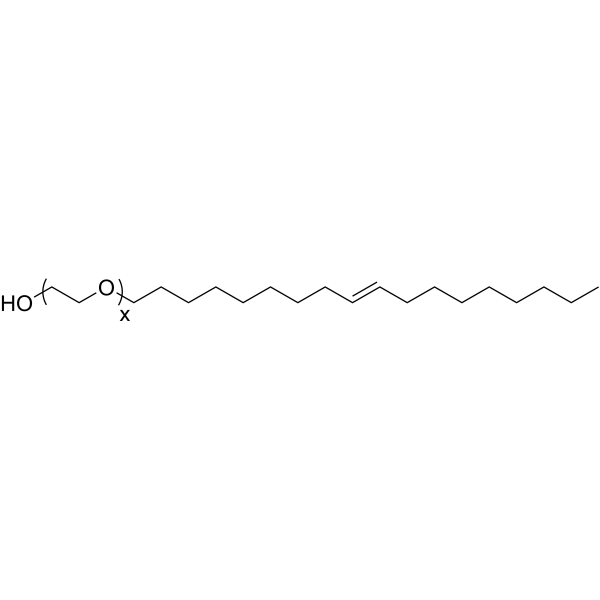
    polyethylene glycol oleyl ether, average Mn~709; polyethylene glycol monooleyl ether, n~10

    Environmental Pollutants Biochemical Assay Reagents Others
    Polyoxyethylene(10) oleyl ether, also known as POE(10) monooleate, is a nonionic surfactant consisting of a polyethylene glycol chain with 10 ethylene oxide units and an oleic acid residue. It has excellent emulsifying, wetting and dispersing properties, making it suitable for a variety of applications including personal care products and pharmaceutical formulations. POE(10) monooleate is commonly used as a solubilizer to improve the solubility and bioavailability of poorly soluble drugs. Furthermore, it is biodegradable and has low toxicity, making it an environmentally friendly ingredient suitable for various industrial applications.
    Polyoxyethylene(10) oleyl ether
  • HY-D1005A8

    PEG-PPG-PEG, 2000 (Average)

    Environmental Pollutants Biochemical Assay Reagents Bacterial P-glycoprotein Infection Cancer
    Poloxamer 181 L61 is a block polymer of polyethylene oxide and polypropylene oxide with an average molecular weight of 2000. Poloxamer has the ability to inhibit P-gp. Poloxamer 181 has antimicrobial activity and can inhibit Mycobacterium avium. Poloxamer 181 can form a thermally reversible hydrogel and is used as a food additive, and as an agent delivery carrier in cosmetics, pharmaceuticals and tissue engineering .
    Poloxamer 181 (L61)
  • HY-D1005A10

    PEG-PPG-PEG, 2900 (Average)

    Environmental Pollutants Biochemical Assay Reagents Bacterial P-glycoprotein Infection Inflammation/Immunology
    Poloxamer 184 L64 is a block copolymer of polyethylene oxide and polypropylene oxide with an average molecular weight of 2900. Poloxamer has the ability to inhibit P-gp. Poloxamer 184 exhibits short-term skin toxicity, characterized by mild erythema and intradermal inflammatory reactions. Poloxamer 184 has antimicrobial activity, inhibiting 60% of Mycobacterium avium at a concentration of 1 mg/mL. Poloxamer 184 forms a thermoreversible hydrogel and is used as a food additive and as a drug delivery carrier in cosmetics and tissue engineering .
    Poloxamer 184 (L64)
  • HY-D1005A23

    PEG-PPG-PEG, 4400 (Average)

    Environmental Pollutants Biochemical Assay Reagents P-glycoprotein Inflammation/Immunology
    Poloxamer 401 L121 is a block copolymer of polyethylene oxide and polypropylene oxide with an average molecular weight of 4400. Poloxamer has the ability to inhibit P-gp. Poloxamer 401 inhibits multiagent resistance and adjuvant activity. Poloxamer 401 can be used as a cosmetic ingredient. Poloxamer 401 can be used in nanoparticle engineering (lymphatic targeting particles) research .
    Poloxamer 401 (L121)
  • HY-116772

    Irganox 1790

    Biochemical Assay Reagents Others
    Cyanox CY 1790 (Irganox 1790) is a synthetic phenolic antioxidant. Cyanox CY 1790 is mainly used to protect polyolefin materials such as polypropylene and polyethylene from thermo-oxidative degradation during processing (high temperature) and service .
    Cyanox CY 1790
  • HY-Y1219E

    Biochemical Assay Reagents Others
    Silica gel, high-purity grade, 130-270 mesh is a low-density, high-surface-area, high-purity inert additive that can be used to prepare chromatographic column sieve plates based on the sol-gel method. Silica gel, high-purity grade prevents DNA degradation by absorbing water from plant leaves, and is suitable for the preservation of field-collected samples for subsequent DNA extraction, restriction endonuclease digestion, PCR amplification and gene sequencing. It can also be reused after being saturated with water. Silica gel, high-purity grade can provide a non-toxic, inert aquatic environment for embedded cells, allowing nutrients, oxygen and metabolic waste to diffuse freely and blocking external pollution, thereby maintaining the activity of fibroblasts and epithelial cells .
    Silica gel, high-purity grade, 130-270 mesh
  • HY-177205

    Biochemical Assay Reagents Others
    DSPE-PEG2000-CRPPR is a polyethylene glycol (PEG) conjugate composed of DSPE and Heart-homing peptide (CRPPR) (HY-P10641). DSPE-PEGs are modified with the CRPPR peptide to bind cysteine-rich protein 2 (CRIP2) as well as FITC-labeled superparamagnetic iron oxide nanoparticles .
    DSPE-PEG2000-CRPPR
  • HY-174343

    Parasite Infection
    ELQ-121 is a potent inhibitor of the ubiquinol-oxidation (QO)-site of parasites. ELQ-121 has IC50 of 0.05 nM against chloroquine sensitive and multidrug resistant P. falciparum in vitro. ELQ-121 inhibits T. gondii and N. caninum with IC50 below 1 nM in vitro. ELQ-121 suppresses B. besnoiti tachyzoite proliferation with an IC50 of 0.49 nM and induces mitochondrial disruption. ELQ-121 can form polyethylene glycol carbonate ester prodrug which demonstrates in vivo efficacy against P. yoelii in mice. ELQ-121 is suitable for antimalarial research .
    ELQ-121
  • HY-P2848E

    Biochemical Assay Reagents Others
    Cholesterol oxidase, PEG Modified, is a polyethylene glycol (PEG) modified cholesterol oxidase. Cholesterol oxidase is an enzyme that catalyzes the oxidation of cholesterol to cholesterol-4-en-3-one and hydrogen peroxide in the presence of oxygen.
    Cholesterol oxidase, PEG Modified

Inquiry Online

Your information is safe with us. * Required Fields.

Salutation


Country or Region *

Applicant Name *


Organization Name *

Department *


Email Address *


Product Name *

Cat. No.


Requested quantity *

Phone Number *


Remarks

Inquiry Online

Inquiry Information

Product Name:
Cat. No.:
Quantity:
MCE Japan Authorized Agent:

