
1. Search Result
Search Result
Results for "

sensory ,neurons

" in MedChemExpress (MCE) Product Catalog:

29

Inhibitors & Agonists

1

Screening Libraries

2

Biochemical Assay Reagents

11

Peptides

1

Inhibitory Antibodies

2

Natural
Products

1

Isotope-Labeled Compounds

Cat. No. Product Name Target Research Area
  • HY-P2847

    CRFR Metabolic Disease Endocrinology
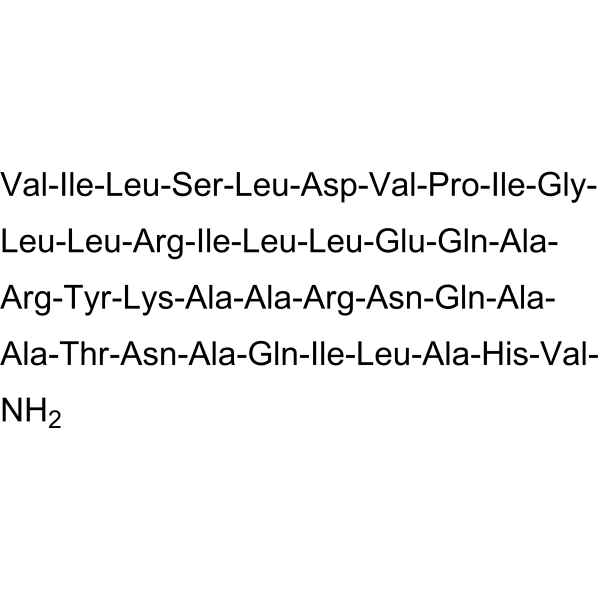
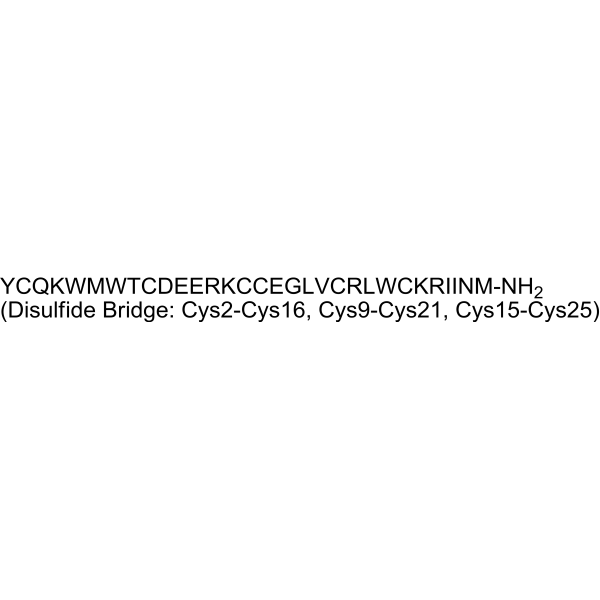
    Urocortin II, mouse is a potent and selective endogenous peptide agonist of type-2 corticotropin-releasing factor (CRF2) receptor with Ki values of 0.66 nM and ﹥100 nM for CRFR2 and CRFR1, respectively. Urocortin II, mouse activates CRF2 receptors in a cAMP/PKA- and Ca 2+/CaMKII-dependent manner.Urocortin II, mouse is expressed in discrete areas of the central nervous system, and activates central neurons involved in the processing of visceral sensory information, and in modulating autonomic outflow .
  • HY-P1241
    BAM(8-22)
    1 Publications Verification

    Mas-related G-protein-coupled Receptor (MRGPR) Neurological Disease Inflammation/Immunology
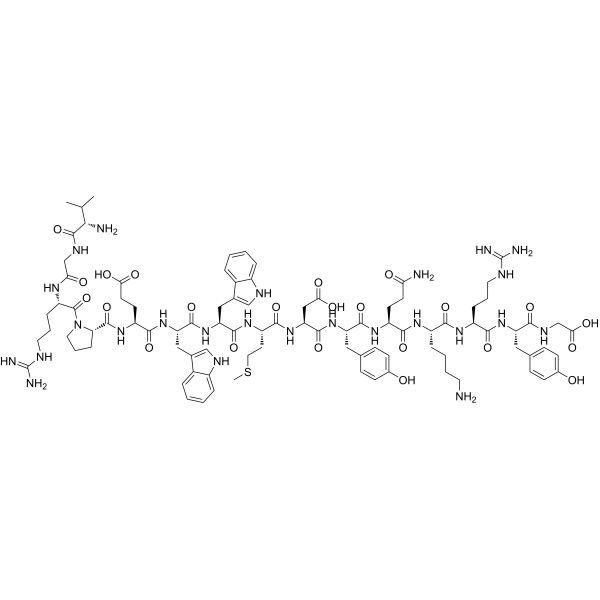
    BAM(8-22), a proteolytically cleaved product of proenkephalin A and sensory neuron-specific receptor (SNSR) agonist, is a potent activator of Mas-related G-protein-coupled receptors (Mrgprs), MrgprC11 and hMrgprX1. BAM(8-22) induces scratching in mice in an Mrgpr-dependent manner. In addition, BAM(8-22) has an analgesic effect and can also inhibit the activation of microglia .
  • HY-P4058
    Calcitonin gene-related peptide free acid
    1 Publications Verification

    CGRP free acid

    CGRP Receptor Neurological Disease
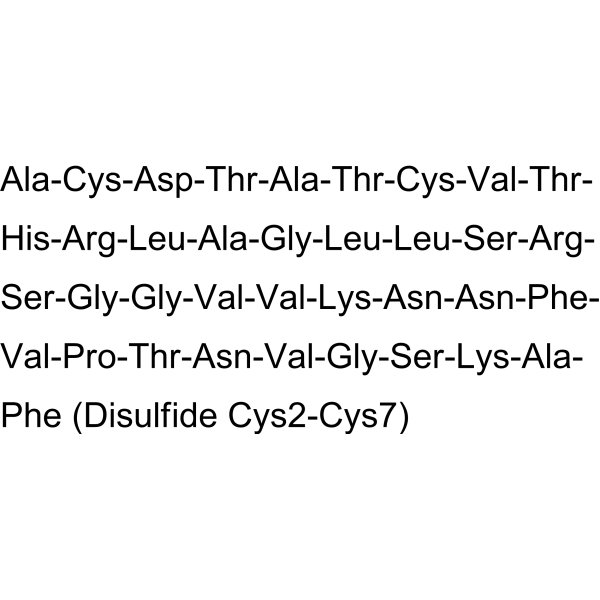
    Calcitonin gene-related peptide (CGRP) free acid is a 37-amino acid neuropeptide, which represents the deamidated form of α-CGRP (human) (HY-P1071). Calcitonin gene-related peptide free acid is produced in the central and peripheral nervous systems of rats, and localizes to specific sensory, integrative and motor neuron systems, including those involved in nociception/thermoreception, feeding behavior, olfaction and visceral motor functions .
  • HY-P5163

    Peptides Inflammation/Immunology
    NMB-1 is a conopeptide analogue. NMB-1 selectively inhibits sustained mechanically activated currents in sensory neurons (IC50: 1 μM). NMB-1 inhibits mechanical pain. NMB-1 can be used for research of hearing and pressure-evoked pain .
  • HY-P10690

    Peptides Neurological Disease
    CCHa1 peptide is a signaling peptide that plays a role in inhibiting sleep arousal. It is produced by enteroendocrine cells in the gut and modulates the animal's response to sensory inputs such as mechanical vibrations by acting on specific dopamine neurons in the brain, thereby helping to suppress arousal responses. CCHa1 peptide holds potential for research in fields related to sleep quality and sensory adaptation .
  • HY-P1241A

    Mas-related G-protein-coupled Receptor (MRGPR) Neurological Disease Inflammation/Immunology
    BAM(8-22) TFA, a proteolytically cleaved product of proenkephalin A and sensory neuron-specific receptor (SNSR) agonist, is a potent activator of Mas-related G-protein-coupled receptors (Mrgprs), MrgprC11 and hMrgprX1. BAM(8-22) TFA induces scratching in mice in an Mrgpr-dependent manner. In addition, BAM(8-22) TFA has an analgesic effect and can also inhibit the activation of microglia .
  • HY-P11702

    Bacterial Others
    f-MFFINTLTL is a formylated nonapeptide and a natural ligand from mitochondria or bacteria. f-MFFINTLTL serves as a tool chemical stimulant for the specific activation of sensory neurons expressing the specific vomeronasal receptor (V2rf2) .
  • HY-P11700

    MHC Inflammation/Immunology
    AAPDARETA is a mutated MHC-associated peptide with reduced binding affinity to H-2D b MHC molecules. AAPDARETA activates subsets of mouse main olfactory epithelium sensory neurons and induces Ca 2+ transients .
  • HY-P11701

    MHC Others
    SEIDLILGY is a nonapeptide identified as a peptide ligand derived from mouse major histocompatibility complex class I (MHC). SEIDLILGY serves as a tool chemical stimulant for the specific activation of sensory neurons expressing the particular vomeronasal receptor (V2rf2) .
  • HY-P11704

    Formyl Peptide Receptor (FPR) Bacterial Neurological Disease
    f-MKKFRW is a selective mouse formyl peptide receptor 3 (Fpr3) activator and bacterial MgrB-derived peptide motif. f-MKKFRW activates Fpr3 to trigger downstream signaling and calcium responses in Fpr3-expressing cells. f-MKKFRW stimulates a subset of mouse vomeronasal sensory neurons in the accessory olfactory system to evoke calcium responses. f-MKKFRW drives innate avoidance behavior in mice via nasal contact .
  • HY-182539

    CGRP Receptor Others Neurological Disease
    DD04107 is a neuronal exocytosis inhibitor with a rat Syt1-C2B domain binding Ka of 2.4 μM. DD04107 interferes with synaptobrevin-syntaxin-SNAP-25 complex formation and Syt1-SNARE complex interaction to block α-calcitonin gene-related peptide (α-CGRP) exocytotic release from primary sensory neurons. DD04107 blocks inflammatory ion channel recruitment to nociceptor plasma membranes. DD04107 can be used for the research of chronic inflammatory pain, neuropathic pain, osteosarcoma pain, chemotherapy-induced peripheral neuropathy, diabetic neuropathy, inflammatory pain .

Inquiry Online

Your information is safe with us. * Required Fields.

Salutation


Country or Region *

Applicant Name *


Organization Name *

Department *


Email Address *


Product Name *

Cat. No.


Requested quantity *

Phone Number *


Remarks

Inquiry Online

Inquiry Information

Product Name:
Cat. No.:
Quantity:
MCE Japan Authorized Agent:

