5 Results for "

soy protein

" in MedChemExpress (MCE) Product Catalog:
Products (5)

5 Results for "soy protein" in MCE Product Catalog:

1
1 Cited Publications
Cat. No.: HY-B2228
CAS No.: 9001-92-7
Proteinase, Aspergillus oryzae is a serine protease that hydrolyzes peptide bonds in protein substrates, preferring alkaline conditions (optimal pH 10.5). It efficiently degrades casein, poly-L-glutamic acid, and poly-L-lysine, with activity irreversibly inhibited by diisopropylfluorophosphate (DFP) and potato inhibitor. This enzyme catalyzes proteolysis via serine residues in its active site, finding applications in food processing (e.g., soy sauce fermentation), detergents, and leather industries due to its high yield in solid-state fermentation and cost-effective production.
loading...
    loading...
Cat. No.: HY-112747
CAS No.: 97281-51-1
Synonyms: LPI; PE (soy)
Target:  

Phospholipase

Research Areas:  

Infection

Soy PE (LPI) is the most abundant phospholipid in prokaryotes and the second most abundant found in the membrane of mammalian, plant, and yeast cells, comprising approximately 25% of total mammalian phospholipids. In the brain, phosphatidylethanolamine comprises almost half of the total phospholipids. It is synthesized mainly through the cytidine diphosphate-ethanolamine and phosphatidylserine decarboxylation pathways, which occur in the endoplasmic reticulum (ER) and mitochondrial membranes, respectively. It is a precursor in the synthesis of phosphatidylcholine and arachidonoyl ethanolamide and is a source of ethanolamine used in various cellular functions. In E.coli, phosphatidylethanolamine deficiency prevents proper assembly of lactose permease, suggesting a role as a lipid chaperone. It is a cofactor in the propagation of prions in vitro and can convert recombinant mammalian proteins into infectious molecules even in the absence of RNA. This product contains phosphatidylethanolamine molecular species with variable fatty acyl chain lengths at the sn-1 and sn-2 positions .
loading...
    loading...
Cat. No.: HY-P4371
CAS No.: 177942-21-1
Research Areas:  

Inflammation/Immunology

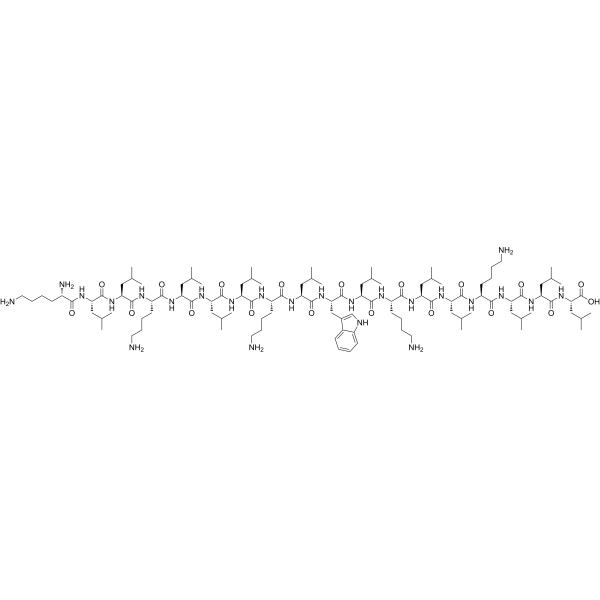
Hel 13-5 is a monomeric, lipophilic, basic amphipathic α-helical synthetic peptide composed of 18 amino acid residues. Hel 13-5 is designed as a substitute for proteins in artificial pulmonary surfactants, and it mimics the interaction between the N-terminal fragment of human pulmonary surfactant protein B and lipids. Hel 13-5 can bind to phospholipids for the development of pulmonary surfactant model systems. Hel 13-5 can be used in studies related to respiratory distress syndrome .
loading...
    loading...
Cat. No.: HY-P10342
CAS No.: 510725-34-5
Target:  

Inhibitory Antibodies

Research Areas:  

Cardiovascular Disease

Soystatin is a peptide extracted from soy protein, whose main activity is to inhibit the absorption of cholesterol. Soystatin, as a peptide with significant cholic acid binding ability, can be used in the study of cardiovascular diseases .
loading...
    loading...
Cat. No.: HY-118707
CAS No.: 14486-15-8
Synonyms: Met-met-met
Research Areas:  

Infection

Trimethionine (Met-met-met) is an orally active tripeptide substrate of peptide transport systems. Trimethionine interacts with the triple-leucine-triple-threonine transport system and the oligopeptide permease (Opp) system in Escherichia coli, competing for uptake and transport processes. Trimethionine antagonizes the toxicity of threonine tripeptide and ornithine tripeptide, and competes with peptide-supported growth and amino acid source utilization processes in Escherichia coli strains. Trimethionine is taken up by Candida albicans via a carrier-mediated, energy-dependent manner, and is subsequently hydrolyzed into free methionine intracellularly. Trimethionine can be used in studies related to Candida albicans infections .
loading...
    loading...

