13 Results for "

triphenylamine

" in MedChemExpress (MCE) Product Catalog:
Products (13)

13 Results for "triphenylamine" in MCE Product Catalog:

Cat. No.: HY-W011998
CAS No.: 603-34-9
Synonyms: N,N-Diphenylbenzenamine
Research Areas:  

Others

Triphenylamine (N,N-Diphenylbenzenamine) is a highly fluorescent compound. Triphenylamine can induce apoptosis. Triphenylamine can be used as a fluorescent dye and is also used in photodynamic therapy research .
loading...
    loading...
Cat. No.: HY-W004611
CAS No.: 118996-38-6
Synonyms: 4,4',4''-Tricarboxyl triphenylamine
Target:  

MOFs

Research Areas:  

Others

4,4',4''-Nitrilotribenzoic acid (4,4',4''-Tricarboxyl triphenylamine) is a metal-organic framework (MOF).
loading...
    loading...
Cat. No.: HY-P10563
CAS No.: 2580150-96-3
Synonyms: BHV-1100
Target:  

CD38 IFNAR

Research Areas:  

Cancer

Noraramtide (BHV-1100) is an antibody-recruiting molecule. Noraramtide binds to CD38 and recruits natural killer (NK) cells to mediate antibody-dependent cellular cytotoxicity. Noraramtide enhances the capacity of autologous cytokine-induced memory-like (CIML) NK cells to produce IFNγ and CD107a, thereby improving their cytotoxicity against multiple myeloma cells. Noraramtide can be used in the research of multiple myeloma .
loading...
    loading...
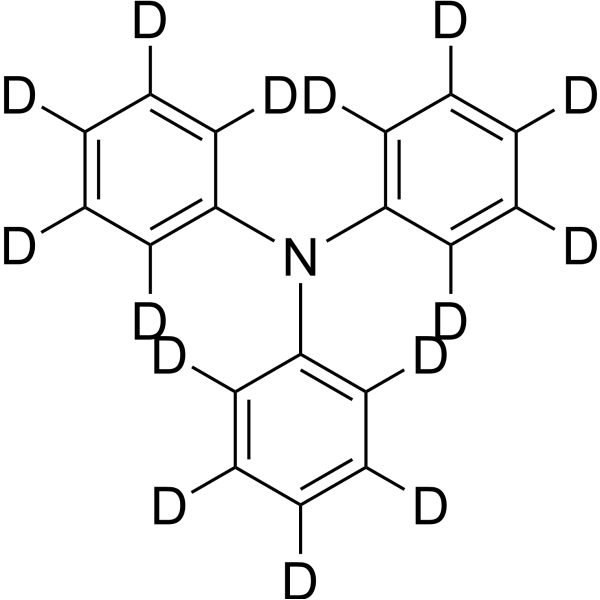
Cat. No.: HY-W011998S
CAS No.: 880462-20-4
Triphenylamine-d15 is the deuterium labeled Triphenylamine .
loading...
    loading...
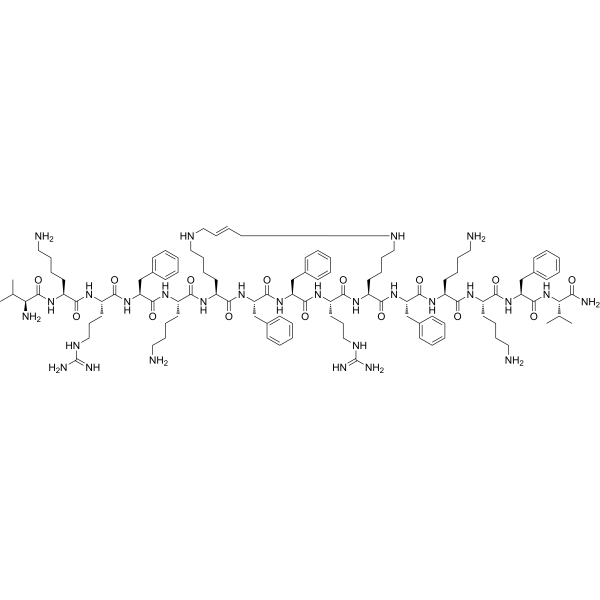
Cat. No.: HY-P3350
CAS No.: 2892148-58-0
Target:  

Bacterial

Research Areas:  

Infection

LS-BF1 is a stable and low toxic cationic antimicrobial peptide. LS-BF1 displays broad spectrum of antibacterial activity, including the challenging ESKAPE pathogens, by cell membrane disruptive mechanism. LS-BF1 shows good in vivo efficacy for elimination of bacteria in a mouse infection model[1].
loading...
    loading...
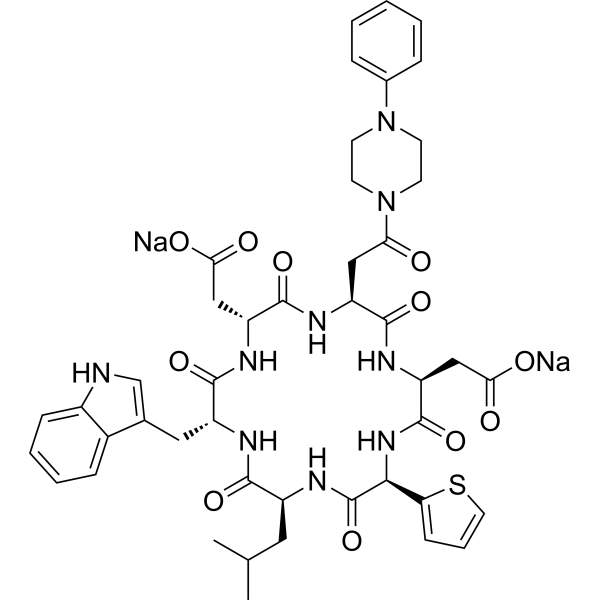
Cat. No.: HY-105168
CAS No.: 157380-72-8
Target:  

Endothelin Receptor

Research Areas:  

Cardiovascular Disease

TAK 044 is an antagonist of Endothelin Receptor. TAK 044 strongly inhibits ET-induced deterioration in various animal models. TAK 044 can be used in study ET-related diseases such as acute myocardial infarction,acute renal failure, acute hepatic malfunction, and subarachnoid hemorrhage .
loading...
    loading...
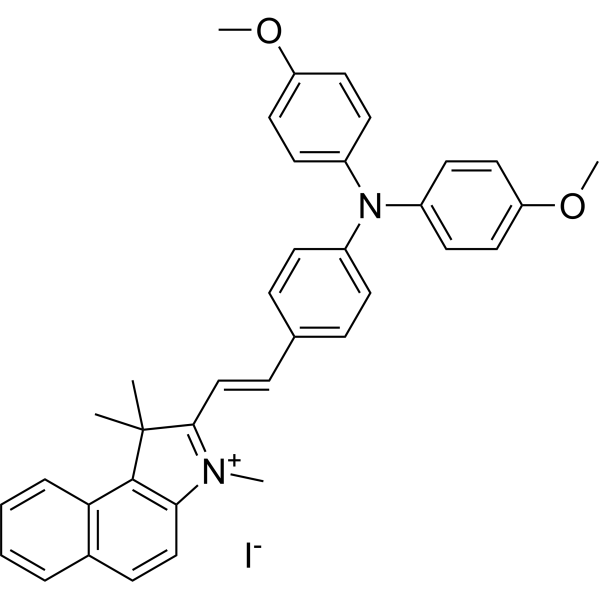
Cat. No.: HY-158126
Target:  

DNA/RNA Synthesis

Research Areas:  

Cancer

G-quadruplex ligand 2 (compound A3) is a triphenylamine-based ligand that targets mitochondrial DNA G4s. G-quadruplex ligand 2 activates the cGAS-STING pathway. G-quadruplex ligand 2 inhibits tumor growth and metastasis via regulation of TME .
loading...
    loading...
Cat. No.: HY-144314
CAS No.: 2906869-08-5
Research Areas:  

Cancer

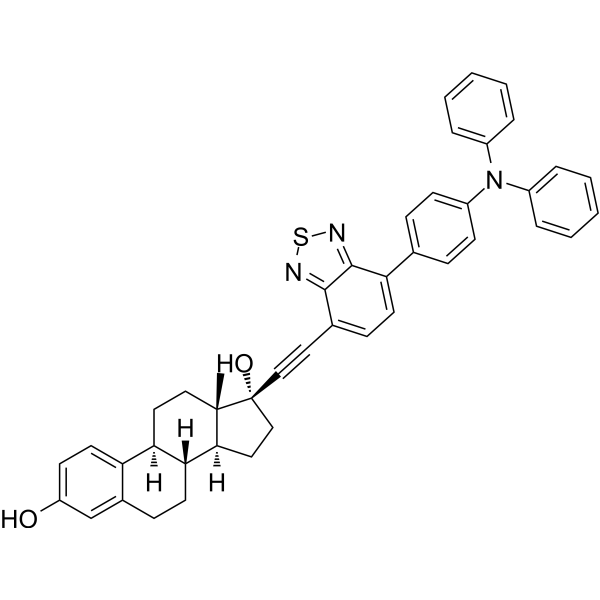
PSDalpha is a photoactivatable PS-Degron targeting estrogen receptor α (ERα/ESR1), with a Ki of 72.8 nM for ERα. PSDalpha consists of an ERα-targeting estradiol moiety conjugated via an alkyne bond to triphenylamine-benzothiadiazole (TB), an aggregation-induced emission (AIE) photosensitizer. Upon visible light irradiation, PSDalpha generates singlet oxygen ( 1O2) and induces controllable ERα degradation. PSDalpha also induces G1 phase arrest and apoptosis. PSDalpha can be used in studies related to ERα-positive breast cancer and light-controlled targeted protein degradation .
loading...
    loading...
Cat. No.: HY-D3101
Target:  

Fluorescent Dye

Research Areas:  

Others

Nile-TPA is a fluorescent probe for polarity detection, which can be used for lipid droplet targeting, cell polarity analysis, in vivo polarity imaging, and blood polarity monitoring in circulating tumor mouse models. The detection mechanism of Nile-TPA relies on the dual intramolecular charge transfer (ICT) effect generated by the electron-donating triphenylamine and Nile Red moieties and the electron-withdrawing carbonyl group; this probe emits strong red fluorescence in a low-polarity environment, and as polarity increases, the fluorescence intensity decreases and a red shift occurs due to changes in the excited-state dipole moment. In spectral tests, its excitation wavelength is 540 nm, and the emission wavelength varies in the range of 550-800 nm depending on solvent polarity; for cell, zebrafish and mouse imaging, Ex/Em = 561/570-620 nm, and for in vivo mouse imaging, Ex/Em = 560/620 nm .
loading...
    loading...
Cat. No.: HY-P1981
CAS No.: 157381-54-9
Target:  

HIV Protease

Research Areas:  

Infection Inflammation/Immunology

Rpi-856 A is a competitive inhibitor of HIV-1 protease and HTLV-I protease, with an IC50 of 37 nM against HIV-1 protease and an IC50 of 27 nM against HTLV-I protease. Rpi-856 A inhibits Pepsin with an IC50 of 1.9 μM . Rpi-856 A does not inhibit chymosin, trypsin, chymotrypsin, papain, bromelain, thermolysin, prolyl endopeptidase, carboxypeptidase A or carboxypeptidase B. Rpi-856 A can be used in the research of acquired immunodeficiency syndrome (AIDS) and related diseases, as well as HIV infection .
loading...
    loading...
Cat. No.: HY-P1982
CAS No.: 157381-55-0
Rpi-856 C is an Aspartic protease inhibitor, with an IC50 of 5.5 nM against HIV-1 protease, 9.2 nM against HTLV-I protease, 2.0 μM against Cathepsin D, and 4.8 μM against Pepsin. Rpi-856 C is produced by the Streptomyces strain AL-322. Rpi-856 C does not inhibit chymosin, trypsin, chymotrypsin, papain, bromelain, thermolysin, prolyl endopeptidase, carboxypeptidase A or carboxypeptidase B. Rpi-856 C can be used in the research of acquired immunodeficiency syndrome (AIDS) and related diseases, as well as HIV infection .
loading...
    loading...
Cat. No.: HY-D3084
Target:  

Fluorescent Dye

Research Areas:  

Cancer

C-TPA is a fluorescent probe used for hypochlorite detection and bioimaging of lipid droplet polarity in cancer cells. For hypochlorite detection, when its derivative C-TPA-S is exposed to hypochlorite, an oxidative desulfurization reaction converts the thiocarbonyl group of C-TPA-S to the carbonyl group of C-TPA, thus restoring bright fluorescence from the almost non-fluorescent C-TPA-S. For bioimaging of lipid droplet polarity, the intramolecular charge transfer process between its Triphenylamine (HY-W011998) donor group and Coumarin (HY-N0709) acceptor group endows C-TPA with solvatochromism-it exhibits stronger fluorescence in less polar environments (such as lipid droplets in cancer cells) and weaker fluorescence in more polar environments (such as lipid droplets in normal cells), enabling the differentiation of cancer cells and cancer tissues from normal cells and normal tissues. The excitation wavelength of C-TPA is 405 nm, and the emission wavelengths used for cell and tissue imaging cover 425-475 nm and 500-550 nm; in solvents, its emission peak shifts from 494 nm in non-polar toluene to 528 nm in polar water .
loading...
    loading...
Cat. No.: HY-P4948
CAS No.: 1926163-49-6
Research Areas:  

Others

Coumarin-phalloidin is a kind of phalloidin labeled with Coumarin (HY-N0709). Coumarin-phalloidin is a new type of actin probe that can be used for triple immunofluorescence microscopic observation of the cell skeleton .
loading...
    loading...
  • 1

