4 Results for "

zebrafish developmental toxicity model

" in MedChemExpress (MCE) Product Catalog:
Products (4)

4 Results for "zebrafish developmental toxicity model" in MCE Product Catalog:

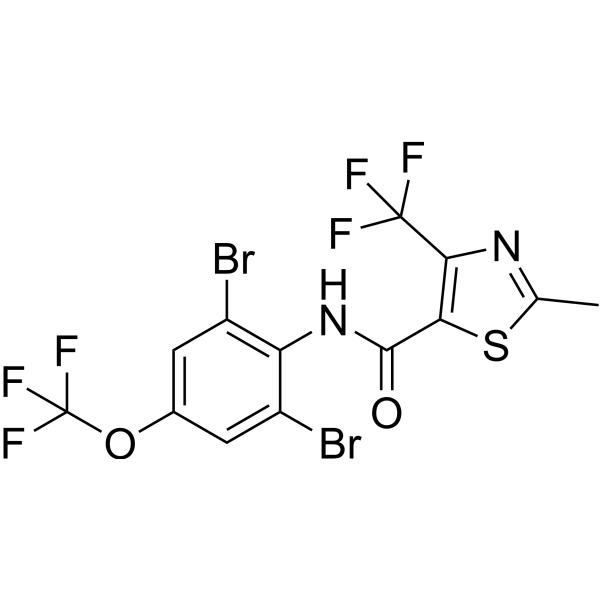
Cat. No.: HY-B2004
CAS No.: 130000-40-7
Thifluzamide is a fungicide that inhibits fungal respiration by blocking the ubiquinone-binding site in mitochondrial complex II. Thifluzamide exhibits significant activity against Basidiomycota pathogens (such as Rhizoctonia cerealis, Ustilago and Puccinia genera) and is commonly used in studies on wheat sharp eyespot. Thifluzamide displays a dual mechanism in regulating lipid metabolism: it reduces fatty acid synthase activity to inhibit endogenous fatty acid synthesis, and increases carnitine palmitoyltransferase-I activity to accelerate fatty acid β-oxidation, thereby reducing total cholesterol and triglyceride levels in the liver. Thifluzamide also induces hepatotoxicity in zebrafish models and carries a risk of developmental toxicity. Thifluzamide inhibition of Rhizoctonia cerealis may result in low to moderate levels of drug resistance, leading to the generation of stable drug-resistant mutants .
loading...
    loading...
Cat. No.: HY-B2004R
CAS No.: 130000-40-7
Thifluzamide (Standard) is the analytical standard of Thifluzamide. This product is intended for research and analytical applications. Thifluzamide is a fungicide that inhibits fungal respiration by blocking the ubiquinone-binding site in mitochondrial complex II. Thifluzamide exhibits significant activity against Basidiomycota pathogens (such as Rhizoctonia cerealis, Ustilago and Puccinia genera) and is commonly used in studies on wheat sharp eyespot. Thifluzamide displays a dual mechanism in regulating lipid metabolism: it reduces fatty acid synthase activity to inhibit endogenous fatty acid synthesis, and increases carnitine palmitoyltransferase-I activity to accelerate fatty acid β-oxidation, thereby reducing total cholesterol and triglyceride levels in the liver. Thifluzamide also induces hepatotoxicity in zebrafish models and carries a risk of developmental toxicity. Thifluzamide inhibition of Rhizoctonia cerealis may result in low to moderate levels of drug resistance, leading to the generation of stable drug-resistant mutants .
loading...
    loading...
Cat. No.: HY-189263
Research Areas:  

Cancer

VEGFR-2/P-gp-IN-2 is a VEGFR-2 inhibitor (IC50 = 126.4 nM) and P-glycoprotein inhibitor. VEGFR-2/P-gp-IN-2 induces G1 phase cell cycle arrest and Apoptosis. VEGFR-2/P-gp-IN-2 can be used for research on cervical cancer .
loading...
    loading...
Cat. No.: HY-182372
CAS No.: 1638153-78-2
Target:  

Epoxide Hydrolase

Research Areas:  

Neurological Disease

SH-11037 is a potent inhibitor of soluble epoxide hydrolase (sEH) and docks to the substrate binding cleft in the sEH hydrolase domain. SH-11037 dose-dependently suppresses angiogenesis in the choroidal sprouting assay ex vivo and inhibited ocular developmental angiogenesis in zebrafish larvae. SH-11037 reduces choroidal neovascularisation lesion volume in the laser-induced CNV mouse model. SH-11037 synergises with anti-VEGF treatments in vitro and in vivo. SH-11037 induces G2/M phase blockade and retains retinal endothelial cell viability at active concentrations without overt toxicity. SH-11037 can be used for the research of retinal neovascularization and ocular neovascularization .
loading...
    loading...

