



SJH1-51B
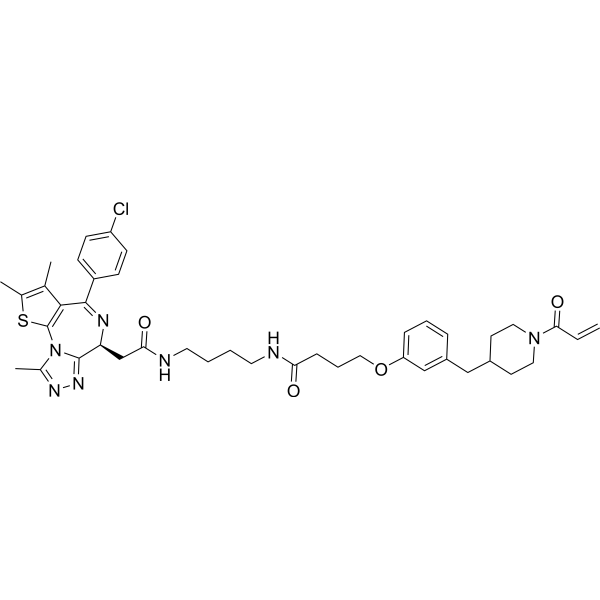
SJH1-51B is a SKP1-recruiting BRD4 PROTAC degrader. SJH1-51B binds to SKP1 in the SKP1-FBXO7-CUL1-RBX1 complex, but shows no or weak binding to monomeric SKP1. SJH1-51B induces proteasome- and SKP1-dependent degradation of BRD4, and this degradation process relies on the neddylation modification of Cullin-RING E3 ligase. SJH1-51B induces proteasome-mediated degradation of the short isoform of BRD4 in non-cancer cells, while it induces proteasome-mediated degradation of both the long and short isoforms of BRD4 in breast cancer cells. SJH1-51B can be used for breast cancer research.
(Pink: BET ligand (HY-78695); Blue: SKP1 ligand (HY-175905); Black: linker).
For research use only. We do not sell to patients.
- Formula: C42H50ClN7O4S
- Molecular Weight:784.41
-
Storage:
Please store the product under the recommended conditions in the Certificate of Analysis.

To place orders, for customer services and technical support, please contact: MedChemExpress USA
Tel: 609-228-6898 E-mail: [email protected] [email protected]


-
 Biological Activity
-
Chemical Information
- Protocols
- Purity & Documentation
- References
-
 Help & FAQs


All PROTACs Isoforms
More

Biological Activity
Description
IC50 & Target
[1]|
BRD4 |
SKP1 |
In Vitro
SJH1-51B (0.1-10 μM; 24 h) dose-dependently degrades the short isoform of BRD4 in HEK293T cells, with the most robust degradation at 10 μM, but does not affect the long BRD4 isoform[1].
SJH1-51B (0.1-10 μM; 24 h) dose-dependently degrades both the long and short isoforms of BRD4 in MDA-MB-231 cells, with the most robust degradation at 10 μM[1].
MedChemExpress (MCE) has not independently confirmed the accuracy of these methods. They are for reference only.
-
Cell Line:HEK293T cells
-
Concentration:0.1, 1, 5, 10 μM
-
Incubation Time:24 h
-
Result:Reduced short BRD4 levels to ~95% of vehicle control at 0.1 μM.
Reduced short BRD4 levels to ~50% of vehicle control at 1 μM.
Reduced short BRD4 levels to ~60% of vehicle control at 5 μM.
Reduced short BRD4 levels to ~20% of vehicle control at 10 μM.
Did not degrade the long BRD4 isoform.
-
Cell Line:MDA-MB-231 breast cancer cells
-
Concentration:0.1, 1, 5, 10 μM
-
Incubation Time:24 h
-
Result:Reduced long BRD4 levels to ~80% and short BRD4 levels to ~85% of vehicle control at 0.1 μM.
Reduced long BRD4 levels to ~80% and short BRD4 levels to ~70% of vehicle control at 1 μM.
Reduced long BRD4 levels to ~50% and short BRD4 levels to ~60% of vehicle control at 5 μM.
Reduced long BRD4 levels to ~30% and short BRD4 levels to ~10% of vehicle control at 10 μM.


Chemical Information
-
Molecular Weight 784.41
-
Formula C42H50ClN7O4S
-
SMILES
O=C(NCCCCNC(C[C@H]1C2=NN=C(C)N2C3=C(C(C)=C(C)S3)C(C4=CC=C(Cl)C=C4)=N1)=O)CCCOC5=CC=CC(CC6CCN(C(C=C)=O)CC6)=C5
-
Shipping
Room temperature in continental US; may vary elsewhere.
-
Storage
Please store the product under the recommended conditions in the Certificate of Analysis.


Purity & Documentation
References

Calculators
Concentration (start) × Volume (start) = Concentration (final) × Volume (final)


SJH1-51B Related Classifications
HY-162240 Related Classifications
 Powered by Bioz