



JQ-1 carboxylic acid
Based on 9 publication(s) in Google Scholar
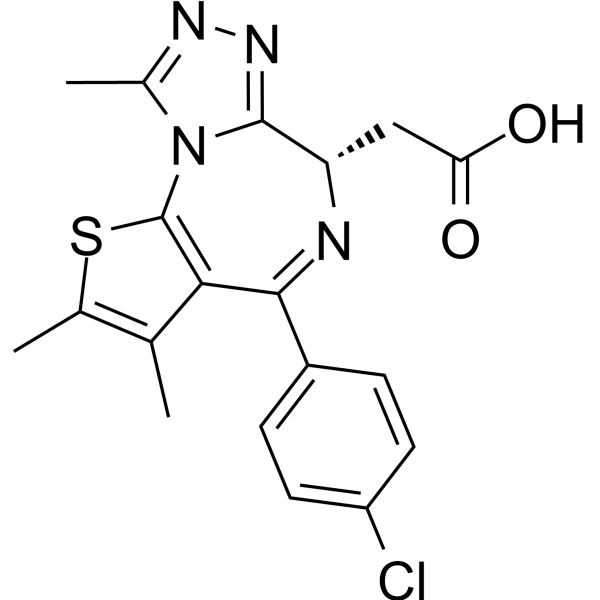
JQ-1 carboxylic acid, a (+)-JQ-1 (HY-13030) derivative, is a potent BET bromodomain inhibitor. JQ-1 carboxylic acid can be used to synthesize PROTAC, which can target the degradation of BRD4.
For research use only. We do not sell to patients.
- Purity : 99.69%
- CAS No.: 202592-23-2
- Formula: C19H17ClN4O2S
- Molecular Weight:400.88
-
Storage:Powder -20°C, 3 years , 4°C, 2 years ; In solvent -80°C, 2 years , -20°C, 1 year

To place orders, for customer services and technical support, please contact: MedChemExpress USA
Tel: 609-228-6898 E-mail: [email protected] [email protected]


-
 Biological Activity
-
Chemical Information
-
Solvent & Solubility
- Purity & Documentation
- References
-
 Help & FAQs


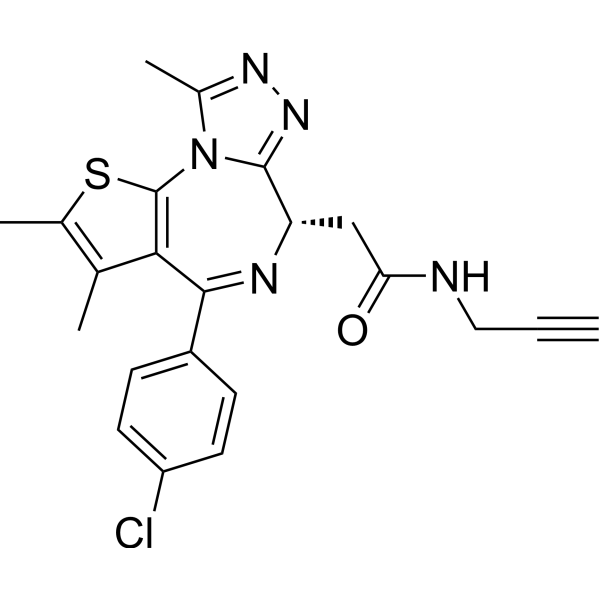
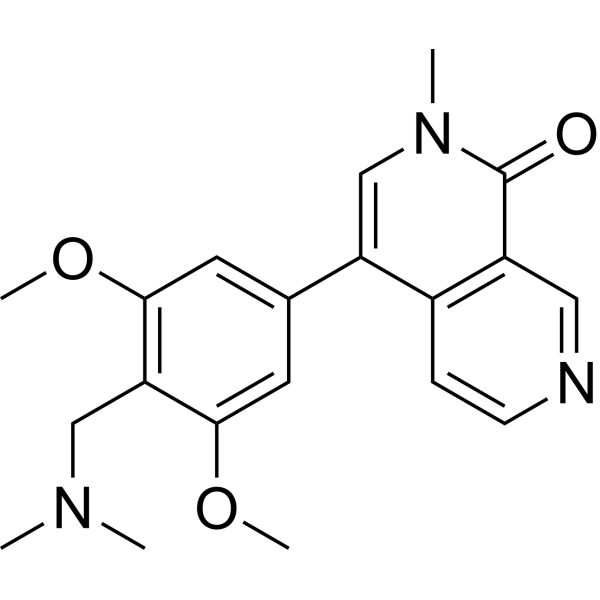
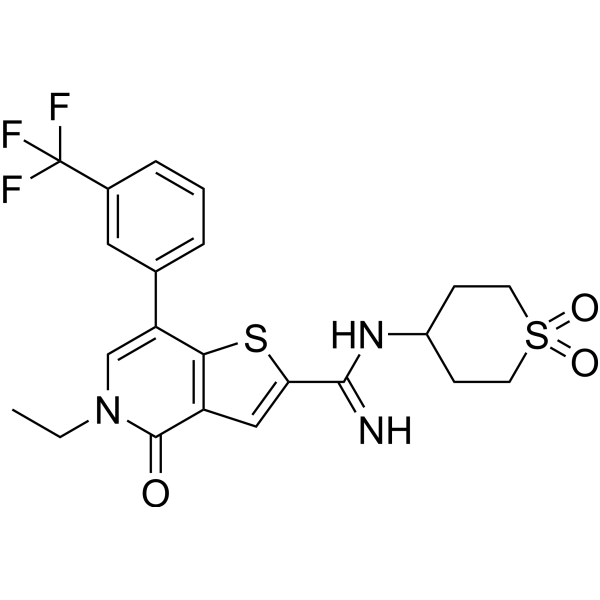
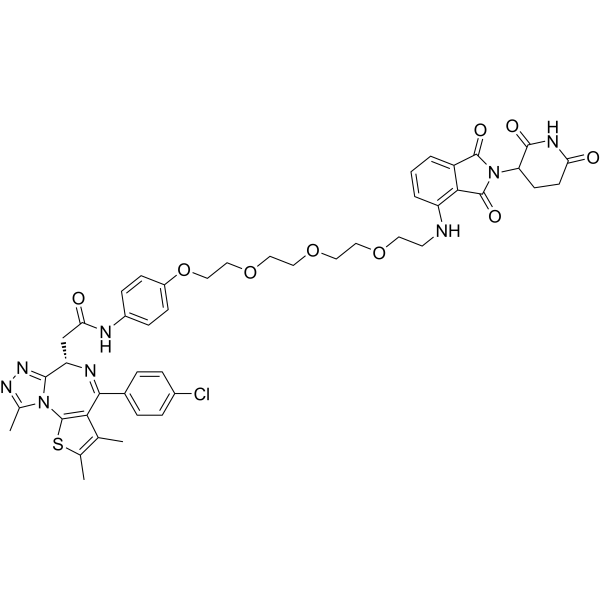
Publications Citing Use of MedChemExpress (MCE) JQ-1 carboxylic acid
More- Int J Oral Sci. 2024 Jul 1;16(1):47. [Abstract]
- J Am Chem Soc. 2024 Apr 10;146(14):9779-9789. [Abstract]
- Nucleic Acids Res. 2022 May 20;50(9):4917-4937. [Abstract]
- Cell Rep Med. 2025 Dec 16;6(12):102467. [Abstract]
- Cell Death Dis. 2020 Jun 15;11(6):459. [Abstract]
- Biochem Pharmacol. 2025 Oct 19;243(Pt 1):117442. [Abstract]
- Biochem Pharmacol. 2023 Apr:210:115497. [Abstract]
- Biochem Biophys Res Commun. 2024 Dec 3:736:150503. [Abstract]
- Patent. US20240261416A1.
 Customer Validation & Images

-
WB
-
WB
-
WB
-
RT-PCR
-
WB


Biological Activity
Description
IC50 & Target
[1]|
BET |
BRD4 |
DCAF1 |
BRD2 |
BRD3 |
BRD4BD1 |
KLHDC2 |
GSPT1 |
KEAP1 |
Cellular Effect
|
Cell Line

|
Type | Value | Description | References |
|---|---|---|---|---|
| HEK293 | EC50 |
>50 μM
Compound: JQ1-CO2H
|
Cytotoxicity against human HEK293 cells assessed as inhibition of cell viability incubated for 30 mins by cell titer-glo assay
Cytotoxicity against human HEK293 cells assessed as inhibition of cell viability incubated for 30 mins by cell titer-glo assay
|
[PMID: 35859867] |
| HEK293 | IC50 |
>50 μM
Compound: JQ1-CO2H
|
Cytotoxicity against human HEK293 cells assessed as inhibition of cell viability incubated for 30 mins in presence of CRBN-tracer by nanoBRET assay
Cytotoxicity against human HEK293 cells assessed as inhibition of cell viability incubated for 30 mins in presence of CRBN-tracer by nanoBRET assay
|
[PMID: 35859867] |
| HEK293 | IC50 |
>50 μM
Compound: JQ1-CO2H
|
Cytotoxicity against permeabilized HEK293 cells assessed as inhibition of cell viability incubated for 30 mins in presence of CRBN-tracer by nanoBRET assay
Cytotoxicity against permeabilized HEK293 cells assessed as inhibition of cell viability incubated for 30 mins in presence of CRBN-tracer by nanoBRET assay
|
[PMID: 35859867] |
In Vitro


Chemical Information
-
CAS No. 202592-23-2
-
Appearance Solid
-
Molecular Weight 400.88
-
Formula C19H17ClN4O2S
-
Color Off-white to yellow
-
SMILES
ClC1=CC=C(C(C2=C(N3C4=NN=C3C)SC(C)=C2C)=N[C@H]4CC(O)=O)C=C1
-
Shipping
Room temperature in continental US; may vary elsewhere.
-
Storage
Powder -20°C 3 years 4°C 2 years In solvent -80°C 2 years -20°C 1 year


Publications (9)
-
Journal Impact Factor
-
Most Recent
-
Int J Oral Sci
Stabilization of EREG via STT3B-mediated N-glycosylation is critical for PDL1 upregulation and immune evasion in head and neck squamous cell carcinoma. [Abstract]2024 Jul 1;16(1):47. PMID: 38945975
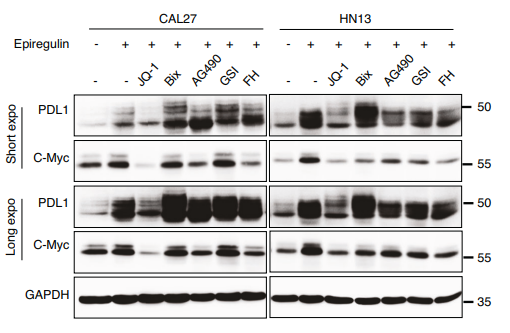
JQ-1 carboxylic acid purchased from MedChemExpress. Usage Cited in: Int J Oral Sci. 2024 Jul 1;16(1):47. [Abstract]
CAL27 and HN13 cells were pretreated with JQ-1 carboxylic acid (JQ-1) for 1 h followed by stimulation with epiregulin for 24 h. The levels of PDL1 and c-Myc were examined by Western blot analysis.
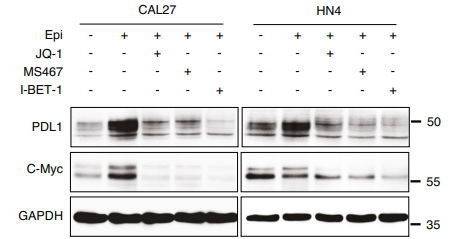
JQ-1 carboxylic acid purchased from MedChemExpress. Usage Cited in: Int J Oral Sci. 2024 Jul 1;16(1):47. [Abstract]
CAL27 and HN4 cells were pretreated with JQ-1 carboxylic acid (JQ-1) for 1 h followed by stimulation with epiregulin for 24 h. The levels of PDL1 and c-Myc were examined by Western blot analysis.
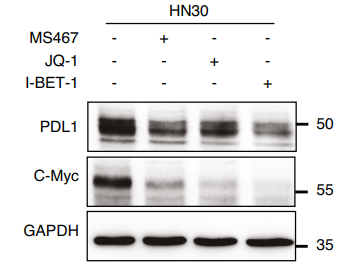
JQ-1 carboxylic acid purchased from MedChemExpress. Usage Cited in: Int J Oral Sci. 2024 Jul 1;16(1):47. [Abstract]
HN30 cells were treated with JQ-1 carboxylic acid (JQ-1) for 24 h, and the levels of PDL1 and c-Myc were examined by Western blot analysis
-
J Am Chem Soc
2024 Apr 10;146(14):9779-9789. PMID: 38561350 -
Nucleic Acids Res
A histidine cluster determines YY1-compartmentalized coactivators and chromatin elements in phase-separated enhancer clusters. [Abstract]2022 May 20;50(9):4917-4937. PMID: 35390165 -
Cell Rep Med
2025 Dec 16;6(12):102467. PMID: 41308642 -
Cell Death Dis
Brd4 inhibition ameliorates Pyocyanin-mediated macrophage dysfunction via transcriptional repression of reactive oxygen and nitrogen free radical pathways. [Abstract]2020 Jun 15;11(6):459. PMID: 32541671 -
Biochem Pharmacol
BRD2 promotes inflammation and lipid accumulation through the NF-κB pathway in alcoholic liver injury. [Abstract]2025 Oct 19;243(Pt 1):117442. PMID: 41120012 -
Biochem Pharmacol
BRD4 promotes hepatic stellate cells activation and hepatic fibrosis via mediating P300/H3K27ac/PLK1 axis. [Abstract]2023 Apr:210:115497. PMID: 36907496
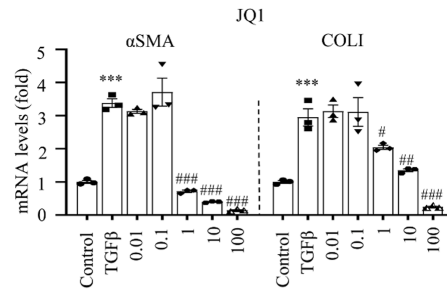
JQ-1 carboxylic acid purchased from MedChemExpress. Usage Cited in: Biochem Pharmacol. 2023 Apr:210:115497. [Abstract]
The LX2 cells were pretreated with gradient concentrations (μM) of JQ-1 carboxylic acid (JQ1; 0-100 μM) and DMSO (0.1%) for 2 h and then stimulated with TGFβ for 24 h, and the mRNA levels of αSMA and COLI were detected.
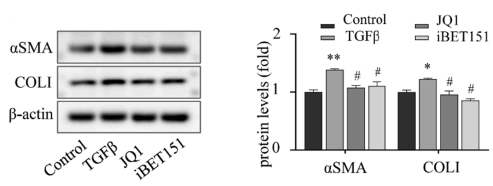
JQ-1 carboxylic acid purchased from MedChemExpress. Usage Cited in: Biochem Pharmacol. 2023 Apr:210:115497. [Abstract]
Fibrosis-related protein expressions after treatment with JQ-1 carboxylic acid (JQ1; 1 μM) in LX2 cells.
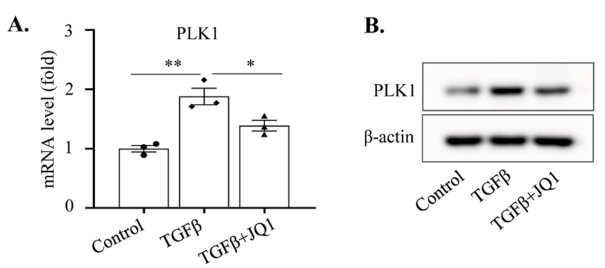
JQ-1 carboxylic acid purchased from MedChemExpress. Usage Cited in: Biochem Pharmacol. 2023 Apr:210:115497. [Abstract]
The mRNA and protein expressions of PLK1 with JQ-1 carboxylic acid (JQ1; 1 μM) treatment as detected by qRT-PCR and western blot in TGFβ-activated LX2 cells.
-
Biochem Biophys Res Commun
Topical application of phenformin ameliorates the psoriasis-like inflammatory response via the inhibition of c-Myc expression in keratinocytes. [Abstract]2024 Dec 3:736:150503. PMID: 39121669 -


Solvent & Solubility
In Vitro:
DMSO : 100 mg/mL (249.45 mM; Need ultrasonic; Hygroscopic DMSO has a significant impact on the solubility of product, please use newly opened DMSO)
Please refer to the solubility information to select the appropriate solvent. Once prepared, please aliquot and store the solution to prevent product inactivation from repeated freeze-thaw cycles.
Storage method and period of stock solution: -80°C, 2 years; -20°C, 1 year. When stored at -80°C, please use it within 2 years. When stored at -20°C, please use it within 1 year.
Please refer to the solubility information to select the appropriate solvent. Once prepared, please aliquot and store the solution to prevent product inactivation from repeated freeze-thaw cycles.
Storage method and period of stock solution: -80°C, 2 years; -20°C, 1 year. When stored at -80°C, please use it within 2 years. When stored at -20°C, please use it within 1 year.
Concentration (start) × Volume (start) = Concentration (final) × Volume (final)
In Vivo:
Select the appropriate dissolution method based on your experimental animal and administration route.
- For the following dissolution methods, please ensure to first prepare a clear stock solution using an In Vitro approach and then sequentially add co-solvents:
- To ensure reliable experimental results, the clarified stock solution can be appropriately stored based on storage conditions. As for the working solution for In Vivo experiments, it is recommended to prepare freshly and use it on the same day.
- The percentages shown for the solvents indicate their volumetric ratio in the final prepared solution. If precipitation or phase separation occurs during preparation, heat and/or sonication can be used to aid dissolution.
Add each solvent one by one: 10% DMSO 40% PEG300 5% Tween-80 45% Saline
Solubility: ≥ 2.08 mg/mL (5.19 mM); Clear solution
This protocol yields a clear solution of ≥ 2.08 mg/mL (saturation unknown).
Taking 1 mL working solution as an example, add 100 μL DMSO stock solution (20.8 mg/mL) to 400 μL PEG300, and mix evenly; then add 50 μL Tween-80 and mix evenly; then add 450 μL Saline to adjust the volume to 1 mL.
Preparation of Saline: Dissolve 0.9 g sodium chloride in ddH₂O and dilute to 100 mL to obtain a clear Saline solution.
Add each solvent one by one: 10% DMSO 90% (20% SBE-β-CD in Saline)
Solubility: ≥ 2.08 mg/mL (5.19 mM); Clear solution
This protocol yields a clear solution of ≥ 2.08 mg/mL (saturation unknown).
Taking 1 mL working solution as an example, add 100 μL DMSO stock solution (20.8 mg/mL) to 900 μL 20% SBE-β-CD in Saline, and mix evenly.
Preparation of 20% SBE-β-CD in Saline (4°C, storage for one week): 2 g SBE-β-CD powder is dissolved in 10 mL Saline, completely dissolve until clear.
In Vivo Dissolution Calculator
Please enter the basic information of animal experiments:
-
-
-
-
Recommended: Prepare an additional quantity of animals to account for potential losses during experiments.
Please enter your animal formula composition:
-
%DMSO +
Recommended: Keep the proportion of DMSO in working solution below 2% if your animal is weak.
-
%+
-
+%Tween-80 + +
-
%Saline +
The co-solvents required include: DMSO, . All of co-solvents are available by MedChemExpress (MCE). , Tween 80. All of co-solvents are available by MedChemExpress (MCE).
Working solution concentration: 0.22 mg/mL
Method for preparing stock solution: mg drug dissolved in μL DMSO. Stock solution concentration: mg/mL.
1. Take μL DMSO stock solution;
2. Add μL .
μL , mix evenly;
3. Then add μL Tween 80, mix evenly;
4. Then add μL
Please ensure that the stock solution in the first step is dissolved to a clear state, and add co-solvents in sequence. You can use ultrasonic heating (ultrasonic cleaner, recommended frequency 20-40 kHz), vortexing, etc. to assist dissolution.


Purity & Documentation
-
Data Sheet (298 KB)
-
SDS (396 KB)
- English - EN (396 KB)
- Français - FR (396 KB)
- Deutsch - DE (396 KB)
- Norwegian - NO (396 KB)
- Español - ES (396 KB)
- Swedish - SV (396 KB)
- Italian - IT (396 KB)
- Korean - KR (396 KB)
- Portuguese - PT (396 KB)
-
Handling Instructions (2659 KB)
References
[1]. Huang Y, et, al. Design, Synthesis, and Evaluation of Trivalent PROTACs Having a Functionalization Site with Controlled Orientation. Bioconjug Chem. 2022 Jan 19;33(1):142-151. [Content Brief]
[2]. Chen W, et, al. Dual drugs decorated bacteria irradiate deep hypoxic tumor and arouse strong immune responses. Biomaterials. 2022 Jul;286:121582. [Content Brief]


Complete Stock Solution Preparation Table
Please refer to the solubility information to select the appropriate solvent. Once prepared, please aliquot and store the solution to prevent product inactivation from repeated freeze-thaw cycles.
Storage method and period of stock solution: -80°C, 2 years; -20°C, 1 year. When stored at -80°C, please use it within 2 years. When stored at -20°C, please use it within 1 year.
| Optional Solvent | Concentration Solvent Mass | 1 mg | 5 mg | 10 mg | 25 mg |
|---|---|---|---|---|---|
| DMSO | 1 mM | 2.4945 mL | 12.4726 mL | 24.9451 mL | 62.3628 mL |
| 5 mM | 0.4989 mL | 2.4945 mL | 4.9890 mL | 12.4726 mL | |
| 10 mM | 0.2495 mL | 1.2473 mL | 2.4945 mL | 6.2363 mL | |
| 15 mM | 0.1663 mL | 0.8315 mL | 1.6630 mL | 4.1575 mL | |
| 20 mM | 0.1247 mL | 0.6236 mL | 1.2473 mL | 3.1181 mL | |
| 25 mM | 0.0998 mL | 0.4989 mL | 0.9978 mL | 2.4945 mL | |
| 30 mM | 0.0832 mL | 0.4158 mL | 0.8315 mL | 2.0788 mL | |
| 40 mM | 0.0624 mL | 0.3118 mL | 0.6236 mL | 1.5591 mL | |
| 50 mM | 0.0499 mL | 0.2495 mL | 0.4989 mL | 1.2473 mL | |
| 60 mM | 0.0416 mL | 0.2079 mL | 0.4158 mL | 1.0394 mL | |
| 80 mM | 0.0312 mL | 0.1559 mL | 0.3118 mL | 0.7795 mL | |
| 100 mM | 0.0249 mL | 0.1247 mL | 0.2495 mL | 0.6236 mL |


JQ-1 carboxylic acid Related Classifications
HY-78695 Related Classifications
 Powered by Bioz