



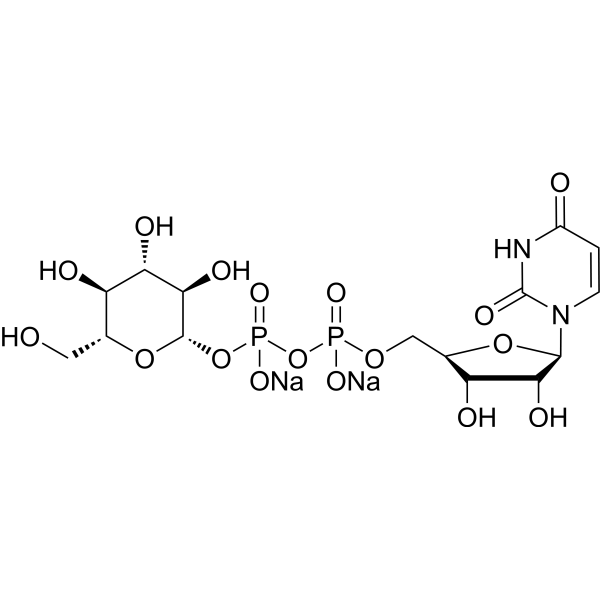
UDP-β-D-glucose disodium

Based on 1 Customer Validation
UDP-β-D-glucose disodium acts as a glycosyl donor and biosynthetic intermediate, and is also a stereoisomer of UDP-α-D-glucose.
For research use only. We do not sell to patients.
- Purity : 99.9%
- CAS No.: 7333-33-7
- Formula: C15H22N2Na2O17P2
- Molecular Weight:610.27
-
Storage:
4°C, sealed storage, away from moisture
* In solvent : -80°C, 6 months; -20°C, 1 month (sealed storage, away from moisture)

To place orders, for customer services and technical support, please contact: MedChemExpress USA
Tel: 609-228-6898 E-mail: [email protected] [email protected]


-
 Biological Activity
-
Chemical Information
- Purity & Documentation
- References
-
 Help & FAQs


All Endogenous Metabolite Isoforms
More

Biological Activity
Description
In Vitro
UDP-β-D-glucose (19u) disodium acts as the exclusive donor substrate for purified AprO from Streptomyces tenebrarius to catalyze glycosylation of aprosamine 5-phosphate, forming saccharocin (HY-106590) 5-phosphate[1].
UDP-β-D-glucose disodium undergoes transamination catalyzed by purified AprD5 and AprL from Streptomyces tenebrarius to form UDP-4″-amino-4″-deoxy-β-D-glucose, which serves as a donor substrate for AprO to produce Apramycin (HY-17558)[1].
UDP-β-D-glucose (substrate level; several hours) acts as the sugar donor for mammalian UDP-glucosyltransferases to glucosidate tea polyphenols in microsomal systems in vitro[2].
MedChemExpress (MCE) has not independently confirmed the accuracy of these methods. They are for reference only.


Chemical Information
-
CAS No. 7333-33-7
-
Appearance Solid
-
Molecular Weight 610.27
-
Formula C15H22N2Na2O17P2
-
Color White to off-white
-
SMILES
O[C@H]1[C@H](O)[C@@H](O)[C@H](O[P](O[P](OC[C@@H]2[C@@H](O)[C@@H](O)[C@H](N3C=CC(NC3=O)=O)O2)(O[Na])=O)(O[Na])=O)O[C@@H]1CO
-
Shipping
Room temperature in continental US; may vary elsewhere.
-
Storage
4°C, sealed storage, away from moisture
* In solvent : -80°C, 6 months; -20°C, 1 month (sealed storage, away from moisture)


Purity & Documentation
-
Data Sheet (271 KB)
-
SDS (394 KB)
- English - EN (394 KB)
- Français - FR (394 KB)
- Deutsch - DE (394 KB)
- Norwegian - NO (394 KB)
- Español - ES (394 KB)
- Swedish - SV (394 KB)
- Italian - IT (394 KB)
- Korean - KR (394 KB)
- Portuguese - PT (394 KB)
-
Handling Instructions (2659 KB)
References
[1]. Sato S, et al. Complete In Vitro Reconstitution of the Apramycin Biosynthetic Pathway Demonstrates the Unusual Incorporation of a β-d-Sugar Nucleotide in the Final Glycosylation Step. J Am Chem Soc. 2024;146(14):10103-10114. [Content Brief]
[2]. Sang S, et al. The chemistry and biotransformation of tea constituents. Pharmacol Res. 2011;64(2):87-99. [Content Brief]
[3]. Hundt K, et al. Transformation of triclosan by Trametes versicolor and Pycnoporus cinnabarinus. Appl Environ Microbiol. 2000;66(9):4157-4160. [Content Brief]

Calculators
Concentration (start) × Volume (start) = Concentration (final) × Volume (final)


UDP-β-D-glucose disodium Related Classifications
HY-137261 Related Classifications
 Powered by Bioz