



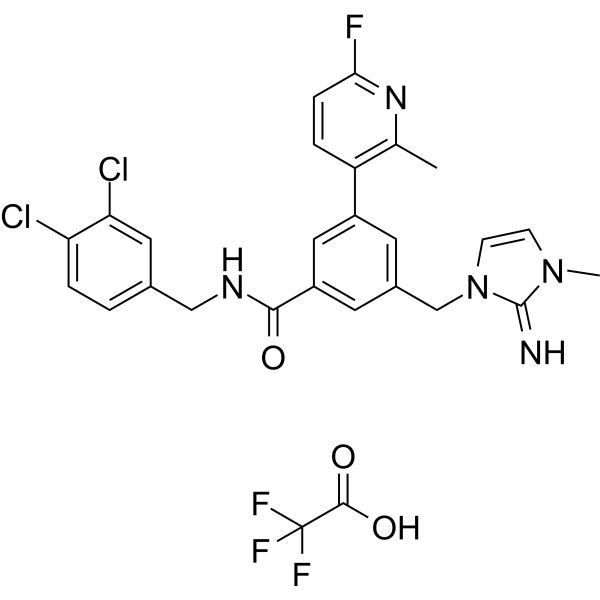
WDR5-IN-4 TFA
Based on 5 publication(s) in Google Scholar
WDR5-IN-4 TFA (Compound C6) is an inhibitor of the WIN site of chromatin-associated WD repeat-containing protein 5 (WDR5), with a Kd of 0.1 nM. WDR5-IN-4 TFA displaces WDR5 from chromatin and decreases the expression of associated genes, causing translational inhibition, nucleolar stress. Anti-cancer activity.
For research use only. We do not sell to patients.
- Purity : 98.04%
- CAS No.: 2749300-35-2
- Formula: C27H23Cl2F4N5O3
- Molecular Weight:612.40
-
Storage:
4°C, stored under nitrogen, away from moisture
* In solvent : -80°C, 6 months; -20°C, 1 month (stored under nitrogen, away from moisture)

To place orders, for customer services and technical support, please contact: MedChemExpress USA
Tel: 609-228-6898 E-mail: [email protected] [email protected]


-
 Biological Activity
-
Chemical Information
-
Solvent & Solubility
- Purity & Documentation
- References
-
 Help & FAQs


Publications Citing Use of MedChemExpress (MCE) WDR5-IN-4 TFA
More

Biological Activity
Description
In Vitro
WDR5-IN-4 TFA (0-50 μM, 3 days) inhibits the proliferation of MLL1-rearranged cancer cells MV4:11 and K562 cells with GI50s of 3.20 μM and 25.4 μM[1].
WDR5-IN-4 TFA (2 μM, 6 days) arrests the cell cycle of MV4:11 at sub-G1 phase, induces apoptosis in MV4:11[1].
MedChemExpress (MCE) has not independently confirmed the accuracy of these methods. They are for reference only.
-
Cell Line:MV4:11 and K562
-
Concentration:0-50 μM
-
Incubation Time:6 days
-
Result:Arrested the cell cycle at sub-G1 phase.
In Vivo
MedChemExpress (MCE) has not independently confirmed the accuracy of these methods. They are for reference only.
-
Animal Model:Rnf220+/- mouse models[2]
-
Dosage:100 μg
-
Administration:intrauterine injection, single dose
-
Result:Upregulated the expression of Hox genes.


Chemical Information
-
CAS No. 2749300-35-2
-
Appearance Solid
-
Molecular Weight 612.40
-
Formula C27H23Cl2F4N5O3
-
Color Light yellow to orange
-
SMILES
ClC1=CC=C(CNC(C2=CC(CN3C(N(C)C=C3)=N)=CC(C4=C(C)N=C(F)C=C4)=C2)=O)C=C1Cl.O=C(O)C(F)(F)F
-
Shipping
Room temperature in continental US; may vary elsewhere.
-
Storage
4°C, stored under nitrogen, away from moisture
* In solvent : -80°C, 6 months; -20°C, 1 month (stored under nitrogen, away from moisture)


Publications (5)
-
Journal Impact Factor
-
Most Recent
-
Cell Rep
UTP18-mediated p21 mRNA instability drives adenoma-carcinoma progression in colorectal cancer. [Abstract]2023 Apr 21;42(5):112423. PMID: 37086406 -
-
bioRxiv
SAGA/ATAC complexes sustain aberrant chromatin regulation and promote tumorigenesis in diffuse midline glioma. [Abstract]2026 Jan 23:2026.01.22.701194. PMID: 41648478 -
-


Solvent & Solubility
In Vitro:
DMSO : 100 mg/mL (163.29 mM; Need ultrasonic; Hygroscopic DMSO has a significant impact on the solubility of product, please use newly opened DMSO)
Please refer to the solubility information to select the appropriate solvent. Once prepared, please aliquot and store the solution to prevent product inactivation from repeated freeze-thaw cycles.
Storage method and period of stock solution: -80°C, 6 months; -20°C, 1 month (stored under nitrogen, away from moisture). When stored at -80°C, please use it within 6 months. When stored at -20°C, please use it within 1 month.
Please refer to the solubility information to select the appropriate solvent. Once prepared, please aliquot and store the solution to prevent product inactivation from repeated freeze-thaw cycles.
Storage method and period of stock solution: -80°C, 6 months; -20°C, 1 month (stored under nitrogen, away from moisture). When stored at -80°C, please use it within 6 months. When stored at -20°C, please use it within 1 month.
Concentration (start) × Volume (start) = Concentration (final) × Volume (final)
In Vivo:
Select the appropriate dissolution method based on your experimental animal and administration route.
- For the following dissolution methods, please ensure to first prepare a clear stock solution using an In Vitro approach and then sequentially add co-solvents:
- To ensure reliable experimental results, the clarified stock solution can be appropriately stored based on storage conditions. As for the working solution for In Vivo experiments, it is recommended to prepare freshly and use it on the same day.
- The percentages shown for the solvents indicate their volumetric ratio in the final prepared solution. If precipitation or phase separation occurs during preparation, heat and/or sonication can be used to aid dissolution.
Add each solvent one by one: 10% DMSO 40% PEG300 5% Tween-80 45% Saline
Solubility: ≥ 2.5 mg/mL (4.08 mM); Clear solution
This protocol yields a clear solution of ≥ 2.5 mg/mL (saturation unknown).
Taking 1 mL working solution as an example, add 100 μL DMSO stock solution (25.0 mg/mL) to 400 μL PEG300, and mix evenly; then add 50 μL Tween-80 and mix evenly; then add 450 μL Saline to adjust the volume to 1 mL.
Preparation of Saline: Dissolve 0.9 g sodium chloride in ddH₂O and dilute to 100 mL to obtain a clear Saline solution.
Add each solvent one by one: 10% DMSO 90% (20% SBE-β-CD in Saline)
Solubility: ≥ 2.5 mg/mL (4.08 mM); Clear solution
This protocol yields a clear solution of ≥ 2.5 mg/mL (saturation unknown).
Taking 1 mL working solution as an example, add 100 μL DMSO stock solution (25.0 mg/mL) to 900 μL 20% SBE-β-CD in Saline, and mix evenly.
Preparation of 20% SBE-β-CD in Saline (4°C, storage for one week): 2 g SBE-β-CD powder is dissolved in 10 mL Saline, completely dissolve until clear.
In Vivo Dissolution Calculator
Please enter the basic information of animal experiments:
-
-
-
-
Recommended: Prepare an additional quantity of animals to account for potential losses during experiments.
Please enter your animal formula composition:
-
%DMSO +
Recommended: Keep the proportion of DMSO in working solution below 2% if your animal is weak.
-
%+
-
+%Tween-80 + +
-
%Saline +
The co-solvents required include: DMSO, . All of co-solvents are available by MedChemExpress (MCE). , Tween 80. All of co-solvents are available by MedChemExpress (MCE).
Working solution concentration: 0.22 mg/mL
Method for preparing stock solution: mg drug dissolved in μL DMSO. Stock solution concentration: mg/mL. * In solvent : -80°C, 6 months; -20°C, 1 month (stored under nitrogen, away from moisture)
1. Take μL DMSO stock solution;
2. Add μL .
μL , mix evenly;
3. Then add μL Tween 80, mix evenly;
4. Then add μL
Please ensure that the stock solution in the first step is dissolved to a clear state, and add co-solvents in sequence. You can use ultrasonic heating (ultrasonic cleaner, recommended frequency 20-40 kHz), vortexing, etc. to assist dissolution.


Purity & Documentation
-
Data Sheet (277 KB)
-
SDS (252 KB)
- English - EN (252 KB)
- Français - FR (252 KB)
- Deutsch - DE (252 KB)
- Norwegian - NO (252 KB)
- Español - ES (252 KB)
- Swedish - SV (252 KB)
- Italian - IT (252 KB)
- Korean - KR (252 KB)
- Portuguese - PT (252 KB)
-
Handling Instructions (2659 KB)
References
[1]. Aho ER, et al. Displacement of WDR5 from Chromatin by a WIN Site Inhibitor with Picomolar Affinity. Cell Rep. 2019 Mar 12;26(11):2916-2928.e13. [Content Brief]
[2]. Pan M, et al., UTP18-mediated p21 mRNA instability drives adenoma-carcinoma progression in colorectal cancer. Cell Rep. 2023 May 30;42(5):112423. [Content Brief]
[3]. Wang H, et al. The E3 ubiquitin ligase RNF220 maintains hindbrain Hox expression patterns through regulation of WDR5 stability[J]. Elife, 2024, 13: RP94657. [Content Brief]


Complete Stock Solution Preparation Table
Please refer to the solubility information to select the appropriate solvent. Once prepared, please aliquot and store the solution to prevent product inactivation from repeated freeze-thaw cycles.
Storage method and period of stock solution: -80°C, 6 months; -20°C, 1 month (stored under nitrogen, away from moisture). When stored at -80°C, please use it within 6 months. When stored at -20°C, please use it within 1 month.
| Optional Solvent | Concentration Solvent Mass | 1 mg | 5 mg | 10 mg | 25 mg |
|---|---|---|---|---|---|
| DMSO | 1 mM | 1.6329 mL | 8.1646 mL | 16.3292 mL | 40.8230 mL |
| 5 mM | 0.3266 mL | 1.6329 mL | 3.2658 mL | 8.1646 mL | |
| 10 mM | 0.1633 mL | 0.8165 mL | 1.6329 mL | 4.0823 mL | |
| 15 mM | 0.1089 mL | 0.5443 mL | 1.0886 mL | 2.7215 mL | |
| 20 mM | 0.0816 mL | 0.4082 mL | 0.8165 mL | 2.0411 mL | |
| 25 mM | 0.0653 mL | 0.3266 mL | 0.6532 mL | 1.6329 mL | |
| 30 mM | 0.0544 mL | 0.2722 mL | 0.5443 mL | 1.3608 mL | |
| 40 mM | 0.0408 mL | 0.2041 mL | 0.4082 mL | 1.0206 mL | |
| 50 mM | 0.0327 mL | 0.1633 mL | 0.3266 mL | 0.8165 mL | |
| 60 mM | 0.0272 mL | 0.1361 mL | 0.2722 mL | 0.6804 mL | |
| 80 mM | 0.0204 mL | 0.1021 mL | 0.2041 mL | 0.5103 mL | |
| 100 mM | 0.0163 mL | 0.0816 mL | 0.1633 mL | 0.4082 mL |


WDR5-IN-4 TFA Related Classifications
HY-111753A Related Classifications
 Powered by Bioz