Others
-
Others Related Products (76551)
Related Products (76551)

-
Rolapitant Intermediate
 0 ImagesSynonyms: (3R,7aR)-3-(tert-Butyl)-1-hydroxy-7a-vinyltetrahydropyrrolo[1,2-c]oxazol-5(3H)-one
Rolapitant Intermediate ((3R,7aR)-3-(tert-Butyl)-1-hydroxy-7a-vinyltetrahydropyrrolo[1,2-c]oxazol-5(3H)-one) is a drug intermediate for synthesis of various active compounds.
-
2-Phenoxyphenol
 0 ImagesCat. No.: HY-W018584CAS No.: 2417-10-9Synonyms: o-Phenoxyphenol
-
3-Ethylphenol
 0 ImagesSynonyms: m-Hydroxyethylbenzene
3-Ethylphenol (m-Hydroxyethylbenzene) is a Phenylpropanoids product that can be isolated from the fruits of Syringa vulgaris.
-
Benzothiazole-5-boronic acid pinacol ester
 0 ImagesCat. No.: HY-W019633CAS No.: 1073354-91-2
Benzothiazole-5-boronic acid pinacol ester is a compound that can be used in the boronate part of Suzuki coupling reactions.

-
N-(Hydroxymethyl)acetamide
 0 ImagesCat. No.: HY-W024564CAS No.: 625-51-4Synonyms: Acetamidomethanol
N-(Hydroxymethyl)acetamide (Acetamidomethanol) is a model molecule of Ceramide. The dimers of N-(Hydroxymethyl)acetamide have various hydrogen bonds, and the three-dimensional network structure formed by these hydrogen bonds may be the main reason for the barrier function of the stratum corneum of the skin.
-
Spiro-MeOTAD
 0 Images
Spiro-MeOTAD is a high performance hole transport layer material. Spiro-MeOTAD can be used in highly efficient perovskite solar cells.
-
2-Benzoylbenzoic acid
 0 ImagesSynonyms: o-Benzoylbenzoic acid
2-Benzoylbenzoic acid is a Benzophenone (HY-Y0546) analog. 2-Benzoylbenzoic acid is non-phototoxic due to the alteration of the functional groups. 2-Benzoylbenzoic acid can be used to study the mechanism of phototoxicit.
-
3-Aminocoumarin
 0 Images
3-Aminocoumarin, also known as 3-aminochromen-2-one, serves as a crucial intermediate for the synthesis of metal complexes.
-
Methyl 3-carbamoylbicyclo[1.1.1]pentane-1-carboxylate
![Methyl 3-carbamoylbicyclo[1.1.1]pentane-1-carboxylate](https://file.medchemexpress.com/product_pic/hy-w032995.gif "Click to View Methyl 3-carbamoylbicyclo[1.1.1]pentane-1-carboxylate Product Detail") 0 ImagesCat. No.: HY-W032995CAS No.: 156329-77-0
0 ImagesCat. No.: HY-W032995CAS No.: 156329-77-0Methyl 3-carbamoylbicyclo[1.1.1]pentane-1-carboxylate is a drug intermediate for synthesis of various active compounds.
-
NPN12830
 0 ImagesCat. No.: HY-W035135CAS No.: 22112-83-0
NPN12830 is a dye compound. NPN12830 can be used in various photodynamic therapy research.
-
3-Oxo-2,3-dihydro-1H-indazole-5-carboxylic acid
 0 Images
3-Oxo-2,3-dihydro-1H-indazole-5-carboxylic acid is a drug intermediate for synthesis of various active compounds.
-
(1S,2R)-2-Fluorocyclopropan-1-amine hydrochloride
 0 ImagesCat. No.: HY-W036541CCAS No.: 141042-20-8
(1S,2R)-2-Fluorocyclopropan-1-amine hydrochloride is a drug impurity.
-
tert-Butyl (R)-3-(4-chlorophenyl)piperazine-1-carboxylate
 0 ImagesCat. No.: HY-W037792CAS No.: 1228556-99-7
tert-Butyl (R)-3-(4-chlorophenyl)piperazine-1-carboxylate is a drug intermediate for synthesis of various active compounds.
-
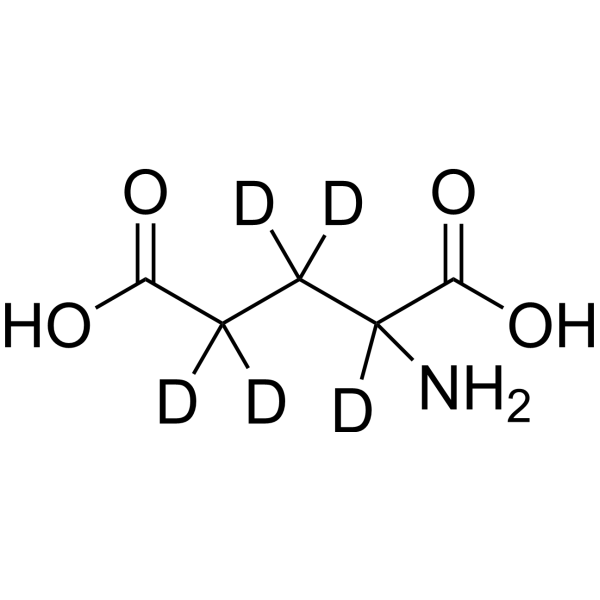
DL-Glutamic acid-d5
 0 Images
DL-Glutamic acid-d5 is the deuterium labeled DL-Glutamic acid. DL-Glutamic acid is the conjugate acid of Glutamic acid, which acts as a fundamental metabolite. Comparing with the second phase of polymorphs α and β L-Glutamic acid, DL-Glutamic acid presents better stability.
-
3-Methyl-4-nitrophenol
 0 Images
3-Methyl-4-nitrophenol, an environmental contaminant, is a well-known constituent of diesel exhaust particles and degradation products of insecticide fenitrothion. 3-Methyl-4-nitrophenol can induce nasal epithelial cell apoptosis and increase the permeability of the nasal epithelial barrier. 3-Methyl-4-nitrophenol is also toxic to the female reproductive system.
-
Isopropyl benzenesulfonate
 0 ImagesSynonyms: Isopropyl besylate
Isopropyl benzenesulfonate (Isopropyl besylate) is an aromatic sulfonate compound and also a potentially genotoxic impurity.
-
(S)-2-(1,4-Dibenzylpiperazin-2-yl)acetonitrile
 0 Images
(S)-2-(1,4-Dibenzylpiperazin-2-yl)acetonitrile is a drug intermediate for synthesis of various active compounds.