



Apoptosis
Apoptosis
Apoptosis is a distinctive form of cell death exhibiting specific morphological and biochemical characteristics, including cell membrane blebbing, chromatin condensation, genomic DNA fragmentation, and exposure of specific phagocytosis signaling molecules on the cell surface. Cells undergoing apoptosis differ from those dying through necrosis. Necrotic cells are usually recognized by the immune system as a danger signal and, thus, resulting in inflammation; in contrast, apoptotic death is quiet and orderly.
There are two major pathways of apoptotic cell death induction: The intrinsic pathway, also called the Bcl-2-regulated or mitochondrial pathway, is activated by various developmental cues or cytotoxic insults, such as viral infection, DNA damage and growth-factor deprivation, and is strictly controlled by the BCL-2 family of proteins. The extrinsic or death-receptor pathway is triggered by ligation of death receptors (members of the tumor necrosis factor (TNF) receptor family, such as Fas or TNF receptor-1 (TNFR1)) that contain an intracellular death domain, which can recruit and activate caspase-8 through the adaptor protein Fas-associated death domain (FADD; also known as MORT1) at the cell surface. This recruitment causes subsequent activation of downstream (effector) caspases, such as caspase-3, -6 or -7, without any involvement of the BCL-2 family.
Studies suggest that alterations in cell survival contribute to the pathogenesis of a number of human diseases, including cancer, viral infections, autoimmune diseases, neurodegenerative disorders, and AIDS (acquired immunodeficiency syndrome). Treatments designed to specifically alter the apoptotic threshold may have the potential to change the natural progression of some of these diseases.
All Product Categories
-
Apoptosis Inhibitors
(866)
View all products
-
Apoptosis Agonists
(7)
View all products
-
Apoptosis Antagonists
(9)
View all products
-
Apoptosis Activators
(358)
View all products
-
Apoptosis Modulators
(57)
View all products
-
Apoptosis Inducers
(7665)
View all products
-
Apoptosis Degrader
(1)
View all products
-
Apoptosis Controls
(33)
View all products
-
Apoptosis Related Products (9540)
Related Products (9540)

-
Antibodies (120)
-
BP-1-108
 0 ImagesCat. No.: HY-125151CAS No.: 1334492-85-1BP-1-108 is a selective inhibitor of STAT5 (Ki=8.3 μM) with anticancer activity. BP-1-108 induces apoptosis of leukemia cells by inhibiting the phosphorylation of STAT5. BP-1-108 can be used in the study of acute myeloid leukemia and prostate cancer.
-
Thalidomide 4'-oxyacetamide-C1-PEG3-C3-amine hydrochloride
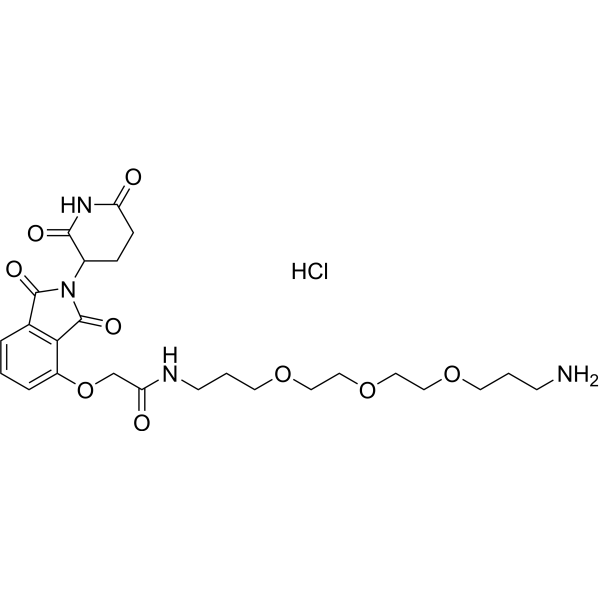 0 ImagesCat. No.: HY-139227CAS No.: 2564466-93-7Thalidomide 4'-oxyacetamide-C1-PEG3-C3-amine hydrochloride is a functionalized cereblon ligand for PROTAC research and development with terminal amine ready for conjugation to a target protein ligand.
-
CAY10404 (Standard)
 0 ImagesCat. No.: HY-121537RCAS No.: 340267-36-9CAY10404 (Standard) is the analytical standard of CAY10404. This product is intended for research and analytical applications. CAY10404 is a potent and selective cyclooxygenase-2 (COX-2) inhibitor with an IC50 of 1 nM and a selectivity index (SI; COX-1 IC50/COX-2 IC50) of >500000. CAY10404 is a potent PKB/Akt and MAPK signaling pathways inhibitor and induces apoptosis in non-small cell lung cancer (NSCLC) cells. CAY10404, a diarylisoxazole, has good analgesic, anti-inflammatory, and anti-cancer activities.
-
Vitexin-2"-O-rhamnoside (Standard)
 0 ImagesCat. No.: HY-N0534RCAS No.: 64820-99-1Vitexin-2"-O-rhamnoside (Standard) is the analytical standard of Vitexin-2"-O-rhamnoside (HY-N0534). This product is intended for research and analytical applications. Vitexin-2"-O-rhamnoside is an orally active flavonoid glycoside. Vitexin-2"-O-rhamnoside inhibits Apoptosis, increases the phosphorylation levels of PI3K/Akt, inhibits caspase-3, SOD activity, and promotes cytokine (IL-2, IL-6, and IL-12) secretion. Vitexin-2"-O-rhamnoside strongly inhibits DNA synthesis in MCF-7 cells with an IC50 of 17.5 μM. Vitexin-2"-O-rhamnoside enhances immune function and improves the absorption of active compounds. Vitexin-2"-O-rhamnoside has antioxidant activity. Vitexin-2"-O-rhamnoside is used in the study of cardiovascular disease and immune-related diseases.
-
Apitolisib (Standard)
 0 ImagesSynonyms: GDC-0980 (Standard); GNE 390 (Standard); RG 7422 (Standard)Apitolisib (Standard) is the analytical standard of Apitolisib. This product is intended for research and analytical applications. Apitolisib (GDC-0980; GNE 390; RG 7422) is a selective, potent, orally bioavailable Class I PI3 kinase and mTOR kinase (TORC1/2) inhibitor with IC50s of 5 nM/27 nM/7 nM/14 nM for PI3Kα/PI3Kβ/PI3Kδ/PI3Kγ, and with a Ki of 17 nM for mTOR.
-
Hepatoprotective agent-2
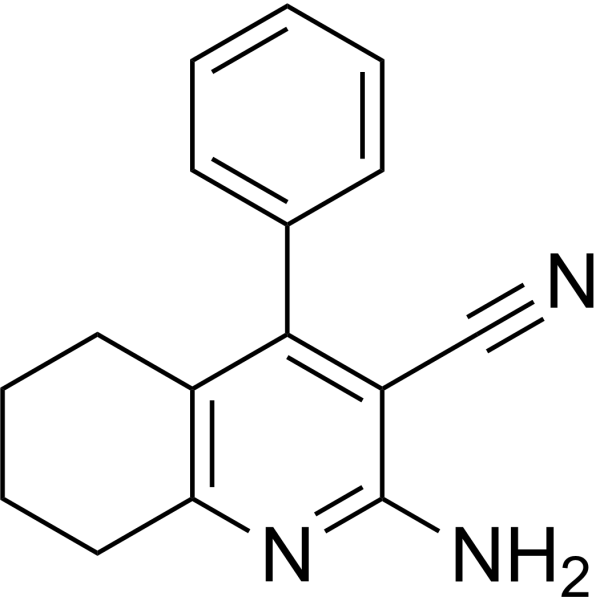 0 ImagesCat. No.: HY-W027126CAS No.: 74873-41-9Hepatoprotective agent-2 (compound 2a), a 4-phenyl-tetrahydroquinoline derivative, displays a remarkable hepatoprotective effect. Hepatoprotective agent-2 has antiapoptotic activity. Hepatoprotective agent-2 notably prevents the chemically induced elevation of hepatic indicators associated with liver injury.
-
Oxatomide (Standard)
 0 ImagesCat. No.: HY-123205RCAS No.: 60607-34-3Synonyms: KW-4354 (Standard)Oxatomide (Standard) (KW-4354 (Standard)) is the analytical standard of Oxatomide (HY-123205). This product is intended for research and analytical applications. Oxatomide (KW-4354) is an orally active dual antagonist of the H1-histamine receptor and the P2X7 receptor, as well as an inhibitor of serotonin. Oxatomide possesses antihistaminic, antiallergic and anti-inflammatory activities. Oxatomide can be used in the research of allergic diseases.
-
Methazolamide (Standard)
 0 ImagesMethazolamide (Standard) is the analytical standard of Methazolamide. This product is intended for research and analytical applications. Methazolamide (L584601) is a BBB-penetrable and orally active carbonic anhydrase inhibitor, with a Ki of 14 nM for human carbonic anhydrase II. Methazolamide can reduce intraocular pressure and has a neuroprotective effect, being able to inhibit neuronal apoptosis. Methazolamide can be used in the research of ophthalmic diseases such as glaucoma and cerebrovascular diseases such as subarachnoid hemorrhage.
-
D-Cl-amidine hydrochloride (Standard)
 0 ImagesCat. No.: HY-100574DRCAS No.: 2985338-61-0D-Cl-amidine (hydrochloride) (Standard) is the analytical standard of D-Cl-amidine (hydrochloride) (HY-100574D). This product is intended for research and analytical applications. D-Cl-amidine hydrochloride is a potent and highly selective PAD1 inhibitor. D-Cl-amidine is well-torelated with no significant toxicity.
-
Alisertib (Standard)
 0 ImagesCat. No.: HY-10971RCAS No.: 1028486-01-2Synonyms: MLN 8237 (Standard)Alisertib (Standard) is the analytical standard of Alisertib. This product is intended for research and analytical applications. Alisertib (MLN 8237) is an orally active and selective Aurora A kinase inhibitor (IC50=1.2 nM), which binds to Aurora A kinase resulting in mitotic spindle abnormalities, mitotic accumulation. Alisertib (MLN 8237) induces apoptosis and autophagy through targeting the AKT/mTOR/AMPK/p38 pathway in leukemic cells. Antitumor activity.
-
AEG3482 (Standard)
 0 ImagesCat. No.: HY-107599RCAS No.: 63735-71-7AEG3482 (Standard) is the analytical standard of AEG3482 (HY-107599). This product is intended for research and analytical applications. AEG3482 is a potent antiapoptotic compound that inhibits Jun Kinase (JNK) activity through induced expression of heat shock protein 70 (HSP70). AEG3482 directly binds HSP90, thereby facilitating HSF1-dependent expression of HSP70 and HSP25.
-
R547 mesylate
 0 ImagesCat. No.: HY-111260CAS No.: 869369-26-6R547 mesylate is a potent, selective and orally active ATP-competitive CDK inhibitor, with Kis of 2 nM, 3 nM and 1 nM for CDK1/cyclin B, CDK2/cyclin E and CDK4/cyclin D1, respectively.
-
Zonisamide (Standard)
 0 ImagesSynonyms: AD 810 (Standard); CI 912 (Standard)Zonisamide (Standard) is the analytical standard of Zonisamide. This product is intended for research and analytical applications. Zonisamide (AD 810) is an orally active carbonic anhydrase inhibitor, with Kis of 35.2 and 20.6 nM for hCA II and hCA V, respectively. Zonisamide exerts neuroprotective effects through anti-apoptosis and upregulating MnSOD levels. Zonisamide also increases the expression of Hrd1, thereby improving cardiac function in AAC rats. Zonisamide can be used in studies of seizure, parkinson’s disease and cardiac hypertrophy.
-
KYP-2047 (Standard)
 0 ImagesCat. No.: HY-100475RCAS No.: 796874-99-2KYP-2047 (Standard) is the analytical standard of KYP-2047 (HY-100475). This product is intended for research and analytical applications. KYP-2047 is a potent and BBB-penetrating prolyl-oligopeptidase (POP) inhibitor, with an Ki value of 0.023 nM. KYP-2047 reduces glioblastoma proliferation through angiogenesis and apoptosis modulation.
-
Liensinine (Standard)
 0 ImagesLiensinine (Standard) is the analytical standard of Liensinine (HY-N0484). This product is intended for research and analytical applications. Liensinine is a bisbenzylisoquinoline alkaloid. By inhibiting the PI3K/AKT and JNK/p38-MAPK signaling pathways, Liensinine suppresses autophagy and apoptosis, clears Aβ, and exerts anti-inflammatory, antioxidant and neuroprotective effects. Liensinine activates AMPK and inhibits the expression of HIF-1α and VEGF, thereby suppressing angiogenesis. Liensinine exerts anti-tumor effects through ROS-mediated inhibition of the JAK2/STAT3 signaling pathway. Liensinine can be used for the research of diseases such as Alzheimer's disease, hepatocellular carcinoma, osteosarcoma, sepsis-induced organ injury and stroke.
-
Pranoprofen (Standard)
 0 ImagesPranoprofen (Standard) is the analytical standard of Pranoprofen. This product is intended for research and analytical applications. Pranoprofen is a non-steroidal anti-inflammatory agent (NSAID) for the research of keratitis or other ophthalmology diseases. Pranoprofen inhibit COX-1 and COX-2 enzymes, thus blocking arachidonic acid converted to eicosanoids and reducing prostaglandins synthesis.
-
C6 Ceramide-13C2,d2
 0 ImagesCat. No.: HY-W766368Synonyms: C6-Cer-13C2,d2; N-Hexanoylsphingosine-13C2,d2C6 Ceramide-13C2,d2 (C6-Cer-13C2,d2) is the deuterium labeled and 13C-labeled C6 Ceramide (HY-19542). C6 Ceramide (C6-Cer) is a short-chain, cell-permeable ceramide pathway activator with anticancer activity. C6 Ceramide-mediated miR-29b expression participates in the progression of multiple myeloma through suppressing the proliferation, migration and angiogenesis of endothelial cells by targeting Akt signal pathway. C6 Ceramide exhibits multiple anti-cancer properties including cell cycle arrest, Apoptosis, inhibition of tumor growth and enhances the effects of chemotherapy in drug-resistant cancer cells. C6-ceramide can be used as an adjuvant for chemotherapeutic agents, to enhance anti-tumor effects.
-
Imifoplatin (Standard)
 0 ImagesCat. No.: HY-109146RCAS No.: 1339960-28-9Synonyms: PT-112 (Standard)Imifoplatin (Standard) is the analytical standard of Imifoplatin (HY-109146). This product is intended for research and analytical applications. Imifoplatin (PT-112) is a platinum-based active molecule and a member of the phosphaplatins family. Imifoplatin can induce Apoptosis and exhibits antitumor activity.
-
TP-472 (Standard)
 0 ImagesCat. No.: HY-100517RCAS No.: 2079895-62-6TP-472 (Standard) is the analytical standard of TP-472 (HY-100517). This product is intended for research and analytical applications. TP-472, a chemical probe, is a selective BRD9/7 inhibitor, with Kds of 33 nM and 340 nM for BRD9 and BRD7, respectively. TP-472 exhibits >30-fold selectivity for BRD9 over other bromodomain family members except BRD7. TP-472 induces apoptosis of melanoma cells.
-
Garlic oil
 0 ImagesGarlic oil is an orally effective anti-inflammatory, antioxidant, and anticancer agent. Garlic oil inhibits the activation of NF-κB, NFκB2 and NLRP3 inflammasome, and induces the expression of GSTA1, HO-1 and NQO-1. Garlic oil reduces the Bcl-2/Bax protein ratio and activates NNK-induced apoptosis (apoptosis) in lung tissues. Garlic oil attenuates NNK-induced apoptosis in MRC-5 cells and reduces excessive ROS production. Garlic oil alleviates pyroptosis (pyroptosis) and exerts a protective effect against acute lung injury in mice. Garlic oil inhibits lung tumorigenesis in mice and improves small intestinal motility in rats with type 2 diabetes. Garlic oil can be used in research related to acute lung injury, lung cancer, peptic ulcer, type 2 diabetes and hypertension.




