



Isotope-Labeled Compounds
Isotope-labeled compounds are chemical substances in which some atoms in their molecules are replaced by isotope atoms. The range of stable isotope products can cover from gases to complex molecules. Isotope-labeled compounds could provide a site-specific investigation of structures, making molecules easily detectable by mass spectrometry and NMR, and maintaining the physico-chemical properties of the target molecule at the same time.
MCE isotope-labeled compounds are all stable isotope-labeled compounds and are non-radioactive labeled substances. MCE isotope-labeled compounds are unique tools for identifying and understanding biological and chemical processes. Stable isotope-labeled products are now getting more and more popular among scientists. The scope of application is gradually penetrating into various scientific fields, such as life sciences, food and medicine, agriculture, environment, geology, etc. Stable isotope-labeled compounds have a wide range of applications in the Life Science areas, such as Metabolomics, Proteomics, Clinical studies, Deuterium drugs, etc.
All Product Categories
-
Isotope-Labeled Compounds Related Products (11097)
Related Products (11097)

-
2-(2-Hydroxy-N-(2-(methoxy-d3)ethyl)acetamido)-3-methylbenzoic acid
 0 ImagesCat. No.: HY-W714228S2-(2-Hydroxy-N-(2-(methoxy-d3)ethyl)acetamido)-3-methylbenzoic acid is deuterium labeled 2-(2-Hydroxy-N-(2-methoxyethyl)acetamido)-3-methylbenzoic acid.
-
Mirabegron-d8
 0 ImagesCat. No.: HY-14773S1Synonyms: YM178-d8Mirabegron-d8 (YM178-d8) is deuterium labeled Mirabegron. Mirabegron is a selective β3-adrenoceptor agonist with EC50 of 22.4 nM.
-
N6-(4-Methoxybenzyl)adenosine-d3
 0 ImagesCat. No.: HY-152303SN6-(4-Methoxybenzyl)adenosine-d3 is deuterium labeled N6-(4-Methoxybenzyl)adenosine. N6-(4-Methoxybenzyl)adenosine is an adenosine analog. Adenosine analogs mostly act as smooth muscle vasodilators and have also been shown to inhibit cancer progression. Its popular products are adenosine phosphate, Acadesine (HY-13417), Clofarabine (HY-A0005), Fludarabine phosphate (HY-B0028) and Vidarabine (HY-B0277).
-
Toremifene-d6 citrate
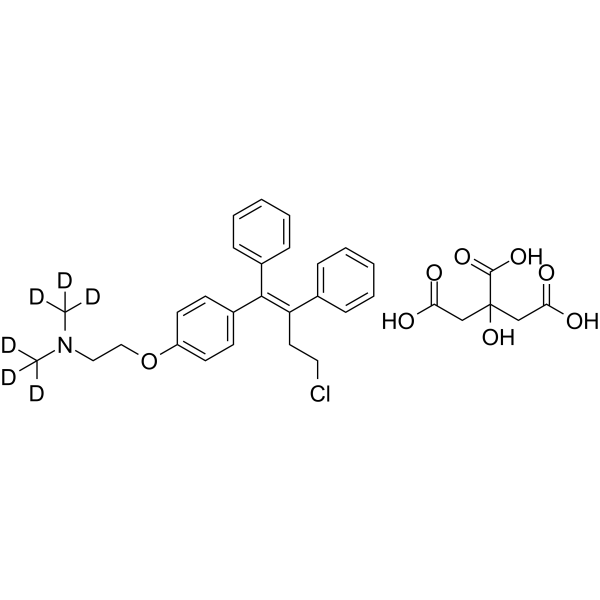 0 ImagesCat. No.: HY-B0005SCAS No.: 1246833-71-5Toremifene-d6 (citrate) is the deuterium labeled Toremifene citrate. Toremifene citrate (Z-Toremifene citrate) is a second-generation selective estrogen-receptor modulator (SERM) in development for the prevention of osteoporosis. Toremifene citrate also potent inhibits infectious EBOV Zaire and Marburg (MARV) with IC50 of 0.07 μM and 2.6 μM, respectively.

-
1,1-Diethoxybutane-d10
 0 ImagesCat. No.: HY-W551703S1,1-Diethoxybutane-d10 is a deuterated labeled 1,1-Diethoxybutane.
-
3-(2,5-Dimethoxyphenyl)propanoic acid-d6
 0 ImagesCat. No.: HY-W097796S3-(2,5-Dimethoxyphenyl)propanoic acid-d6 is the deuterium labeled 3-(2,5-Dimethoxyphenyl)propanoic acid.
-
(rac)-Viloxazine-d5 hydrochloride
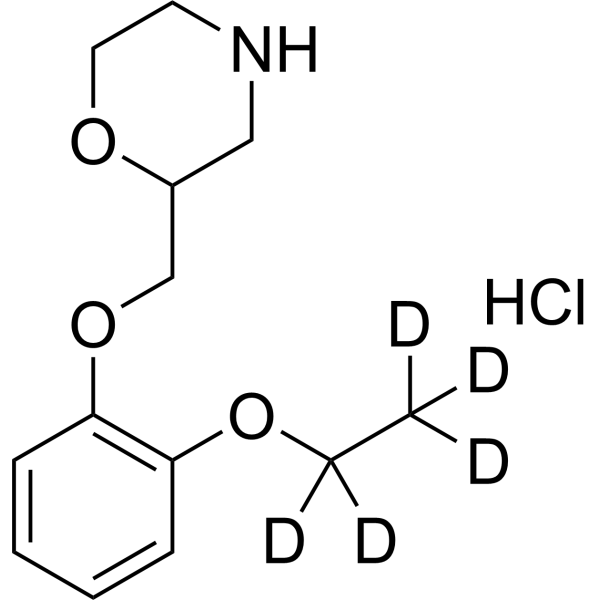 0 ImagesCat. No.: HY-125784SCAS No.: 1276483-10-3(rac)-Viloxazine-d5 (hydrochloride) is the deuterium labeled (rac)-Viloxazine hydrochloride.
-
3α,7α-Dihydroxycoprostanic acid-d5
 0 ImagesCat. No.: HY-113097S13α,7α-Dihydroxycoprostanic acid-d5 is deuterium labeled 3α,7α-Dihydroxycoprostanic acid. 3α,7α-Dihydroxycoprostanic acid is an endogenous metabolite. 3α,7α-Dihydroxycoprostanic acid, a bile acid, is the precursor to chenodeoxycholic acid.
-
1-Heptadecanoyl-2-eicosatrienoyl-sn-glycero(-d5)-3-phospho-(1’-rac-glycerol)(sodium)
 0 ImagesCat. No.: HY-167590SCAS No.: 2936622-53-41-Heptadecanoyl-2-eicosatrienoyl-sn-glycero(d5)-3-phospho-(1’-rac-glycerol)(sodium) is deuterium labeled 1-Heptadecanoyl-2-eicosatrienoyl-sn-glycero-3-phospho-(1’-rac-glycerol)(sodium).
-
Tricyclodecenyl acetate-13C2
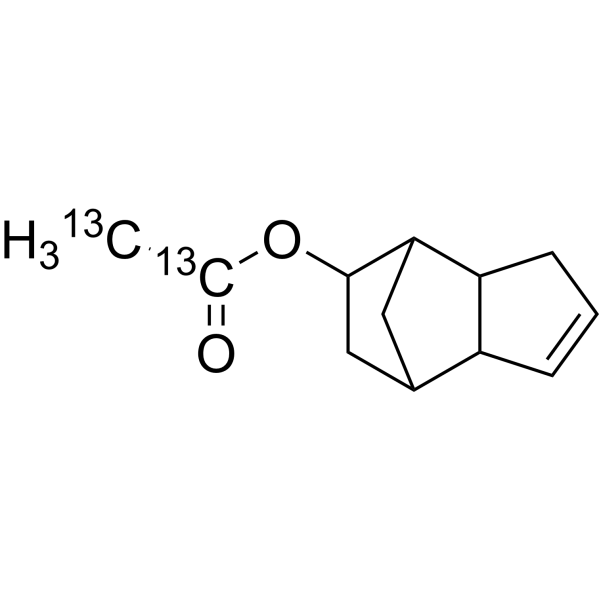 0 ImagesCat. No.: HY-118560SSynonyms: NSC 6598-13C2; Herbaflorat-13C2; Greenyl acetate-13C2; Verdyl acetate-13C2Tricyclodecenyl acetate-13C2 is 13C-labeled Tricyclodecenyl acetate (HY-118560).
-
Benzaldehyde diethyl acetal-d10
 0 ImagesCat. No.: HY-W150644SSynonyms: α,α-Diethoxytoluene-d10Benzaldehyde diethyl acetal-d10 is a deuterated labeled Benzaldehyde diethyl acetal.
-
Diphenylmethane-d2
 0 ImagesCat. No.: HY-W008814SCAS No.: 3947-98-6Synonyms: Benzylphenyl-d2Diphenylmethane-d2 (Benzylphenyl-d2) is the deuterium labeled Diphenylmethane (HY-W008814). Diphenylmethane (Benzylphenyl) is an aromatic compound used as a drug intermediate. Diphenylmethane in the fragrance industry is used as an oxidizing agent and in soaps; in pesticides, as a synergist; and in dyes, as a plasticizer.
-
3-Mercaptohexan-1-ol-d5
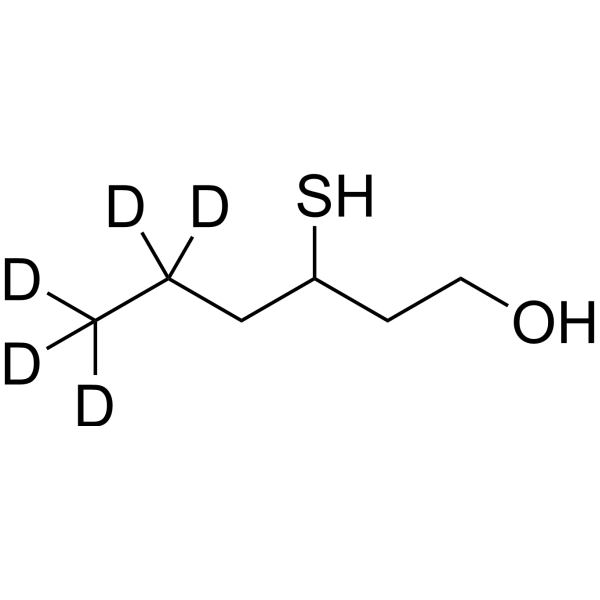 0 ImagesCat. No.: HY-W008819S2CAS No.: 3028868-82-53-Mercaptohexan-1-ol-d5 is deuterated labeled Methionol.
-
Rifapentine-d8
 0 ImagesCat. No.: HY-W739149Rifapentine-d8 is deuterium labeled Rifapentine. Rifapentine (DL 473) is an antibiotic used in tuberculosis research.
-
CER5-2’R-d9
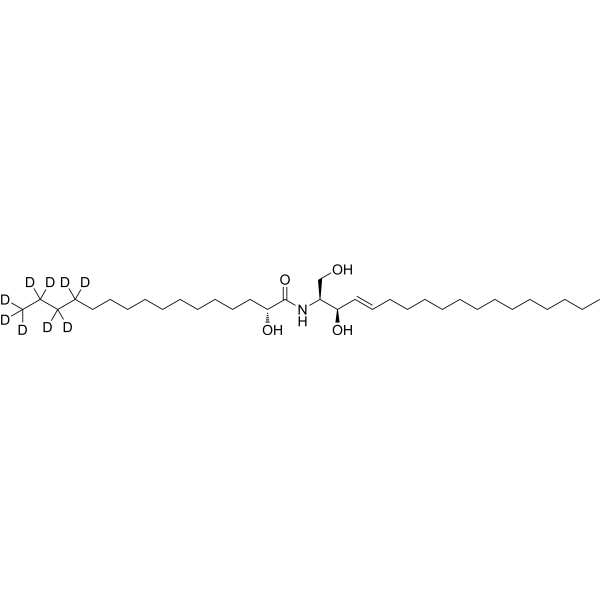 0 ImagesCER5-2’R-d9 is deuterium labeled CER5-2’R.
-
2-(2-Furanyl)-5-methylpyrazine-d3
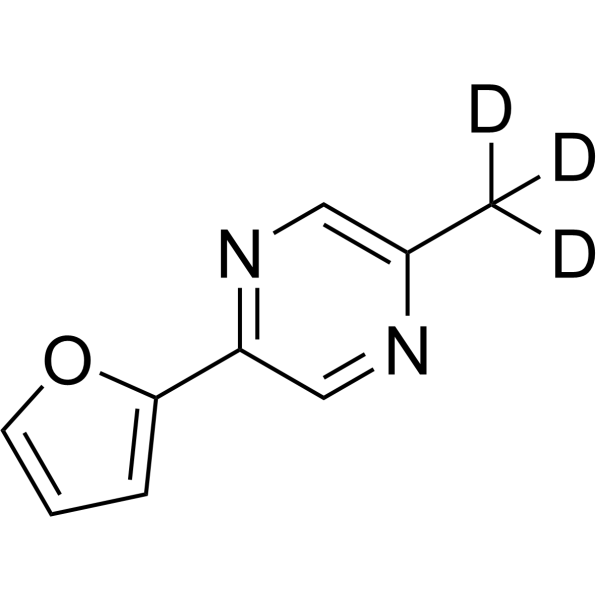 0 ImagesCat. No.: HY-156268SCAS No.: 1335402-07-72-(2-Furanyl)-5-methylpyrazine-d3 is deuterated labeled 2-(2-Furanyl)-5-methylpyrazine.
-
Ganglioside GM3-d3 ammonium
 0 ImagesCat. No.: HY-152002SCAS No.: 2692623-85-9Ganglioside GM3-d3 ammonium is a deuterated labeled Ganglioside GM3 ammonium.
-
11-(4-Nitrosopiperazin-1-yl)dibenzo[b,f][1,4]thiazepine-d8
![11-(4-Nitrosopiperazin-1-yl)dibenzo[b,f][1,4]thiazepine-d8](https://file.medchemexpress.com/product_pic/hy-w754764s.gif "Click to View 11-(4-Nitrosopiperazin-1-yl)dibenzo[b,f][1,4]thiazepine-d8 Product Detail") 0 ImagesCat. No.: HY-W754764SSynonyms: Nitroso aryl piperazine-d811-(4-Nitrosopiperazin-1-yl)dibenzo[b,f][1,4]thiazepine-d8 (Nitroso aryl piperazine-d8) is deuterium labeled Nitroso aryl piperazine.
0 ImagesCat. No.: HY-W754764SSynonyms: Nitroso aryl piperazine-d811-(4-Nitrosopiperazin-1-yl)dibenzo[b,f][1,4]thiazepine-d8 (Nitroso aryl piperazine-d8) is deuterium labeled Nitroso aryl piperazine.
-
L-Citrulline-d2
 0 ImagesCat. No.: HY-N0391S6CAS No.: 1021439-17-7L-Citrulline-d2 is the deuterium labeled L-Citrulline (HY-N0391). L-Citrulline is an amino acid derived from ornithine in the catabolism of proline or glutamine and glutamate, or from l-arginine via arginine-citrulline pathway.



