



mTOR
Mammalian target of Rapamycin
mTOR (mammalian target of Rapamycin) is a protein that in humans is encoded by the mTOR gene. mTOR is a serine/threonine protein kinase that regulates cell growth, cell proliferation, cell motility, cell survival, protein synthesis, and transcription. mTOR belongs to the phosphatidylinositol 3-kinase-related kinase protein family. mTOR integrates the input from upstream pathways, including growth factors and amino acids. mTOR also senses cellular nutrient, oxygen, and energy levels. The mTOR pathway is dysregulated in human diseases, such as diabetes, obesity, depression, and certain cancers. Rapamycin inhibits mTOR by associating with its intracellular receptor FKBP12. The FKBP12-rapamycin complex binds directly to the FKBP12-Rapamycin Binding (FRB) domain of mTOR, inhibiting its activity.
mTOR Isoform Specific Products
All Product Categories
-
mTOR Inhibitors
(516)
View all products
-
mTOR Agonists
(8)
View all products
-
mTOR Antagonist
(1)
View all products
-
mTOR Activators
(73)
View all products
-
mTOR Modulators
(16)
View all products
-
mTOR p53 Inhibitor
(1)
View all products
-
mTOR Degraders
(2)
View all products
-
mTOR Control
(1)
View all products
-
mTOR Substrate
(1)
View all products
-
mTOR Ligands
(2)
View all products
-
mTOR Related Products (660)
Related Products (660)

-
Antibodies (14)
-
mTOR Signaling Pathway
-
mTOR Isoform Comparison
-
Isoviolanthin (Standard)
 0 ImagesCat. No.: HY-N6896RCAS No.: 40788-84-9Isoviolanthin (Standard) is the analytical standard of Isoviolanthin (HY-N6896). This product is intended for research and analytical applications. Isoviolanthin is a flavonoid glycoside. Isoviolanthin can be extracted from Dendrobium officinale. Isoviolanthin has a strong affinity for binding to KDM6B, CHAC2, ESCO2, and IPO4. Isoviolanthin decreases MMP-2 and MMP-9. Isoviolanthin inhibits TGF-β/Smad and PI3K/Akt/mTOR signaling pathways. Isoviolanthin increases Fhl3 expression. Isoviolanthin has cytoprotective effects. Isoviolanthin has anticancer activity against hepatocellular carcinoma.
-
OSU-03013
 0 ImagesCat. No.: HY-122352CAS No.: 742112-34-1OSU-03013 is a Celecoxib (HY-14398) analog. OSU-03013 can promote apoptosis, up-regulate E-cadherin, and down-regulate β-catenin, c-myc, Wnt1, and N-cadherin. OSU-03013 reduces cell migration and invasion. OSU-03013 regulates both Wnt and mTOR expression to inhibit colon cancer (CC) cell proliferation. OSU-03013 can be used for CC cancer research.
-
KRAS IN-44
 0 ImagesCat. No.: HY-174379KRAS IN-44 (Compound S2C2M2) is a PDE6D degrader. KRAS IN-44 inhibits PDE6D-dependent KRAS trafficking and KRAS downstream signaling pathways. KRAS IN-44 down-regulates EGF-induced the phosphorylation of PI3K, AKT, and mTOR. KRAS IN-44 increases Apoptosis. KRAS IN-44 has antitumor activity against hepatoblastoma.
-
Deltafluorine
 0 ImagesCat. No.: HY-181020Deltafluorine is a phosphodiesterase delta (PDEδ) inhibitor with an IC50 of 27 nM, a KD of 148 nM. Deltafluorine covalently modifies the specific glutamate residue p.E88 in the ligand binding site of PDEδ, interfering with its chaperone function. Deltafluorine inhibits signaling through the MAPK and Akt-mTOR pathway, reduces ERK1/2 expression. Deltafluorine reduces tumor volume in an autochthonous mouse model of Kras-driven lung adenocarcinoma. Deltafluorine can be used for the research of lung adenocarcinoma.
-
Avicin D
 0 ImagesCat. No.: HY-N13338CAS No.: 197787-20-5Avicin D is a plant triterpenoid. Avicin D induces Autophagy by activation of AMPK. Avicin D inhibits mTOR and S6 kinase activity. Avicin D selectively induces Apoptosis and downregulates p-STAT-3, bcl-2, and Survivin. Avicin D has properties of being a selective Glucocorticoid receptor modulator. Avicin D inhibits NF-κB activation. Avicin D shows anti-tumor effects against cutaneous T-cell lymphomas.
-
COH-17
 0 ImagesCat. No.: HY-184166COH-17 is a potent mTOR inhibitor. COH-17 exhibits selective anticancer activity against breast cancer cells, showing significant anticancer effects through inhibiting mTOR, inducing apoptosis and arresting the cell cycle. COH-17 can be used for the research of breast cancer.
-
Kuwanon H (Standard)
 0 ImagesCat. No.: HY-N2600RCAS No.: 76472-87-2Kuwanon H (Standard) is the analytical standard of Kuwanon H. This product is intended for research and analytical applications. Kuwanon H is a selective non-peptide bombesin receptor antagonist and platelet activation inhibitor. Kuwanon H also acts as a specific antagonist of GRP-preferring receptors, with a Ki value of 290 nM for mouse GRP-R and 6500 nM for rat NMB-R. Kuwanon H inhibits the phosphorylation of AKT, mTOR, ERK, cPLA2 and p38, and upregulates TRIB3. It induces endoplasmic reticulum stress, apoptosis and autophagosome formation. Kuwanon H blocks calcium mobilization, mitogenic signaling, DNA synthesis, dense granule secretion, thromboxane A2 generation and integrin αIIb/β3 activity. It inhibits collagen-induced platelet aggregation and fibronectin adhesion, and delays clot retraction. Kuwanon H inhibits melanoma cell growth in vitro and in vivo, and enhances the sensitivity of melanoma cells to CDDP. It can be used in research related to melanoma, small cell lung cancer and thrombosis.
-
PUC-10
 0 ImagesCat. No.: HY-172678CAS No.: 2064126-76-5PUC-10 is a 5-HT6 receptor antagonist with a Ki of 14.6 nM and an IC50 of 32 nM. In silico predictions suggest that PUC-10 is orally active and can cross the blood-brain barrier. PUC-10 can induce autophagy in SH-SY5Y cells by inhibiting the mTOR pathway. PUC-10 can be used in the research of neurological disorders.
-
D-Glucose 6-phosphate dipotassium
 0 ImagesCat. No.: HY-112537ACAS No.: 5996-17-8D-Glucose 6-phosphate dipotassium is a key central node metabolite in glucose metabolism. It serves as the initiating metabolite for glycolysis and the pentose phosphate pathway, as well as a substrate for glycogen synthesis. D-Glucose 6-phosphate dipotassium acts as a metabolic stress signal, which activates the mTOR pathway to promote protein synthesis, especially when phosphoglucose isomerase (PGI) is inhibited, thereby participating in cardiac remodeling processes. D-Glucose 6-phosphate dipotassium can be used in research related to non-insulin-dependent diabetes mellitus and heart failure.
-
Lw13
 0 ImagesCat. No.: HY-162589Lw13 is a Hsp90 PROTAC degrader. Lw13 induces Hsp90 degradation via the ubiquitin-proteasome system, destabilizes client proteins HER2 and AKT, and blocks the activation of the HER2/AKT/mTOR signaling pathway. Lw13 inhibits the metastasis of cervical cancer cells, induces cell cycle arrest and apoptosis (apoptosis). Lw13 exerts synergistic anti-tumor activity with Cisplatin (HY-17394). Lw13 is applicable to cervical cancer-related research.
-
Carbonic anhydrase inhibitor 32
 0 ImagesCat. No.: HY-172816Carbonic anhydrase inhibitor 32 (compound 5B) is an orally active and selective hCA (Carbonic anhydrase ) II/VII inhibitor with the Ki values of 6.3 nM, 10.1 nM and 681 nM for hCA II, hCA VII and hCA I,respectively. Carbonic anhydrase inhibitor 32 shows neuroprotective and anticonvulsant potential by reducing mTOR activation, and raising hippocampus KCC2 levels.
-
OSU-53
 0 ImagesCat. No.: HY-125535CAS No.: 1290069-19-0OSU-53 is an orally active AMPK activator (EC50: 0.3 μM) and a direct mTOR inhibitor. OSU-53 induces autophagy and increases conversion of LC3 I to LC3 II. OSU-53 also modulates energy homeostasis by suppressing fatty acid biosynthesis and shifting the metabolism to oxidation by up-regulating the expression of PGC1α and NRF-1. OSU-53 has antitumor activity in various tumor models, such as breast cancer and thyroid cancer.
-
Gedatolisib-d6
 0 ImagesCat. No.: HY-10681S1Synonyms: PKI-587-d6; PF-05212384-d6Gedatolisib-d6 (PKI-587-d6) is the deuterium labeled Gedatolisib (HY-10681). Gedatolisib (PKI-587) is a highly potent dual inhibitor of PI3Kα, PI3Kγ, and mTOR with IC50s of 0.4 nM, 5.4 nM and 1.6 nM, respectively. Gedatolisib is equally effective in both complexes of mTOR, mTORC1 and mTORC2.
-
JM1-24-3
 0 ImagesCat. No.: HY-P992392JM1-24-3 is an anti-MUC18 mouse monoclonal antibody with a Kd value of 1.60e-9 M. JM1-24-3 reduces the phosphorylation levels of p-AKT (Ser473) and p-mTOR (Ser2448) in a time-dependent manner. JM1-24-3 exhibits anticancer activity against melanoma. JM1-24-3 can be used in studies related to metastatic melanoma.
-
YVPGP
 0 ImagesCat. No.: HY-P10992CAS No.: 2095286-57-8YVPGP is an oligopeptide exacted from Anthopleura anjunae. YVPGP has a significant antitumor activity by mediating PI3K/AKT/mTOR signaling pathway. YVPGP arrests DU-145 cells in the S phase and induces apoptosis via mitochondrial and death receptor pathways (caspase3, 7, 8, 9). YVPGP effectively inhibits tumor growth in DU-145 xenografts mice model, promising for prostate cancer research.
-
Levomilnacipran-d10 hydrochloride
 0 ImagesCat. No.: HY-14794ASCAS No.: 2747914-23-2Synonyms: (1S,2R)-Milnacipran-d10 hydrochloride; F2695-d10 hydrochlorideLevomilnacipran-d10 ((1S,2R)-Milnacipran-d10) hydrochloride is deuterium labeled Levomilnacipran hydrochloride (HY-B0168B). Levomilnacipran ((1S,2R)-Milnacipran) hydrochloride is the enantiomer of Milnacipran (HY-B0168) and a strong substrate of P-gp that can cross the blood-brain barrier. Levomilnacipran hydrochloride is a serotonin and norepinephrine reuptake inhibitor, with IC50 values of 10.5 nM and 19.0 nM, and Ki values of 92.2 nM and 1.2 nM for human norepinephrine transporter (NET) and serotonin transporter (SERT), respectively. Levomilnacipran hydrochloride has antidepressant and anxiolytic activities. Levomilnacipran hydrochloride can be used for the research of depression.

-
QL-IX-55
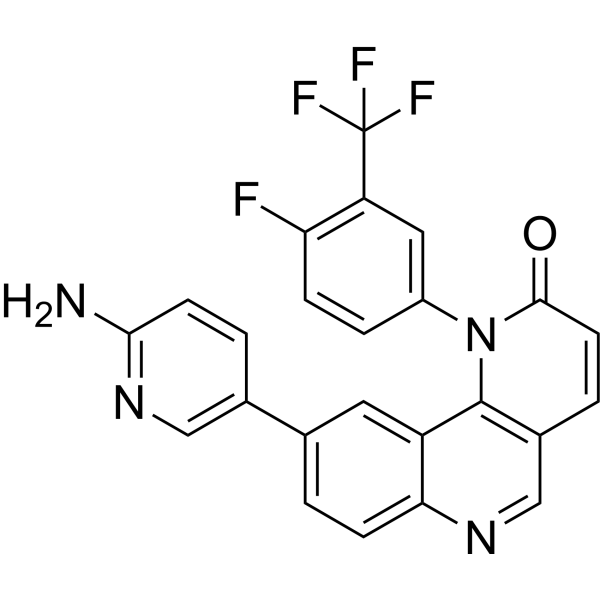 0 ImagesCat. No.: HY-15281CAS No.: 1223002-54-7QL-IX-55 is a selective ATP-competitive inhibitor of mTORC1/2 with IC50s of 50/50/10-50 nM for Human mTORC1/Yeast mTORC1/Yeast mTORC2, respectively.
-
Pertuzumab-LD3
 0 ImagesCat. No.: HY-185460Pertuzumab-LD3 is a humanized antibody-drug conjugate (ADC) targeting HER2. Pertuzumab-LD3 consists of the anti-HER2 humanized IgG1 monoclonal antibody Pertuzumab (HY-P9912), the cleavable linker Gly-Gly-Phe-Gly (HY-P3669), and the PI3K/mTOR-IN-21 (HY-185456) payload. Pertuzumab-LD3 can be used in research on metastatic HER2-positive breast cancer.
-
RMC-4998 TFA
 0 ImagesCat. No.: HY-156671BPurity: 99.02%RMC-4998 TFA is an orally active inhibitor targeting the active or GTP-bound state of the KRASG12C mutant. RMC-4998 TFA can form a ternary complex with intracellular CYPA and the activated KRASG12C mutant, with an IC50 value of 28 nM. RMC-4998 TFA can inhibit ERK signaling in KRASG12C mutant cancer cells and induce apoptosis. RMC-4998 TFA can be used for for non-small cell lung cancer (NSCLC) research.




