



mTOR
Mammalian target of Rapamycin
mTOR (mammalian target of Rapamycin) is a protein that in humans is encoded by the mTOR gene. mTOR is a serine/threonine protein kinase that regulates cell growth, cell proliferation, cell motility, cell survival, protein synthesis, and transcription. mTOR belongs to the phosphatidylinositol 3-kinase-related kinase protein family. mTOR integrates the input from upstream pathways, including growth factors and amino acids. mTOR also senses cellular nutrient, oxygen, and energy levels. The mTOR pathway is dysregulated in human diseases, such as diabetes, obesity, depression, and certain cancers. Rapamycin inhibits mTOR by associating with its intracellular receptor FKBP12. The FKBP12-rapamycin complex binds directly to the FKBP12-Rapamycin Binding (FRB) domain of mTOR, inhibiting its activity.
mTOR Isoform Specific Products
All Product Categories
-
mTOR Inhibitors
(563)
View all products
-
mTOR Agonists
(8)
View all products
-
mTOR Antagonist
(1)
View all products
-
mTOR Activators
(82)
View all products
-
mTOR Modulators
(16)
View all products
-
mTOR p53 Inhibitor
(1)
View all products
-
mTOR Degraders
(2)
View all products
-
mTOR Control
(1)
View all products
-
mTOR Substrate
(1)
View all products
-
mTOR Ligands
(2)
View all products
-
mTOR Related Products (717)
Related Products (717)

-
Antibodies (14)
-
mTOR Signaling Pathway
-
mTOR Isoform Comparison
-
mTORC1-IN-2
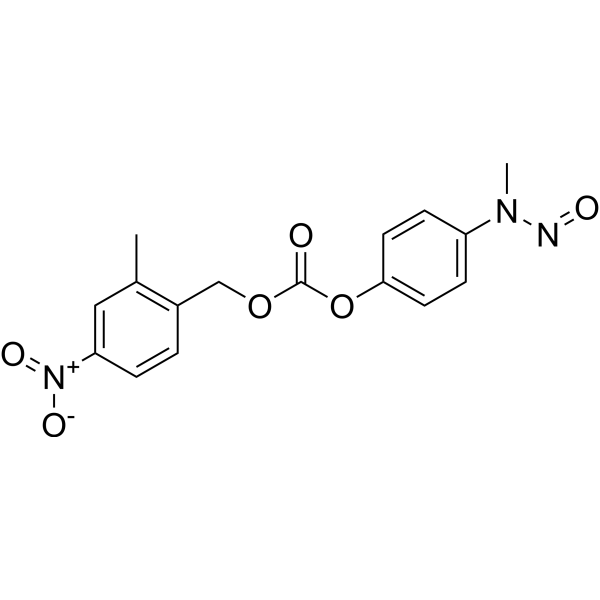 0 ImagesCat. No.: HY-155475CAS No.: 2974368-96-0
-
Guaiazulene (Standard)
 0 ImagesGuaiazulene (Standard) is the analytical standard of Guaiazulene (HY-N6951). This product is intended for research and analytical applications. Guaiazulene is a bicyclic sesquiterpene that can cross the blood-brain barrier. Guaiazulene exhibits various biological activities such as anti-inflammatory, antioxidant, hepatoprotective, antibacterial, and anti-tumor properties. Guaiazulene is also commonly used as a colorant in cosmetics. Guaiazulene shows in vitro cytotoxicity to rat neuronal cells and N2a neuroblastoma cells at high concentrations.
-
L-Proline-d4
 0 ImagesCat. No.: HY-Y0252S8L-Proline-d4 is the deuterium labeled L-Proline (HY-Y0252). L-Proline is one of the twenty amino acids used in living organisms as the building blocks of proteins.
-
Jervine hydriodide
 0 ImagesCat. No.: HY-N0836ACAS No.: 60326-37-6Synonyms: 11-Ketocyclopamine hydriodideJervine hydriodide (11-Ketocyclopamine hydriodide) is an orally active steroidal alkaloid and Hedgehog signaling pathway inhibitor. Jervine hydriodide can be isolated from Veratrum californicum. Jervine hydriodide regulates Wnt, inhibits the AKT/mTOR signaling pathway, and activates the AMPK signaling pathway. Jervine hydriodide induces DNA damage, Apoptosis, Autophagy, ROS production and Mitochondrial damage. Jervine hydriodide exhibits anti-cancer and anti-inflammatory activities. Jervine hydriodide reduces tumor growth rate and weight in xenograft models. Jervine hydriodide can be used in studies related to triple-negative breast cancer, nasopharyngeal carcinoma and non-small cell lung cancer.
-
Molephantin
 0 ImagesCat. No.: HY-N12531CAS No.: 50656-66-1Molephantin is a blood-brain barrier permeable anti-glioblastoma compound. Molephantin induces ROS generation, leading to mitochondrial damage, Mitophagy flux blockage and Apoptosis induction. Molephantin can suppress the PI3K/Akt/mTOR signaling pathway. Molephantin demonstrates antitumor effects against glioblastoma.
-
Voxtalisib (Standard)
 0 ImagesSynonyms: XL765 (Standard); SAR245409 (Standard)Voxtalisib (Standard) is the analytical standard of Voxtalisib. This product is intended for research and analytical applications. Voxtalisib (XL765) is a potent PI3K inhibitor, which has a similar activity toward class I PI3K (IC50s=39, 113, 9 and 43 nM for p110α, p110β, p110γ and p110δ, respectively), also inhibits DNA-PK (IC50=150 nM) and mTOR (IC50=157 nM). Voxtalisib (XL765) inhibits mTORC1 and mTORC2 with IC50s of 160 and 910 nM, respectively.
-
Lupenone (Standard)
 0 ImagesLupenone is an orally active lupine-type triterpenoid that can be isolated from Musa basjoo. Lupenone Lupenone plays a role through the PI3K/Akt/mTOR and NF-κB signaling pathways. Lupenone has anti-inflammatory, antiviral, antidiabetic and anticancer activities.
-
(S)-2-Amino-5,5,5-trifluoropentanoic acid
 0 ImagesCat. No.: HY-W074912CAS No.: 122565-28-0Synonyms: (S)-5,5,5-Trifluoronorvaline; H-Nva(5,5,5-triF)-OH(S)-2-Amino-5,5,5-trifluoropentanoic acid ((S)-5,5,5-Trifluoronorvaline; H-Nva (5,5,5-triF)-OH) is a selective Sestrin-GATOR2 modulator that indirectly inhibits mTORC1 activity via a competitive binding mechanism. (S)-2-Amino-5,5,5-trifluoropentanoic acid can be used in research on cancer, metabolic diseases, neurodegenerative diseases, and muscle atrophy.\n

-
PI3K/mTOR Inhibitor-2 (Standard)
 0 ImagesCat. No.: HY-111508RCAS No.: 1848242-58-9PI3K/mTOR Inhibitor-2 (Standard) is the analytical standard of PI3K/mTOR Inhibitor-2 (HY-111508). This product is intended for research and analytical applications. PI3K/mTOR Inhibitor-2 is a potent dual pan-PI3K/mTOR inhibitor with IC50s of 3.4/34/16/1 nM for PI3Kα/PI3Kβ/PI3Kδ/PI3Kγ and 4.7 nM for mTOR. Antitumor activity.
-
Aschantin
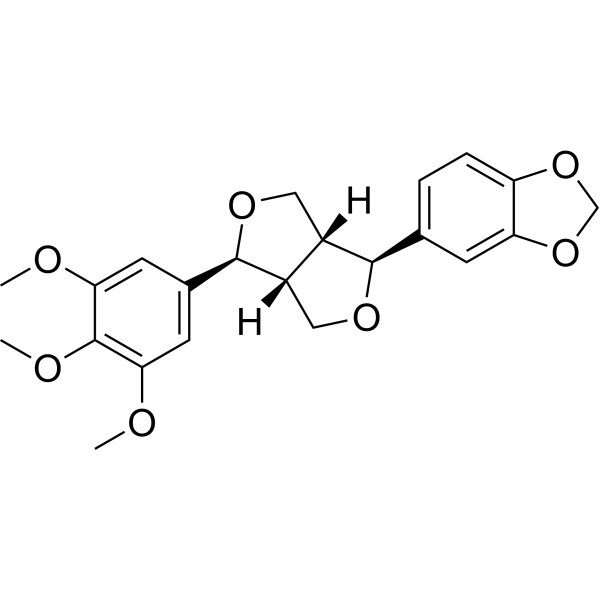 0 ImagesCat. No.: HY-N10754CAS No.: 13060-15-6Aschantin, a bisepoxylignan, can be isolated from Magnolia biondii. Aschantin has antiplasmodial, Ca2+-antagonistic, platelet activating factor-antagonistic, and chemopreventive activities. Aschantin is a mTOR kinase inhibitor. Aschantin is also an inhibitor of Cytochrome P450 and UGT enzyme.
-
Licoflavanone
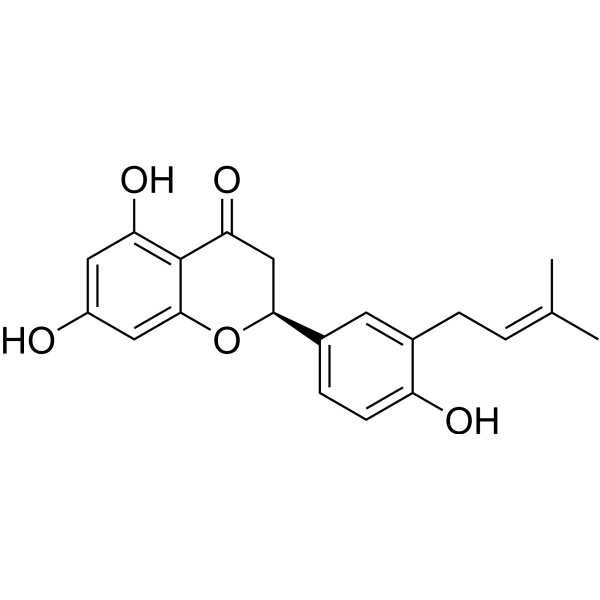 0 ImagesCat. No.: HY-N10133CAS No.: 119240-82-3Synonyms: 3′-PrenylnaringeninLicoflavanone (3′-Prenylnaringenin) is a flavanone with antioxidant, anti-inflammatory and anticancer activities. Licoflavanone can be isolated from the leaf extract of Glycyrrhiza glabra. Licoflavanone downregulates the mTOR/PI3K/AKT signaling pathway to inhibit the proliferation, migration and invasion of cancer cells, while activates Bax, Bad and multiple caspase enzymes to induce apoptosis. Its anti-inflammatory effect is manifested by reducing the nuclear translocation of NF-κB, decreasing the phosphorylation levels of p38, JNK and ERK1/2, thereby inhibiting the expression of nitric oxide, proinflammatory cytokines, COX-2 and iNOS. Licoflavanone is used in studies on nasopharyngeal carcinoma and related mechanisms.
-
PF-06465603
 0 ImagesCat. No.: HY-117923CAS No.: 1431626-44-6PF-06465603 is a highly potent and selective ATP-competitive kinase inhibitor and a class 1 PI3K and mTOR inhibitor. PF-06465603 is a metabolite of PF-04691502 with a terminal carboxylic acid structure.
-
1-Acetyl-DHAP
 0 ImagesCat. No.: HY-171229CAS No.: 2267338-53-21-Acetyl-DHA (Compound 7) is a substrate of the phosphotriesterase homology protein (PHP) and can be hydrolyzed by PHP with a kcat/km value of 100 M-1s-1. The level of 1-Acetyl-DHA is regulated by mTORC1 and is negatively correlated with the nuclear acetate level. 1-Acetyl-DHA plays an important role in cellular metabolism and the regulation of histone acetylation.
-
O6-Benzylguanine sodium
 0 ImagesCat. No.: HY-W002585ACAS No.: 100994-97-6O6-Benzylguanine sodium is an orally active, blood-brain barrier-penetrant inhibitor of O6-methylguanine-DNA methyltransferase (MGMT/AGT). O6-Benzylguanine sodium modulates p53 and its downstream p21 and cyclins to induce cell cycle arrest and apoptosis, and on the other hand activates mTORC1/MAPK and other signaling pathways to induce cellular senescence by inhibiting intracellular MGMT. O6-Benzylguanine sodium is used in research related to various tumors, cellular senescence, and vascular smooth muscle dysfunction.
-
YW3-56 hydrochloride
 0 ImagesYW3-56 (hydrochloride) is a PAD inhibitor. YW3-56 (hydrochloride) activates p53 target genes. YW3-56 (hydrochloride) activates ATF and blocks autophagy flux. YW3-56 induces ER stress through the PERK-eIF2α-ATF4 signaling cascade and inhibits the mTOR signaling. YW3-56 (hydrochloride) inhibits triple-negative breast cancer.
-
(rac)-Monepantel
 0 ImagesSynonyms: (rac)-AAD1566; (rac)-NUZ-001(rac)-Monepantel ((rac)-AAD1566) is the racemic form of Monepantel (HY-14774). Monepantel (AAD1566, NUZ-001), an antiparasitic agent, is an orally active mTOR inhibitor.

-
Methyllycaconitine citrate (Standard)
 0 ImagesCat. No.: HY-N2332ARCAS No.: 351344-10-0Synonyms: MLA citrate (Standard)Methyllycaconitine citrate (Standard) is the analytical standard of Methyllycaconitine citrate (HY-N2332A). This product is intended for research and analytical applications. Methyllycaconitine (MLA) citrate is a blood-brain barrier-permeable antagonist of α7 nicotinic acetylcholine receptor (α7nAChR) with an IC50 of 2 nM. Methyllycaconitine citrate inhibits Aβ25-35-induced autophagy by restoring the mTOR pathway, and prevents reactive oxygen species (ROS) production, microglial activation, reduced dopamine uptake, loss of dopaminergic terminals and catecholamine secretion. Methyllycaconitine citrate induces hippocampal glutamate efflux, enhances long-term potentiation, and improves memory acquisition. Methyllycaconitine citrate can be used in research related to Alzheimer's disease, cerebral palsy, ParKinson's disease and schizophrenia.
-
PP121 (Standard)
 0 ImagesCat. No.: HY-10372RCAS No.: 1092788-83-4




