



NQO2
NQO2 (quinone reductase 2, QR2) is a flavin adenine dinucleotide (FAD)-dependent oxidoreductase that catalyzes two-electron reduction of quinones and related electron acceptors, thereby participating in cellular redox regulation and quinone metabolism[1][2]. Mechanistically, NQO2 belongs to the quinone oxidoreductase family but differs from many classical reductases because it uses reduced nicotinamide derivatives such as N-ribosyldihydronicotinamide (NRH) rather than NADH or NADPH as efficient electron donors[1][3][4]. This distinctive cofactor specificity has driven interest in NQO2 as a regulator of redox biology, reactive oxygen species generation, and cellular metabolic responses[3][4]. In disease-relevant settings, altered NQO2 expression and activity have been associated with oxidative stress-related processes, neurodegeneration, learning and memory regulation, and Alzheimer’s disease-related phenotypes[5][6]. Experimental studies further indicate that genetic or pharmacological suppression of NQO2 can reduce metabolic burden and oxidative stress while improving disease-associated phenotypes in preclinical models[6]. Compared with the closely related isoform NQO1, NQO2 shares structural homology and overlapping substrate classes but exhibits fundamentally different cofactor utilization, making it an atypical oxidoreductase with distinct biological functions and regulatory properties[1][3][4]. For experimental applications, NQO2 has attracted considerable attention as a druggable target, and selective inhibitors including S29434, resveratrol-derived compounds, and other mechanism-based ligands have been developed to probe NQO2-dependent pathways and evaluate therapeutic relevance in redox-associated disorders[7][8].
References:
- [1]. Chen S, et al. Structure-function studies of DT-diaphorase (NQO1) and NRH: quinone oxidoreductase (NQO2). Free Radic Biol Med. 2000 Aug;29(3-4):276-84. [Content Brief]
- [2]. Lee MJ, et al. Time to HIV rebound after infusion of long-acting broadly neutralising antibodies 3BNC117-LS and 10-1074-LS and analytical treatment interruption (the RIO trial): a double-blind, randomised, placebo-controlled trial. Lancet HIV. 2026 May 27:S2352-3018(26)00059-7. [Content Brief]
- [3]. Islam F, et al. The Unusual Cosubstrate Specificity of NQO2: Conservation Throughout the Amniotes and Implications for Cellular Function. Front Pharmacol. 2022 Apr 20;13:838500. [Content Brief]
- [4]. Janda E, et al. Polymorphisms and Pharmacogenomics of NQO2: The Past and the Future. Genes (Basel). 2024 Jan 10;15(1):87. [Content Brief]
- [5]. Guimera AM, et al. Modelling the role of redox-related mechanisms in musculoskeletal ageing. Free Radic Biol Med. 2019 Feb 20;132:11-18. [Content Brief]
- [6]. Gould NL, et al. Specific quinone reductase 2 inhibitors reduce metabolic burden and reverse Alzheimer's disease phenotype in mice. J Clin Invest. 2023 Oct 2;133(19):e162120. [Content Brief]
- [7]. Cash JN, et al. Discovery of Small Molecules That Target the Phosphatidylinositol (3,4,5) Trisphosphate (PIP3)-Dependent Rac Exchanger 1 (P-Rex1) PIP3-Binding Site and Inhibit P-Rex1-Dependent Functions in Neutrophils. Mol Pharmacol. 2020 Mar;97(3):226-236. [Content Brief]
- [8]. Mattmann ME, et al. Potent and selective synthetic modulators of a quorum sensing repressor in Pseudomonas aeruginosa identified from second-generation libraries of N-acylated L-homoserine lactones. Chembiochem. 2011 Apr 11;12(6):942-9. [Content Brief]
-
NQO2 Related Products (5)
Related Products (5)

-
Bisindolylmaleimide III
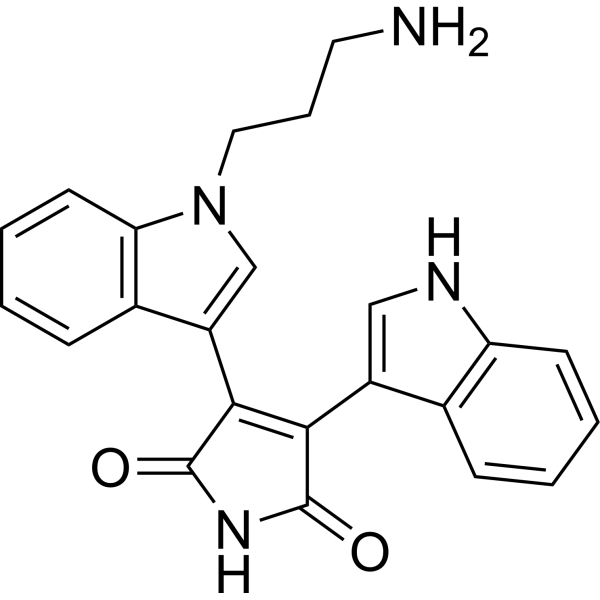 0 ImagesBisindolylmaleimide III is a protein kinase C (PKC) inhibitor with IC50 values of 0.26, 5.7, and 6 μM against PKCα, PKCδ, and PKCμ, respectively. Bisindolylmaleimide III also exhibits inhibitory activity against other off-targets, with IC50 values of 0.17, 1, and 2 μM against SLK, adenosine kinase (AK), and CDK2, respectively; its Ki for NQO2 is 16.5 μM. Bisindolylmaleimide III selectively binds to activated Rsk1 following EGF stimulation, and serves as a tool for detecting the activation status of intracellular Rsk1 and PKCα, as well as for functional analysis of SLK. Bisindolylmaleimide III can be used in studies of signal transduction and colorectal cancer.
-
threo-Guaiacylglycerol β-coniferyl ether
 0 ImagesCat. No.: HY-N9765CAS No.: 168393-18-8threo-Guaiacylglycerol β-coniferyl ether (compound 9) is a potentially active compound, but its inhibitory activity against NF-κB, nitric oxide production, aromatase, quinone reductase 2, and cyclooxygenase (COX-1/-2) is not significant. threo-Guaiacylglycerol β-coniferyl ether can be naturally extracted from the 95% ethanol extract of the whole plant of Lepisorus contortus (Christ) Ching (a plant of the Polypodiaceae family).
-
Caricotamide
 0 ImagesCat. No.: HY-W843391CAS No.: 64881-21-6Synonyms: EP-0152RCaricotamide (EP-0152R) is a coenzyme of quinone oxidoreductase 2 (NQO2). Caricotamide can efficiently induce the catalytic activity of NQO2 and enhance the anticancer activity of Tretazicar (HY-13543).
-
Bisindolylmaleimide III hydrochloride
 0 ImagesCat. No.: HY-112454CAS No.: 683775-59-9Bisindolylmaleimide III hydrochloride is a protein kinase C (PKC) inhibitor with IC50 values of 0.26, 5.7, and 6 μM against PKCα, PKCδ, and PKCμ, respectively. Bisindolylmaleimide III hydrochloride also exhibits inhibitory activity against other off-targets, with IC50 values of 0.17, 1, and 2 μM against SLK, adenosine kinase (AK), and CDK2, respectively; its Ki for NQO2 is 16.5 μM. Bisindolylmaleimide III hydrochloride selectively binds to activated Rsk1 following EGF stimulation, and serves as a tool for detecting the activation status of intracellular Rsk1 and PKCα, as well as for functional analysis of SLK. Bisindolylmaleimide III hydrochloride can be used in studies of signal transduction and colorectal cancer.
-
NQO2 activator-1
 0 ImagesCat. No.: HY-180168CAS No.: 1266401-09-5NQO2 activator-1 (Compound 1d) is a selective NQO2 activator with 20.89% increase of NQO2 activity at 10 μM. NQO2 activator-1 strongly inhibits NLRP3 inflammasome activation. NQO2 activator-1 can be used for the research of inflammation and immunology, such as rheumatoid arthritis.



