



APE1 Antibody (YA2120)
(Synonyms: APEX1; APE; APE1; APEX; APX; HAP1; REF1; DNA-(apurinic or apyrimidinic site) lyase; APEX nuclease; APEN; Apurinic-apyrimidinic endonuclease 1; AP endonuclease 1; APE-1; REF-1; Redox factor-1)
Based on 1 Customer Validation
APE1 Antibody (YA2120) is a Rabbit-derived and non-conjugated IgG monoclonal antibody, targeting to APE1.
-
Host:
Rabbit
-
Isotype:
IgG
-
Application:
WB
-
Reactivity :
Human, Mouse, Rat
-
Formulation:
Supplied in 50mM Tris-Glycine(pH 7.4), 0.15M NaCl, 40% Glycerol, 0.01% Sodium azide and 0.05% BSA
-
Conjugation:
Non-conjugated


To place orders, for customer services and technical support, please contact: MedChemExpress USA
Tel: 609-228-6898 E-mail: [email protected] [email protected]





Applications
| Application |
WB

WB: Western Blot
|
|---|---|
| Dilution Ratio | 1:500-1:1000 |


Product Details
APE1 Antibody (YA2120) is a Rabbit-derived and non-conjugated IgG monoclonal antibody, targeting to APE1.
-
Host Rabbit

-
Clonality Recombinant,Monoclonal

-
Species ReactivityHuman, Mouse, Rat
-
Observed Molecular WeightObserved band size: 36 kDa
Note: Due to possible protein modifications or aggregation, the molecular weight should be confirmed by actual measurement, and the predicted value is for reference only.

-
Calculated Molecular Weight Predicted band size: 36 kDa

Entrez Gene: 328 Human ; 11792 Mouse ; 79116 Rat
SwissProt: P27695 Human ; P28352 Mouse ; P43138 Rat
OMIM: 107748 Human
A synthetic peptide of human APE1
Endogenous
Affinity Purified
Non-conjugated
Unmodified
IgG


Product Properties
-
Appearance
Liquid
-
Formulation
Supplied in 50mM Tris-Glycine(pH 7.4), 0.15M NaCl, 40% Glycerol, 0.01% Sodium azide and 0.05% BSA
-
Concentration
Batch-dependent, Please check the COA for the concentration of each lot. Check Lot Concentration
-
Storage & Stability
Stored at -20°C for 1 year. Avoid repeated freeze / thaw cycles.
-
Shipping
Shipping with blue ice.


Verification Images
-
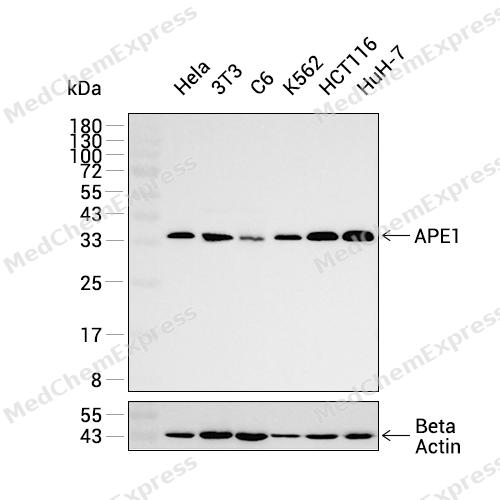 Western blot analysis was performed on extracts from Hela (lane 1, 15 μg), 3T3 (lane 2, 15 μg), C6 (lane 3, 15 μg), K562 (lane 4, 15 μg), HCT116 (lane 5, 15 μg), and HuH-7 (lane 6, 15 μg) using APE1 Rabbit mAb.Proteins were transferred to a PVDF membrane and blocked with 5% non-fat milk in TBST at 4°C overnight.The primary antibody (1:1000 dilution) and the loading control antibody (beta-Actin, HY-P83730, 1:30000 dilution) were incubated in 5% non-fat milk in TBST for 1 hour at 37°C.Goat Anti-Rabbit IgG-HRP Secondary Antibody (1:20000 dilution) was then applied for 40 minutes at 37°C.
 -
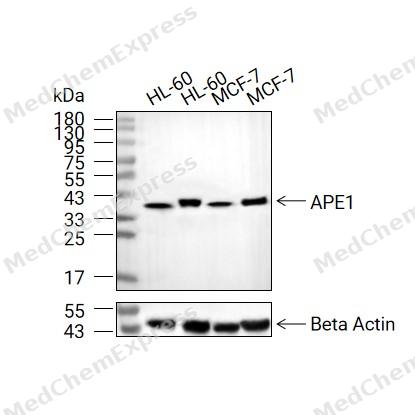 Western blot analysis of extracts from HL-60 (lane 2(20μg) and HL-60 (lane 3(40μg), MCF-7 (lane 4(20μg) and MCF-7 (lane 5(40μg) using APE1 (HY-P82375) Rabbit mAb. Proteins were transferred to a PVDF membrane and blocked with 5% non-fat milk in TBST for 2 hour at room temperature. The primary antibody (1/1000) and Loading control antibody (Beta Actin, HY-P80438, 1/10000) was used in 5% non-fat milk in TBST at 4°C overnight. Goat Anti-Rabbit IgG-HRP Secondary Antibody (1/10000) was used for 1 hour at room temperature.


Background
-
Function
APE1 multifunctional protein that plays a central role in the cellular response to oxidative stress. The two major activities of APEX1 are DNA repair and redox regulation of transcriptional factors. Functions as an apurinic/apyrimidinic (AP) endodeoxyribonuclease in the base excision repair (BER) pathway of DNA lesions induced by oxidative and alkylating agents. Initiates repair of AP sites in DNA by catalyzing hydrolytic incision of the phosphodiester backbone immediately adjacent to the damage, generating a single-strand break with 5'-deoxyribose phosphate and 3'-hydroxyl ends. Also incises at AP sites in the DNA strand of DNA/RNA hybrids, single-stranded DNA regions of R-loop structures, and single-stranded RNA molecules. Operates at switch sites of immunoglobulin (Ig) constant regions where it mediates Ig isotype class switch recombination. Processes AP sites induced by successive action of AICDA and UNG. Generates staggered nicks in opposite DNA strands resulting in the formation of double-strand DNA breaks that are finally resolved via non-homologous end joining repair pathway. Has 3'-5' exodeoxyribonuclease activity on mismatched deoxyribonucleotides at the 3' termini of nicked or gapped DNA molecules during short-patch BER. Possesses DNA 3' phosphodiesterase activity capable of removing lesions (such as phosphoglycolate and 8-oxoguanine) blocking the 3' side of DNA strand breaks. Also acts as an endoribonuclease involved in the control of single-stranded RNA metabolism. Plays a role in regulating MYC mRNA turnover by preferentially cleaving in between UA and CA dinucleotides of the MYC coding region determinant (CRD). In association with NMD1, plays a role in the rRNA quality control process during cell cycle progression. Acts as a loading factor for POLB onto non-incised AP sites in DNA and stimulates the 5'-terminal deoxyribose 5'-phosphate (dRp) excision activity of POLB. Exerts reversible nuclear redox activity to regulate DNA binding affinity and transcriptional activity of transcriptional factors by controlling the redox status of their DNA-binding domain, such as the FOS/JUN AP-1 complex after exposure to IR. Involved in calcium-dependent down-regulation of parathyroid hormone (PTH) expression by binding to negative calcium response elements (nCaREs). Together with HNRNPL or the dimer XRCC5/XRCC6, associates with nCaRE, acting as an activator of transcriptional repression. May also play a role in the epigenetic regulation of gene expression by participating in DNA demethylation. Stimulates the YBX1-mediated MDR1 promoter activity, when acetylated at Lys-6 and Lys-7, leading to drug resistance. Plays a role in protection from granzyme-mediated cellular repair leading to cell death. Binds DNA and RNA. Associates, together with YBX1, on the MDR1 promoter. Together with NPM1, associates with rRNA[1][2][3][4][5][6][7][8][9][10][11][12][13][14][15][16][17][18][19][20][21][22][23][24][25][26][27][28][29][30][31].
-
Subcellular Localization
Nucleus; Nucleus, nucleolus; Nucleus speckle; Endoplasmic reticulum; Cytoplasm; Mitochondrion
-
Expression
Induction:Up-regulated in presence of reactive oxygen species (ROS) , like bleomycin, H (2) O (2) and phenazine methosulfate -
Subunit
Monomer. Homodimer; disulfide-linked. Component of the SET complex, composed of at least APEX1, SET, ANP32A, HMGB2, NME1 and TREX1. Associates with the dimer XRCC5/XRCC6 in a DNA-dependent manner. Interacts with SIRT1; the interaction is increased in the context of genotoxic stress. Interacts with HDAC1, HDAC2 and HDAC3; the interactions are not dependent on the APEX1 acetylation status. Interacts with XRCC1; the interaction is induced by SIRT1 and increased with the APEX1 acetylated form. Interacts with NPM1 (via N-terminal domain); the interaction is RNA-dependent and decreases in hydrogen peroxide-damaged cells. Interacts (via N-terminus) with YBX1 (via C-terminus); the interaction is increased in presence of APEX1 acetylated at Lys-6 and Lys-7. Interacts with HNRNPL; the interaction is DNA-dependent. Interacts (via N-terminus) with KPNA1 and KPNA2. Interacts with TXN; the interaction stimulates the FOS/JUN AP-1 complex DNA-binding activity in a redox-dependent manner. Interacts with GZMA, KRT8, MDM2, PRDX6, PRPF19, RPLP0, TOMM20 and WDR77. Interacts with POLB (PubMed:26760506, PubMed:9207062). Binds to CDK5
-
SwissProt ID
-
Synonyms
APEX1; APE; APE1; APEX; APX; HAP1; REF1; DNA-(apurinic or apyrimidinic site) lyase; APEX nuclease; APEN; Apurinic-apyrimidinic endonuclease 1; AP endonuclease 1; APE-1; REF-1; Redox factor-1
-
Research Field
Epigenetics and Nuclear Signaling


Documentation
-
Data Sheet (259 KB)
-
SDS (252 KB)
- English - EN (252 KB)
- Français - FR (252 KB)
- Deutsch - DE (252 KB)
- Norwegian - NO (252 KB)
- Español - ES (252 KB)
- Swedish - SV (252 KB)
- Italian - IT (252 KB)
- Korean - KR (252 KB)
- Portuguese - PT (252 KB)
-
User Guide for Antibodies (1077 KB)

 Powered by Bioz
