



ATG5 Antibody (YA599)
(Synonyms: APG 5 antibody; APG 5L antibody; APG5 antibody; APG5 autophagy 5 like antibody; APG5 like antibody; APG5-like antibody; APG5L antibody; Apoptosis specific protein antibody; Apoptosis-specific protein antibody; ASP antibody; ATG 5 antibody; Atg5 antibody; ATG5 autophagy related 5 homolog antibody; ATG5_HUMAN antibody; Autophagy protein 5 antibody; Autophagy related 5 antibody; hAPG5 antibody; Homolog of S Cerevisiae autophagy 5 antibody; OTTHUMP00000040507 antibody)
Based on 1 Customer Validation
ATG5 Antibody (YA599) is a Rabbit-derived and non-conjugated IgG monoclonal antibody, targeting to ATG5.
-
Host:
Rabbit
-
Isotype:
IgG
-
Application:
WB, IHC-P, ICC/IF, IP, FC, IF-Tissue
-
Reactivity :
Human, Rat, Mouse, Monkey
-
Formulation:
Supplied in 1*TBS (pH7.4), 0.05% BSA and 40% Glycerol. Preservative: 0.05% Sodium Azide.
-
Conjugation:
Non-conjugated


To place orders, for customer services and technical support, please contact: MedChemExpress USA
Tel: 609-228-6898 E-mail: [email protected] [email protected]





Applications
| Application |
WB

WB: Western Blot
|
ICC/IF
ICC/IF: Immunocytochemistry/
Immunofluorescence |
IHC-P
IHC-P: Immunohistochemistry-Paraffin
|
IP
IP: Immunoprecipitation
|
FC
FC: Flow Cytometry
|
IF-Tissur
|
|---|---|---|---|---|---|---|
| Dilution Ratio | 1:5000-1:10000 | 1:100-1:250 | 1:2000 | 1-2 μg/sample | 1:1000 | 1:50-1:200 |


Product Details
ATG5 Antibody (YA599) is a Rabbit-derived and non-conjugated IgG monoclonal antibody, targeting to ATG5.
-
Host Rabbit

-
Clonality Recombinant,Monoclonal

-
Species ReactivityHuman, Rat, Mouse, Monkey
-
Observed Molecular WeightObserved band size: 55 kDa
Note: Due to possible protein modifications or aggregation, the molecular weight should be confirmed by actual measurement, and the predicted value is for reference only.

-
Calculated Molecular Weight Predicted band size: 32 kDa

Entrez Gene: 9474 Human ; 11793 Mouse ; 365601 Rat
SwissProt: Q9H1Y0 Human ; Q99J83 Mouse ; Q3MQ06 Rat
OMIM: 617584 Human
Synthetic peptide corresponding to Human ATG5.AA range:1-50.
Endogenous
Protein A affinity purified.
Non-conjugated
Unmodified
IgG


Product Properties
-
Appearance
Liquid
-
Formulation
Supplied in 1*TBS (pH7.4), 0.05% BSA and 40% Glycerol. Preservative: 0.05% Sodium Azide.
-
Concentration
Batch-dependent, Please check the COA for the concentration of each lot. Check Lot Concentration
-
Storage & Stability
Stored at -20°C for 1 year. Avoid repeated freeze / thaw cycles.
-
Shipping
Shipping with blue ice.


Verification Images
-
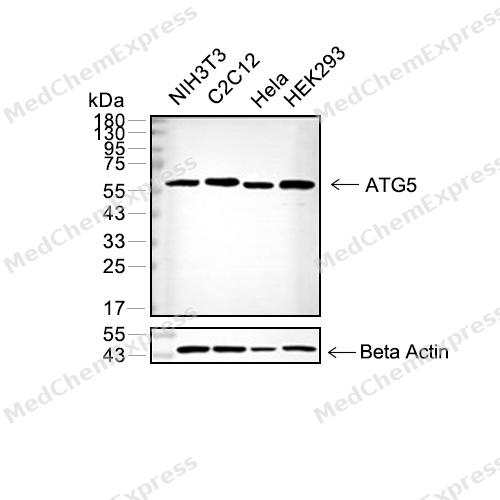 Western blot analysis of extracts from NIH3T3(lane 2(20μg) , C2C12 (lane 3(20μg), Hela (lane 4(20μg) and HEK293(lane 5(20μg) using ATG5 (HY-P80022) Rabbit mAb. Proteins were transferred to a PVDF membrane and blocked with 5% non-fat milk in TBST for 2 hour at room temperature. The primary antibody (1/1000) and Loading control antibody (Beta Actin, HY-P80438, 1/10000) was used in 5% non-fat milk in TBST at 4°C overnight. Goat Anti-Mouse IgG-HRP Secondary Antibody (1/10000) was used for 1 hour at room temperature.
 -
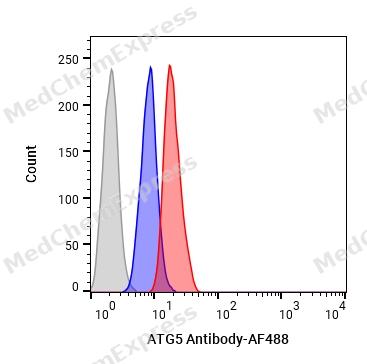 Flow cytometric analysis of 1X10⁶ HeLa cells labeling ATG5 Antibody(HY-P80022, red). Cells were fixed with 4% paraformaldehyde and permeabilised with 90% methanol. Then stained with the primary antibody at 1/1000 dilution for an hour at 4℃. AF488-conjugated Goat Anti-Rabbit IgG H&L (HY-P8002) was used as the secondary antibody at 1/1,000 dilution for 30 minutes at 4℃. Rabbit IgG Isotype Control (HY-P80879, blue) was used as the isotype control, cells without incubation with primary antibody were used as the unlabeled control (black).
 -
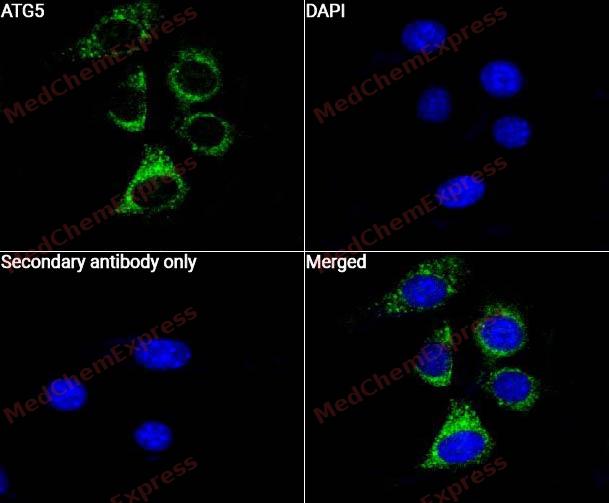 Immunocytochemistry analysis of NIH/3T3 cells labeling ATG5 with ATG5 Antibody (HY-P80022)at 1/50 dilution. Cells were fixed in 4% paraformaldehyde for 15 minutes at room temperature, permeabilized with 0.1% Triton X-100 for 10 minutes at room temperature, then blocked with QuickBlock™ Blocking Buffer for Immunol Staining for 10 min at room temperature. Cells were then incubated with ATG5 Antibody (HY-P80022) at 1/50 dilution in QuickBlock™ Blocking Buffer for Immunol Staining at 4 ℃. Alexa Fluor® 488-conjugated AffiniPure Goat Anti-Rabbit IgG H&L(HY-P8002, Green) was used as the secondary antibody at 1/1,000 dilution. PBS instead of the primary antibody was used as the secondary antibody only control. The Nuclear counterstain was DAPI (Blue).
 -
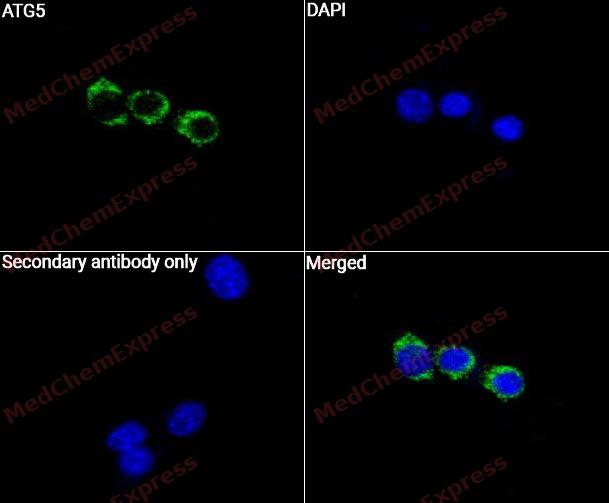 Immunocytochemistry analysis of NIH/3T3 cells labeling ATG5 with ATG5 Antibody (HY-P80022) at 1/100 dilution. Cells were fixed in 4% paraformaldehyde for 15 minutes at room temperature, permeabilized with 0.1% Triton X-100 for 10 minutes at room temperature, then blocked with QuickBlock™ Blocking Buffer for Immunol Staining for 10 min at room temperature. Cells were then incubated with ATG5 Antibody (HY-P80022) at 1/100 dilution in QuickBlock™ Blocking Buffer for Immunol Staining at 4 ℃. Alexa Fluor® 488-conjugated AffiniPure Goat Anti-Rabbit IgG H&L(HY-P8002, Green) was used as the secondary antibody at 1/1,000 dilution. PBS instead of the primary antibody was used as the secondary antibody only control. The Nuclear counterstain was DAPI (Blue).


Background
-
Function
ATG5 is involved in autophagic vesicle formation. Conjugation with ATG12, through a ubiquitin-like conjugating system involving ATG7 as an E1-like activating enzyme and ATG10 as an E2-like conjugating enzyme, is essential for its function. The ATG12-ATG5 conjugate acts as an E3-like enzyme which is required for lipidation of ATG8 family proteins and their association to the vesicle membranes. Involved in mitochondrial quality control after oxidative damage, and in subsequent cellular longevity. Plays a critical role in multiple aspects of lymphocyte development and is essential for both B and T lymphocyte survival and proliferation. Required for optimal processing and presentation of antigens for MHC II. Involved in the maintenance of axon morphology and membrane structures, as well as in normal adipocyte differentiation. Promotes primary ciliogenesis through removal of OFD1 from centriolar satellites and degradation of IFT20 via the autophagic pathway. As part of the ATG8 conjugation system with ATG12 and ATG16L1, required for recruitment of LRRK2 to stressed lysosomes and induction of LRRK2 kinase activity in response to lysosomal stress; May play an important role in the apoptotic process, possibly within the modified cytoskeleton. Its expression is a relatively late event in the apoptotic process, occurring downstream of caspase activity. Plays a crucial role in IFN-gamma-induced autophagic cell death by interacting with FADD; (Microbial infection) May act as a proviral factor. In association with ATG12, negatively regulates the innate antiviral immune response by impairing the type I IFN production pathway upon vesicular stomatitis virus (VSV) infection. Required for the translation of incoming hepatitis C virus (HCV) RNA and, thereby, for initiation of HCV replication, but not required once infection is established[1][2].
-
Subcellular Localization
Cytoplasm; Preautophagosomal structure membrane; Peripheral membrane protein
-
Expression
Tissue_specificity:It is ubiquitous. The levels of mRNA are similar in living cells and apoptotic cells, while protein expression is significantly elevated in apoptotic cells.
Induction:By apoptotic stimuli -
Subunit
Forms a conjugate with ATG12 (PubMed:11825910, PubMed:12207896, PubMed:17709747, PubMed:26812546). Part of the minor complex composed of 4 sets of ATG12-ATG5 and ATG16L1 (400 kDa); this complex interacts with ATG3 leading to disruption of ATG7 interaction and promotion of ATG8-like proteins lipidation (PubMed:24191030). Forms an 800-kDa complex composed of ATG12-ATG5 and ATG16L2 (By similarity). The ATG12-ATG5 conjugate interacts with RAB33A; this interaction is bridged by ATG16L1 and promotes ATG12-ATG5-ATG16L1 complex recruitment to phagophores (PubMed:32960676). Interacts with TECPR1; the interaction is direct and does not take place when ATG16L1 is associated with the ATG5-ATG12 conjugate (PubMed:21575909, PubMed:22342342). Interacts with DHX58/RIG-1, IFIH1/MDA5 and MAVS/IPS-1 in monomeric form as well as in ATG12-ATG5 conjugate form. The interaction with MAVS is further enhanced upon vesicular stomatitis virus (VSV) infection (PubMed:17709747). Interacts with ATG3 (PubMed:11825910, PubMed:12207896). Interacts with ATG7 and ATG10 (By similarity). Interacts with FADD (PubMed:15778222). Interacts with Bassoon/BSN; this interaction is important for the regulation of presynaptic autophagy (By similarity). Interacts with ATG16L2 (By similarity)
-
SwissProt ID
-
Synonyms
APG 5 antibody; APG 5L antibody; APG5 antibody; APG5 autophagy 5 like antibody; APG5 like antibody; APG5-like antibody; APG5L antibody; Apoptosis specific protein antibody; Apoptosis-specific protein antibody; ASP antibody; ATG 5 antibody; Atg5 antibody; ATG5 autophagy related 5 homolog antibody; ATG5_HUMAN antibody; Autophagy protein 5 antibody; Autophagy related 5 antibody; hAPG5 antibody; Homolog of S Cerevisiae autophagy 5 antibody; OTTHUMP00000040507 antibody
-
Research Field
Cell Biology


Documentation
-
Data Sheet (235 KB)
-
SDS (254 KB)
- English - EN (254 KB)
- Français - FR (254 KB)
- Deutsch - DE (254 KB)
- Norwegian - NO (254 KB)
- Español - ES (254 KB)
- Swedish - SV (254 KB)
- Italian - IT (254 KB)
- Korean - KR (254 KB)
- Portuguese - PT (254 KB)
-
User Guide for Antibodies (1077 KB)

 Powered by Bioz
