



ATG7 Antibody (YA598)
(Synonyms: hAGP7; Ubiquitin-activating enzyme E1-like protein; APG7L)
Based on 1 Customer Validation
ATG7 Antibody (YA598) is a Rabbit-derived and non-conjugated IgG monoclonal antibody, targeting to ATG7.
-
Host:
Rabbit
-
Isotype:
IgG
-
Application:
WB
-
Reactivity :
Human, Mouse, Rat
-
Formulation:
Supplied in 50 mM Tris-Glycine (pH 7.4), 0.15 M NaCl, 40% Glycerol and 0.05% BSA. Preservative: 0.01% Sodium azide
-
Conjugation:
Non-conjugated


To place orders, for customer services and technical support, please contact: MedChemExpress USA
Tel: 609-228-6898 E-mail: [email protected] [email protected]





Applications
| Application |
WB

WB: Western Blot
|
|---|---|
| Dilution Ratio | 1:500-1:1000 |


Product Details
ATG7 Antibody (YA598) is a Rabbit-derived and non-conjugated IgG monoclonal antibody, targeting to ATG7.
-
Host Rabbit

-
Clonality Recombinant,Monoclonal

-
Species ReactivityHuman, Mouse, Rat
-
Observed Molecular WeightObserved band size: 78 kDa
Note: Due to possible protein modifications or aggregation, the molecular weight should be confirmed by actual measurement, and the predicted value is for reference only.

-
Calculated Molecular Weight Predicted band size: 78 kDa

Entrez Gene: 10533 Human ; 74244 Mouse ; 312647 Rat
SwissProt: O95352 Human ; Q9D906 Mouse ; Q641Y5 Rat
OMIM: 619422 Human
Synthetic peptide corresponding to Human Apg7.The exact sequence is proprietary to MCE.
Endogenous
affinity purified
Non-conjugated
Unmodified
IgG


Product Properties
-
Appearance
Solution
-
Formulation
Supplied in 50 mM Tris-Glycine (pH 7.4), 0.15 M NaCl, 40% Glycerol and 0.05% BSA. Preservative: 0.01% Sodium azide
-
Concentration
Batch-dependent, Please check the COA for the concentration of each lot. Check Lot Concentration
-
Storage & Stability
Stored at -20°C for 1 year. Avoid repeated freeze / thaw cycles.
-
Shipping
Shipping with blue ice.


Verification Images
-
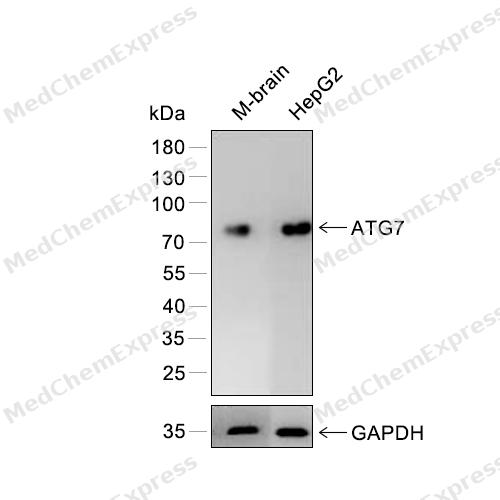 Western blot analysis of extracts from M-brain (lane 1) and HepG2 (lane 2) using ATG7 antibody. Proteins were transferred to a PVDF membrane and blocked with 5% nonfat powdered milk in PBST for 2 hour at room temperature. The primary antibody (1/1000) and loading control antibody (GAPDH, 1/3000) was diluted with 5% nonfat powdered milk in PBST at 4°C overnight. Goat Anti-Rabbit IgG-HRP Secondary Antibody (1/8,000) was incubated for 45min at room temperature.


Background
-
Function
Atg7 is a core autophagy-related protein with E1-like enzyme activity, responsible for activating and transferring Atg8 (LC3/GABARAP) family proteins to facilitate autophagosome formation. In addition to its role in classical autophagy, Atg7 is involved in immune regulation (such as LC3-associated phagocytosis, LAP), cell cycle control, apoptosis, and non-conventional protein secretion. It plays a crucial role in maintaining organelle homeostasis, removing damaged cellular components, and responding to cellular stress. Loss of Atg7 can lead to neurodegenerative diseases such as Alzheimer’s disease, Parkinson’s disease, and amyotrophic lateral sclerosis. Moreover, Atg7 can both suppress tumor development and enhance tumor cell survival under extreme conditions. Atg7 also plays a significant role in infection defense and metabolic homeostasis, with its deficiency potentially increasing the risk of infections and being associated with metabolic diseases such as type 2 diabetes and fatty liver disease. Therefore, Atg7 is a potential research target for multiple diseases[1].
-
Subcellular Localization
Cytoplasm; Preautophagosomal structure
-
Expression
Tissue_specificity:It is widely expressed, especially in the kidneys, liver, lymph nodes, and bone marrow.
Induction:Expression is up-regulated by the transcription factor HSF1 -
Isoforms & Post-Translational Modification
O95352 has 3 isomers: O95352-1: 77960 Da (predicted); O95352-2: 75002 Da (predicted); O95352-3: 68618 Da (predicted).
Acetylated by EP300;Polyubiquitinated on Lys-45 via 'Lys-63'-linked ubiquitin by TRIM32; this modification positiely regulates ATG8 and ATG12 activating enzyme activity leading to initiation of autophagy under metabolic stress -
Subunit
Homodimer (PubMed:11096062). Interacts with ATG3; this interaction is essential for the transfer of ATG8-like proteins's thioester from ATG7 to ATG3 and plays a role in the conjugation of ATG12 to ATG5 (PubMed:11825910, PubMed:26043688). Interacts with ATG12 (PubMed:11096062, PubMed:11825910). Forms intermediate conjugates with GABARAPL1 (By similarity). Forms intermediate conjugates with ATG8-like proteins such as GABARAP, GABARAPL2 or MAP1LC3A (PubMed:11096062, PubMed:16303767). Interacts with EP300 acetyltransferase (PubMed:19124466). Interacts with FOXO1 (PubMed:20543840)
-
SwissProt ID
-
Synonyms
hAGP7; Ubiquitin-activating enzyme E1-like protein; APG7L
-
Research Field
Cell Biology


Documentation
-
Data Sheet (259 KB)
-
SDS (251 KB)
- English - EN (251 KB)
- Français - FR (251 KB)
- Deutsch - DE (251 KB)
- Norwegian - NO (251 KB)
- Español - ES (251 KB)
- Swedish - SV (251 KB)
- Italian - IT (251 KB)
- Korean - KR (251 KB)
- Portuguese - PT (251 KB)
-
User Guide for Antibodies (1077 KB)
References

 Powered by Bioz
