



ATP Citrate Lyase Antibody (YA829)
(Synonyms: ACLY; ATP-citrate synthase; ATP-citrate; pro-S-)-lyase; ACL; Citrate cleavage enzyme)
Based on 1 Customer Validation
ATP Citrate Lyase Antibody (YA829) is a Mouse-derived and non-conjugated IgG2a monoclonal antibody, targeting to ATP Citrate Lyase.
-
Host:
Mouse
-
Isotype:
IgG
-
Application:
WB, ICC/IF, FC
-
Reactivity :
Human, Mouse, Monkey
-
Formulation:
Supplied in 1*PBS (pH 7.3), 50% glycerol and 0.5% BSA. Preservative: 0.02% sodium azide.
-
Conjugation:
Non-conjugated


To place orders, for customer services and technical support, please contact: MedChemExpress USA
Tel: 609-228-6898 E-mail: [email protected] [email protected]





Applications
| Application |
WB

WB: Western Blot
|
ICC/IF
ICC/IF: Immunocytochemistry/
Immunofluorescence |
FC
FC: Flow Cytometry
|
|---|---|---|---|
| Dilution Ratio | 1:500-1:1000 | 1:50-1:200 | 1:50-1:100 |


Product Details
ATP Citrate Lyase Antibody (YA829) is a Mouse-derived and non-conjugated IgG2a monoclonal antibody, targeting to ATP Citrate Lyase.
-
Host Mouse

-
Clonality Monoclonal

-
Species ReactivityHuman, Mouse, Monkey
-
Observed Molecular WeightObserved band size: 121 kDa
Note: Due to possible protein modifications or aggregation, the molecular weight should be confirmed by actual measurement, and the predicted value is for reference only.

-
Calculated Molecular Weight Predicted band size: 121 kDa

Synthetic peptide corresponding to Human ATP-Citrate Lyase.The exact sequence is proprietary to MCE.
Endogenous
affinity purified
Non-conjugated
Unmodified
IgG


Product Properties
-
Appearance
Solution
-
Formulation
Supplied in 1*PBS (pH 7.3), 50% glycerol and 0.5% BSA. Preservative: 0.02% sodium azide.
-
Concentration
Batch-dependent, Please check the COA for the concentration of each lot. Check Lot Concentration
-
Storage & Stability
Stored at -20°C for 1 year. Avoid repeated freeze / thaw cycles.
-
Shipping
Shipping with blue ice.


Verification Images
-
 Western blot analysis was performed on protein extracts (25 μg) from NIH/3T3 (lane 2), HeLa (lane 3), A549 (lane 4), K562 (lane 5), Jurkat (lane 6, Negative), 293T (lane 7) and HepG2 (lane 8) using ATP Citrate Lyase antibody. Proteins were transferred onto a 0.45 μm PVDF membrane using the Trans-Blot® Turbo™ system for 13 min. The membrane was then blocked with 5% nonfat milk in TBST (HY-K1025) for 1 h at room temperature. The primary antibody (1:1000) and loading control antibody GAPDH Antibody (HRP) (HY-P80954A) (1:5000) were diluted in 5% nonfat milk in TBST and incubated with the membrane overnight at 4°C. After washing, the membrane of primary antibody was incubated with HRP-conjugated goat anti-rabbit/mouse IgG secondary antibody (HY-P8001/HY-P8004) (1:5000) diluted in 5% nonfat milk in TBST for 1 h at room temperature. Protein bands were visualized using an Ultra High Sensitivity ECL detection kit (HY-K1005).
 -
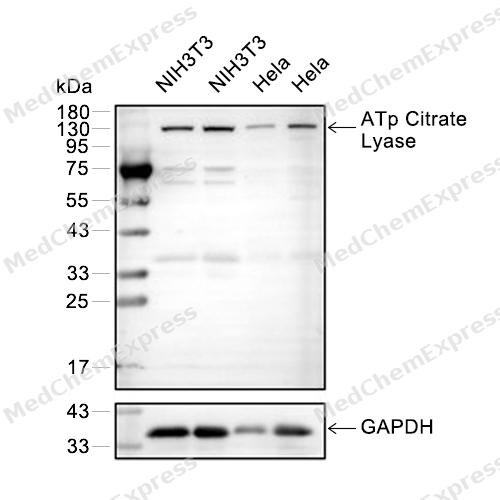 Western blot analysis of extracts from NIH3T3(lane 2(20μg) or lane 3(40μg) ) and Hela(lane 4(20μg) or lane 5(40μg) ) using ATP Citrate Lyase(HY-P80560) Mouse mAb. Proteins were transferred to a PVDF membrane and blocked with 5% BSA in TBST for 2 hour at room temperature. The primary antibody (HY-P80560, 1/1000) and Loading control antibody (GAPDH, HY-P80954, 1/3000) was used in 5% BSA in TBST at 4°C overnight. Goat Anti-Mouse IgG-HRP Secondary Antibody (HY-P8004, 1/10,000) was used for 1 hour at room temperature.
 -
 Immunocytochemistry analysis of Hela cells labeling ATP Citrate Lyase with ATP Citrate Lyase Antibody (HY-P80560) at 1/100 dilution. Cells were fixed in 4% paraformaldehyde for 15 minutes at room temperature, permeabilized with 0.1% Triton X-100 in PBS for 15 minutes at room temperature, then blocked with quick block buffer for 10 minutes at room temperature. Cells were then incubated with ATP Citrate Lyase Antibody (HY-P80560) at 1/100 dilution in quick block buffer overnight at 4 ℃.AF488-conjugated Goat Anti-Mouse IgG H&L (HY-P8005, Green) was used as the secondary antibody at 1/1,000 dilution. PBS instead of the primary antibody was used as the secondary antibody only control. The Nuclear counterstain was DAPI (Blue).
 -
 Immunocytochemistry analysis of U2OS cells labeling ATP Citrate Lyase with ATP Citrate Lyase Antibody (HY-P80560) at 1/100 dilution. Cells were fixed in 4% paraformaldehyde for 15 minutes at room temperature, permeabilized with 0.1% Triton X-100 in PBS for 15 minutes at room temperature, then blocked with quick block buffer for 10 minutes at room temperature. Cells were then incubated with ATP Citrate Lyase Antibody (HY-P80560) at 1/100 dilution in quick block buffer overnight at 4 ℃.AF488-conjugated Goat Anti-Mouse IgG H&L (HY-P8005, Green) was used as the secondary antibody at 1/1,000 dilution. PBS instead of the primary antibody was used as the secondary antibody only control. The Nuclear counterstain was DAPI (Blue).
 -
 Flow cytometric analysis of 1X10⁶ HeLa cells labeling ATP Citrate Lyase Antibody (HY-P80560, red). Cells were fixed with 4% paraformaldehyde and permeabilised with 90% methanol. Then stained with the primary antibody at 1/100 dilution for an hour at 4℃. AF488-conjugated Goat Anti-Mouse IgG H&L (HY-P8005) was used as the secondary antibody at 1/1,000 dilution for 30 minutes at 4℃. Mouse IgG Isotype Control (HY-P80757, blue) was used as the isotype control, cells without incubation with primary antibody were used as the unlabeled control (black).


Background
-
Function
ATP-citrate lyase (ACLY) is a central metabolic enzyme and catalyses the ATP-dependent conversion of citrate and coenzyme A (CoA) to oxaloacetate and acetyl-CoA. The acetyl-CoA product is crucial for the metabolism of fatty acids, the biosynthesis of cholesterol, and the acetylation and prenylation of proteins. Acetyl CoA is also required for acetylation reactions that modify proteins, such as histone acetylation. ACLY is upregulated or activated in several types of cancers, and its inhibition is known to induce proliferation arrest in cancer cells both in vitro and in vivo.
ACLY links glucose and lipid metabolism by catalyzing the formation of acetyl-CoA and oxaloacetate from citrate produced by glycolysis in the presence of ATP and CoA. ACLY is aberrantly expressed in many immortalized cells and tumors, such as breast, liver, colon, lung and prostate cancers, and is correlated reversely with tumor stage and differentiation, serving as a negative prognostic marker. ACLY is an upstream enzyme of the long chain fatty acid synthesis, providing acetyl-CoA as an essential component of the fatty acid synthesis. Therefore, ACLY is a key enzyme of cellular lipogenesis and potent target for cancer therapy.
-
Subcellular Localization
Cytoplasm, cytosol
-
Isoforms & Post-Translational Modification
P53396 has 3 isomers: P53396-1: 120839 Da (predicted); P53396-2: 119772 Da (predicted); P53396-3: 91099 Da (predicted).
Phosphorylated by PKA and GSK3 in a sequential manner; phosphorylation results in activation of its activity (PubMed:10653665). Phosphorylation on Thr-447 and Ser-451 depends on the phosphorylation state of Ser-455 (By similarity). Phosphorylation on Ser-455 is decreased by prior phosphorylation on the other 2 residues (By similarity). Phosphorylated at Ser-455 by BCKDK and dephosphorylated by protein phosphatase PPM1K;ISGylated;Acetylated at Lys-540, Lys-546 and Lys-554 by KAT2B/PCAF (PubMed:23932781). Acetylation is promoted by glucose and stabilizes the protein, probably by preventing ubiquitination at the same sites (PubMed:23932781). Acetylation promotes de novo lipid synthesis (PubMed:23932781). Deacetylated by SIRT2;Ubiquitinated at Lys-540, Lys-546 and Lys-554 by the BCR(KLHL25) E3 ubiquitin ligase complex and UBR4, leading to its degradation (PubMed:23932781, PubMed:27664236, PubMed:34491895). Ubiquitination is probably inhibited by acetylation at same site (PubMed:23932781). BCR(KLHL25)-mediated degradation of ACLY promotes fatty acid oxidation and is required for differentiation of inducible regulatory T (iTreg) cells (PubMed:34491895) -
Subunit
Homotetramer
-
SwissProt ID
-
Synonyms
ACLY; ATP-citrate synthase; ATP-citrate; pro-S-)-lyase; ACL; Citrate cleavage enzyme
-
Research Field
Signal Transduction


Documentation
-
Data Sheet (234 KB)
-
SDS (251 KB)
- English - EN (251 KB)
- Français - FR (251 KB)
- Deutsch - DE (251 KB)
- Norwegian - NO (251 KB)
- Español - ES (251 KB)
- Swedish - SV (251 KB)
- Italian - IT (251 KB)
- Korean - KR (251 KB)
- Portuguese - PT (251 KB)
-
User Guide for Antibodies (1077 KB)

 Powered by Bioz
