



Caspase 11 Antibody (YA562)
(Synonyms: Caspl; ich-3; CASP-4; Casp11; CASP-11)Based on 1 publication(s) in Google Scholar
Caspase 11 Antibody (YA562) is a Rabbit-derived and non-conjugated IgG monoclonal antibody, targeting to Caspase 11.
-
Host:
Rabbit
-
Isotype:
IgG
-
Application:
WB, IP
-
Reactivity :
Human, Mouse, Rat
-
Formulation:
Supplied in 50 mM Tris-Glycine (pH 7.4), 0.15 M NaCl, 40% Glycerol and 0.05% BSA. Preservative: 0.01% Sodium azide
-
Conjugation:
Non-conjugated


To place orders, for customer services and technical support, please contact: MedChemExpress USA
Tel: 609-228-6898 E-mail: [email protected] [email protected]



Publications Citing Use of MedChemExpress (MCE) Caspase 11 Antibody (YA562)
More

Applications
| Application |
WB

WB: Western Blot
|
IP
IP: Immunoprecipitation
|
|---|---|---|
| Dilution Ratio | 1:500-1:1000 | 1:20 |


Product Details
Caspase 11 Antibody (YA562) is a Rabbit-derived and non-conjugated IgG monoclonal antibody, targeting to Caspase 11.
-
Host Rabbit

-
Clonality Recombinant,Monoclonal

-
Species ReactivityHuman, Mouse, Rat
-
Observed Molecular WeightObserved band size: 43,38,25 kDa
Note: Due to possible protein modifications or aggregation, the molecular weight should be confirmed by actual measurement, and the predicted value is for reference only.

-
Calculated Molecular Weight Predicted band size: 43 kDa

Entrez Gene: 839 Human ; 12363 Mouse
SwissProt: P55212 Human ; P70343 Mouse
Synthetic peptide corresponding to Mouse Caspase-11.The exact sequence is proprietary to MCE.
Endogenous
affinity purified
Non-conjugated
Unmodified
IgG


Product Properties
-
Appearance
Solution
-
Formulation
Supplied in 50 mM Tris-Glycine (pH 7.4), 0.15 M NaCl, 40% Glycerol and 0.05% BSA. Preservative: 0.01% Sodium azide
-
Concentration
Batch-dependent, Please check the COA for the concentration of each lot. Check Lot Concentration
-
Storage & Stability
Stored at -20°C for 1 year. Avoid repeated freeze / thaw cycles.
-
Shipping
Shipping with blue ice.


Publications (1)
-
Journal Impact Factor
-
Most Recent
-
Transbound Emerg Dis
2026 Feb 11:2026:4436022. PMID: 41693732


Verification Images
-
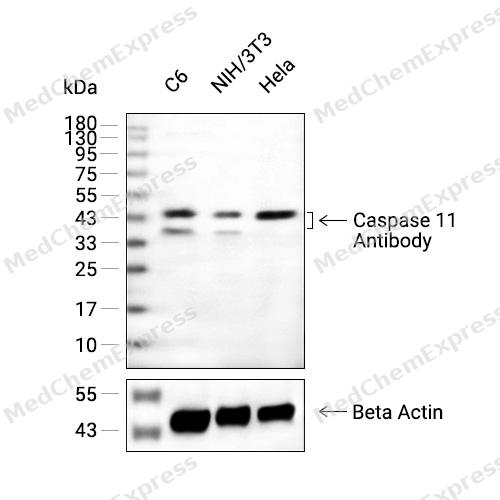 Western blot analysis of extracts from C6(lane 2(20μg) ,NIH/3T3(lane 3(20μg) and Hela(lane 4(20ug)using Caspase 11 Antibody (HY-P80588) Rabbit mAb. Proteins were transferred to a PVDF membrane and blocked with 5% non-fat milk in TBST for 2 hour at room temperature. The primary antibody (1/1000) and Loading control antibody (Beta Actin, HY-P80438, 1/10000) was used in 5% non-fat milk in TBST at 4°C overnight. Goat Anti-Mouse/Rabbit IgG-HRP Secondary Antibody (1/10000) was used for 1 hour at room temperature.


Background
-
Function
Caspase-11 is a murine inflammatory caspase that drives the noncanonical inflammasome response to cytosolic lipopolysaccharide (LPS) from Gram-negative bacteria[1][2]. Mechanistically, activated caspase-11 cleaves gasdermin D (GSDMD), producing an N-terminal fragment that promotes pyroptosis, IL-1β maturation, and lethal LPS responses[1]. In intestinal epithelial defense, caspase-11 deficiency increases Salmonella Typhimurium epithelial colonization, while human caspase-4 depletion similarly increases bacterial colonization in polarized epithelial monolayers[3]. In kidney injury models, caspase-11/GSDMD signaling promotes tubular epithelial pyroptosis, urinary IL-18 excretion, renal functional deterioration, and podocyte injury under diabetic or acute injury conditions[4][5]. Compared with canonical inflammasomes that activate caspase-1 through NLR or PYHIN sensors, caspase-11 and human caspase-4/5 act as noncanonical intracellular LPS sensors[2][6]. For experimental applications, cardiolipin selectively blocks caspase-4/11-dependent cell death by preventing LPS binding, while maclurin suppresses caspase-11 and GSDMD activation in macrophages and improves acute lethal sepsis outcomes in mice[7][8].
-
Subcellular Localization
Cytoplasm, cytosol; Cytoplasm; Endoplasmic reticulum membrane; Peripheral membrane protein; Cytoplasmic side; Mitochondrion; Inflammasome; Secreted
-
Expression
Tissue_specificity:Widely expressed, including in thymus, lung and spleen (at protein level) . Very low levels, if any, in the brain
Induction:Up-regulated by LPS and E.coli (PubMed:10986288, PubMed:22002608, PubMed:26375259, PubMed:8702803) . In LPS-induced lung inflammation, markedly up-regulated after 6 hours of treatment and decreases at 24 hours. The induction is dependent upon DDIT3/CHOP-mediated ER stress (at protein level) (PubMed:16670335) . In the spleen and in bone marrow-derived macrophages, up-regulated by poly (I:C) , a synthetic analog of double-stranded RNA (at protein level) (PubMed:26320999, PubMed:26375259) . Also induced by IFNG and interferon-alpha. Up-regulated by R848, a TLR7 synthetic activator, and Pam3CysK4, a synthetic activator of TLR1/TLR2 (PubMed:26375259) -
Isoforms & Post-Translational Modification
P70343 has 2 isomers: P70343-1: 42742 Da (predicted); P70343-2: 13746 Da (predicted).
In response to activation signals, undergoes autoproteolytic cleavage and activation;(Microbial infection) ADP-riboxanation by S.flexneri OspC3 blocks CASP4 autoprocessing, preventing CASP4 activation and ability to recognize and cleave GSDMD, thereby thwarting the inflammasome/pyroptosis-mediated defense -
Subunit
Heterotetramer that consists of two anti-parallel arranged heterodimers, each one formed by a 20 kDa (Caspase-4 subunit p20) and a 10 kDa (Caspase-4 subunit p10) subunit (PubMed:32109412). Upon direct LPS-binding, forms large homooligomers, resulting in its activation (PubMed:25119034). These oligomers are often referred to as 'non-canonical inflammasomes' (PubMed:25119034). In its precursor form, interacts with TMEM214; this interaction is required for association with the endoplasmic reticulum membrane (By similarity). Interacts with CASP1 (By similarity). Interacts with NOD2 (By similarity). Interacts with Serpinb1a, Serpinb1b and Serpinb1c; these interactions regulate CASP4 activity (By similarity)
-
SwissProt ID
-
Synonyms
Caspl; ich-3; CASP-4; Casp11; CASP-11
-
Research Field
Cell Biology
Documentation
-
Data Sheet (262 KB)
-
SDS (251 KB)
- English - EN (251 KB)
- Français - FR (251 KB)
- Deutsch - DE (251 KB)
- Norwegian - NO (251 KB)
- Español - ES (251 KB)
- Swedish - SV (251 KB)
- Italian - IT (251 KB)
- Korean - KR (251 KB)
- Portuguese - PT (251 KB)
-
User Guide for Antibodies (1077 KB)
References
[1]. Kayagaki N, et al. Caspase-11 cleaves gasdermin D for non-canonical inflammasome signalling. Nature. 2015 Oct 29;526(7575):666-71. [Content Brief]
[2]. Yi YS. Caspase-11 non-canonical inflammasome: a critical sensor of intracellular lipopolysaccharide in macrophage-mediated inflammatory responses. Immunology. 2017 Oct;152(2):207-217. doi: 10.1111/imm.12787. Epub 2017 Jul 31. PMID: 28695629; PMCID: PMC5588777. et al. Caspase-11 non-canonical inflammasome: a critical sensor of intracellular lipopolysaccharide in macrophage-mediated inflammatory responses. Immunology. 2017 Oct;152(2):207-217. [Content Brief]
[3]. Knodler LA, et al. Noncanonical inflammasome activation of caspase-4/caspase-11 mediates epithelial defenses against enteric bacterial pathogens. Cell Host Microbe. 2014 Aug 13;16(2):249-256. [Content Brief]
[4]. Miao N, et al. The cleavage of gasdermin D by caspase-11 promotes tubular epithelial cell pyroptosis and urinary IL-18 excretion in acute kidney injury. Kidney Int. 2019 Nov;96(5):1105-1120. [Content Brief]
[5]. Cheng Q, et al. Caspase-11/4 and gasdermin D-mediated pyroptosis contributes to podocyte injury in mouse diabetic nephropathy. Acta Pharmacol Sin. 2021 Jun;42(6):954-963. [Content Brief]
[6]. Wu J, et al. Pyroptosis by caspase-11 inflammasome-Gasdermin D pathway in autoimmune diseases. Pharmacol Res. 2021 Mar;165:105408. [Content Brief]
[7]. Pizzuto M, et al. Cardiolipin inhibits the non-canonical inflammasome by preventing LPS binding to caspase-4/11. EMBO J. 2025 Aug;44(16):4419-4442. [Content Brief]
[8]. Joon Lee D, et al. Maclurin inhibits caspase-11 non-canonical inflammasome in macrophages and ameliorates acute lethal sepsis in mice. Int Immunopharmacol. 2024 Mar 10;129:111615. [Content Brief]

 Powered by Bioz
