



Caspase 1 Antibody
(Synonyms: CASP1; IL1BC; IL1BCE; Caspase-1; CASP-1; Interleukin-1 beta convertase; IL-1BC; Interleukin-1 beta-converting enzyme; ICE; IL-1 beta-converting enzyme; p45)Based on 5 publication(s) in Google Scholar
Caspase 1 Antibody is a Rabbit-derived and non-conjugated IgG polyclonal antibody, targeting to Caspase 1.
-
Host:
Rabbit
-
Isotype:
IgG
-
Application:
WB, IHC-P, ELISA
-
Reactivity :
Human, Mouse, Rat
-
Formulation:
Supplied in 1*PBS (pH 7.3), 50% glycerol and 0.5% BSA. Preservative: 0.02% sodium azide.
-
Conjugation:
Non-conjugated


To place orders, for customer services and technical support, please contact: MedChemExpress USA
Tel: 609-228-6898 E-mail: [email protected] [email protected]



-

HY-P80246
NLRP3 Antibody (YA266) -
HY-P80622
Cleaved-Caspase-1 Antibody -
HY-P80720
IL-1 beta Antibody -
HY-P80548
TMS1/ASC Antibody -
HY-P8001
HRP-conjugated Goat Anti-Rabbit IgG H&L -
HY-N0830
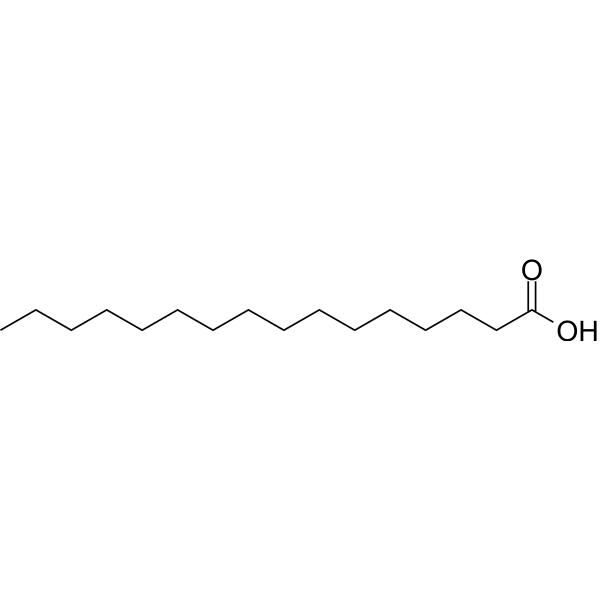
Palmitic acidEndogenous Metabolite -

HY-K0021
Phosphatase Inhibitor Cocktail I (100× in DMSO) -
HY-P81232
Caspase-1 Antibody -
HY-P80046
Caspase-3 Antibody (YA557) -
HY-P80468
Phospho-MLKL (Ser345) Antibody (YA174) -
HY-P80116
EGFR Antibody (YA468) -
HY-P80721
IL18 Antibody (YA344)
Publications Citing Use of MedChemExpress (MCE) Caspase 1 Antibody
More
 5 Publications Citing Use of MCE Caspase 1 Antibody (7)
-
WB
-
WB

-
WB
-
WB

-
IHC


Applications
| Application |
WB

WB: Western Blot
|
IHC-P
IHC-P: Immunohistochemistry-Paraffin
|
ELISA
ELISA: Enzyme Linked Immunosorbent Assay
|
|---|---|---|---|
| Dilution Ratio | 1:500-1:1000 | 1:50-1:100 | 1:10000 |


Product Details
Caspase 1 Antibody is a Rabbit-derived and non-conjugated IgG polyclonal antibody, targeting to Caspase 1.
-
Host Rabbit

-
Clonality Polyclonal

-
Species ReactivityHuman, Mouse, Rat
-
Observed Molecular WeightObserved band size: 45 kDa
Note: Due to possible protein modifications or aggregation, the molecular weight should be confirmed by actual measurement, and the predicted value is for reference only.

-
Calculated Molecular Weight Predicted band size: 45 kDa

Synthetic peptide corresponding to Human Caspase 1.AA range:342-391
Endogenous
affinity purified
Non-conjugated
Unmodified
IgG


Product Properties
-
Appearance
Solution
-
Formulation
Supplied in 1*PBS (pH 7.3), 50% glycerol and 0.5% BSA. Preservative: 0.02% sodium azide.
-
Concentration
Batch-dependent, Please check the COA for the concentration of each lot. Check Lot Concentration
-
Storage & Stability
Stored at -20°C for 1 year. Avoid repeated freeze / thaw cycles.
-
Shipping
Shipping with blue ice.


Publications (5)
-
Journal Impact Factor
-
Most Recent
-
J Transl Med
Single-cell transcriptomic analysis reveals characteristic feature of macrophage reprogramming in liver Mallory-Denk bodies pathogenesis. [Abstract]2025 Jan 16;23(1):77. PMID: 39819676
Caspase 1 Antibody purchased from MedChemExpress. Usage Cited in: J Transl Med. 2025 Jan 16;23(1):77. [Abstract]
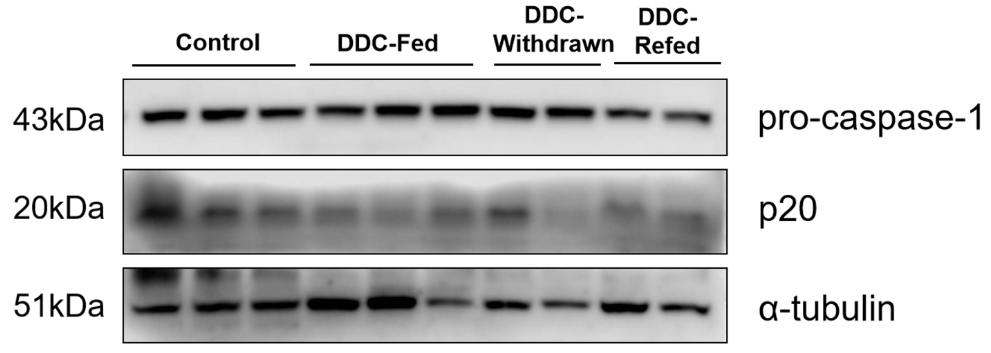
Immunoblot analysis of pro-Caspase-1 and cleaved-caspase-1 in total lysates from liver tissue of Control, DDC-Fed, DDC-Withdrawn, and DDC-Refed mice.
Caspase 1 Antibody purchased from MedChemExpress. Usage Cited in: J Transl Med. 2025 Jan 16;23(1):77. [Abstract]
In the co-culture system without LPS priming, Western blot analysis revealed increased protein levels of NLRP3 and pro-caspase-1 in macrophages.
-
J Med Chem
Discovery of Potent, Specific, and Orally Available NLRP3 Inflammasome Inhibitors Based on Pyridazine Scaffolds for the Treatment of Septic Shock and Peritonitis. [Abstract]2024 Sep 12;67(17):15711-15737. PMID: 39169676
Caspase 1 Antibody purchased from MedChemExpress. Usage Cited in: J Med Chem. 2024 Sep 12;67(17):15711-15737. [Abstract]
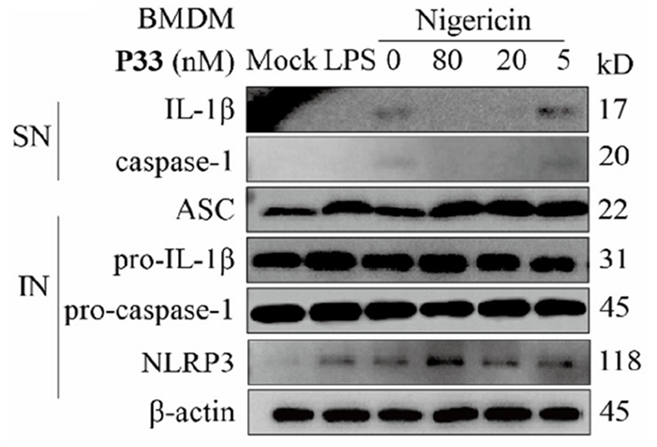
The levels of IL-1β and caspase-1 in culture supernatants (SN), and NLRP3, pro-caspase-1, pro-IL-1β, and ASC in cells extracts (Input) of BMDMs cells were analyzed by Western blot.
-
Immunology
BDNF is a prognostic biomarker involved in immune infiltration of lung adenocarcinoma and is associated with brain metastasis. [Abstract]2023 Feb;168(2):320-330. PMID: 36151890 -
ACS Pharmacol Transl Sci
Silibinin Targeting Heat Shock Protein 90 Represents a Novel Approach to Alleviate Nonalcoholic Fatty Liver Disease by Simultaneously Lowering Hepatic Lipotoxicity and Enhancing Gut Barrier Function. [Abstract]2024 Jul 1;7(7):2110-2124. PMID: 39022366
Caspase 1 Antibody purchased from MedChemExpress. Usage Cited in: ACS Pharmacol Transl Sci. 2024 Jul 1;7(7):2110-2124. [Abstract]
(A) Expression levels and (B−F) semiquantitative analysis of Hsp90α, Hsp90β, NLRP3, ASC, and caspase-1 in HFD-fed mice.
Caspase 1 Antibody purchased from MedChemExpress. Usage Cited in: ACS Pharmacol Transl Sci. 2024 Jul 1;7(7):2110-2124. [Abstract]
Representative immunohistochemical images of the intensity of Hsp90α, Hsp90β, NLRP3, and caspase-1 in colon sections.
-
Exp Cell Res
Exosomes derived from diabetic microenvironment-preconditioned mesenchymal stem cells ameliorate nonalcoholic fatty liver disease and inhibit pyroptosis of hepatocytes. [Abstract]2024 Nov 7;443(2):114325. PMID: 39521106
Caspase 1 Antibody purchased from MedChemExpress. Usage Cited in: Exp Cell Res. 2024 Nov 7;443(2):114325. [Abstract]
The level of Caspase-1 Pro tended to decrease after MSC-Exos, pMSC-Exos, and MCC950 co-culture, and that of Caspase-1 p20, the active form of Caspase-1, decreased significantly after pMSC-Exos and MCC950 co-culture.

Caspase 1 Antibody purchased from MedChemExpress. Usage Cited in: Exp Cell Res. 2024 Nov 7;443(2):114325. [Abstract]
The expression of GSDMD-NT and Caspase-1 p20 increased significantly in the pMSC-Exos + PRDX-1-IN-1 group according to WB results in MSCs(mesenchymal stem cells).


Verification Images
-
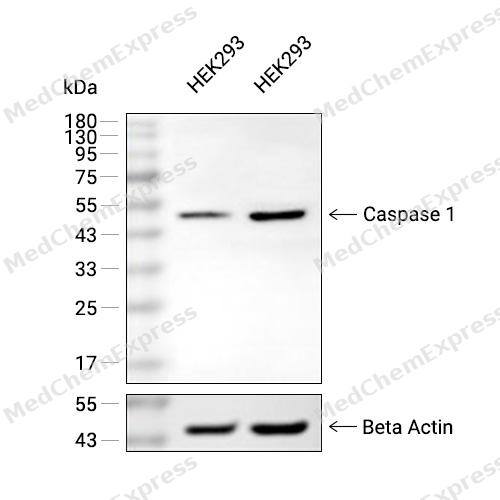 Western blot analysis of extracts from HEK293 (lane 2(20μg) and HEK293(lane 3(40μg) using Caspase 1 (HY-P80587) Rabbit mAb. Proteins were transferred to a PVDF membrane and blocked with 5% non-fat milk in TBST for 2 hour at room temperature. The primary antibody (1/1000) and Loading control antibody (Beta Actin, HY-P80438, 1/10000) was used in 5% non-fat milk in TBST at 4°C overnight. Goat Anti-Mouse/Rabbit IgG-HRP Secondary Antibody (1/10000) was used for 1 hour at room temperature.
 -
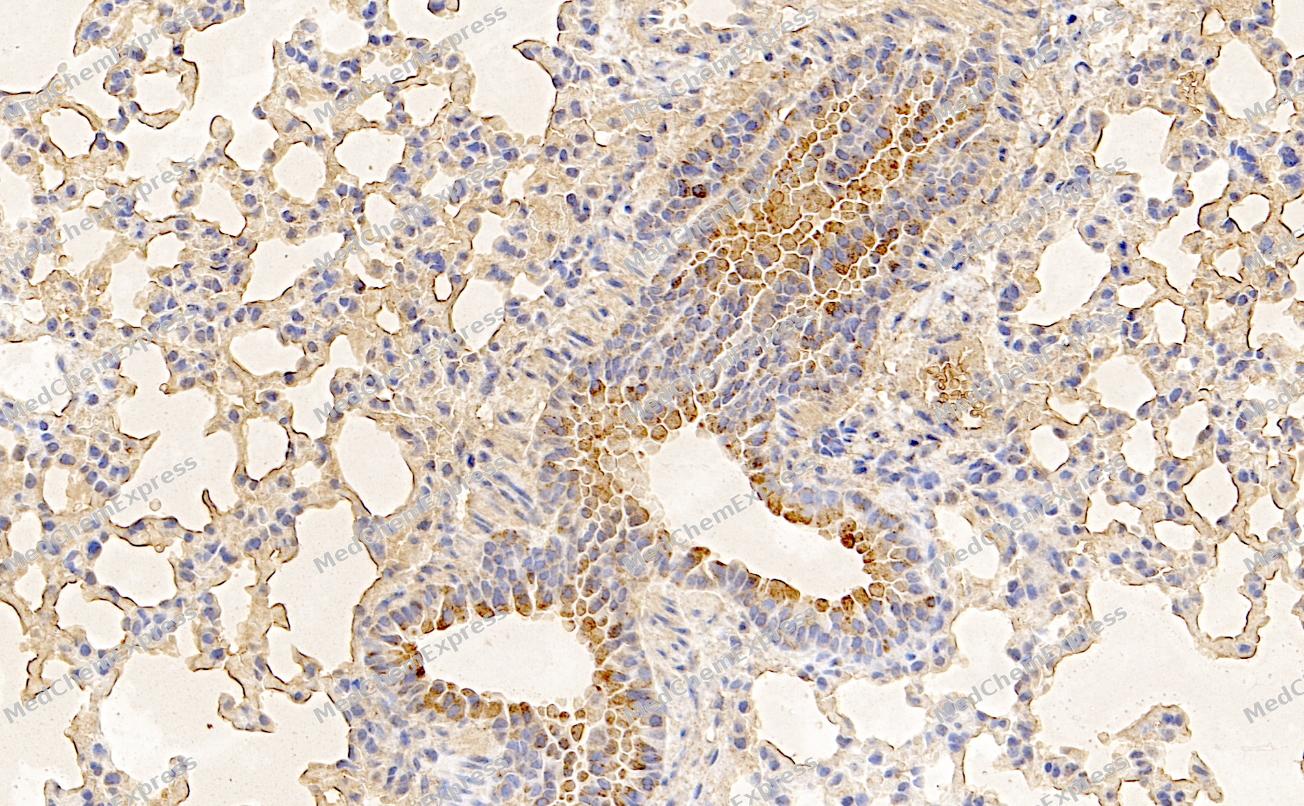 Immunohistochemical analysis of paraffin-embedded Mouse lung tissue using Caspase 1 Antibody. The section was pre-treated using heat mediated antigen retrieval with sodium citrate buffer (pH 6.0) for 8 minutes. The tissues were blocked in QuickBlock for 20 minutes at room temperature, washed with ddH2O and PBS, and then probed with the primary antibody (HY-P80587, 1/100) in 4℃ overnight. The detection was performed using an HRP conjugated compact polymer system. DAB was used as the chromogen. Tissues were counterstained with hematoxylin and mounted with DPX.
 -
Immunohistochemical analysis of paraffin-embedded Mouse lung tissue using Caspase 1 Antibody. The section was pre-treated using heat mediated antigen retrieval with sodium citrate buffer (pH 6.0) for 8 minutes. The tissues were blocked in QuickBlock for 20 minutes at room temperature, washed with ddH2O and PBS, and then probed with the primary antibody (HY-P80587, 1/100) in 4℃ overnight. The detection was performed using an HRP conjugated compact polymer system. DAB was used as the chromogen. Tissues were counterstained with hematoxylin and mounted with DPX.


Background
-
Function
Caspase-1 is the effector protease of canonical inflammasomes, where inflammasome activation enables processing and secretion of IL-1β and IL-18[1]. Mechanistically, caspase-1/11 cleaves gasdermin D (GSDMD), and GSDMD functions downstream as a pyroptosis executioner while also providing negative feedback on caspase-1/11 activation[2]. In endothelial models, homocysteine and lipopolysaccharide induced NLRP3 inflammasome assembly, caspase-1 activation, IL-1β cleavage, and caspase-1-dependent pyroptosis linked to endothelial dysfunction[3]. In respiratory infection models, Nontypeable Haemophilus influenzae activated caspase-1 and caspase-1 inhibition significantly reduced IL-1β release in respiratory cells and human lung tissue[4]. Compared with related isoforms, caspase-1 primarily controlled infected macrophage pyroptosis and IL-18 production in pneumonic melioidosis, whereas caspase-11 mediated infected lung epithelial-cell pyroptosis[5]. More broadly, murine caspase-11 and human caspase-4/5 define the noncanonical inflammasome pathway as cytosolic LPS sensors, separating their upstream recognition role from canonical procaspase-1 inflammasome activation[6]. For experimental applications, caspase-1 inhibitors can test IL-1β-dependent inflammatory output, while GSDMD-derived peptide inhibition provides a tool to suppress caspase-1/11 activation and downstream substrate cleavage[2][4].
-
Subcellular Localization
Cytoplasm; Cell membrane
-
Expression
Tissue_specificity:It is expressed at high levels in the spleen and lungs. It can also be detected in the liver, heart, small intestine, colon, thymus, prostate, skeletal muscle, peripheral blood leukocytes, kidneys, and testes. Expression was not detected in brain tissue.
Induction:Transcription and translation induced by M.tuberculosis and a number of different M.tuberculosis components; EsxA is the most potent activator tested (at protein level) (PubMed:20148899) -
Isoforms & Post-Translational Modification
P29466 has 5 isomers: P29466-1: 45159 Da (predicted); P29466-2: 42888 Da (predicted); P29466-3: 35019 Da (predicted); P29466-4: 29821 Da (predicted); P29466-5: 10417 Da (predicted).
The two subunits are derived from the precursor sequence by an autocatalytic mechanism;Ubiquitinated via 'Lys-11'-linked polyubiquitination. Deubiquitinated by USP8;Cleavage in the interdomain linker region is required to induce pyroptosis -
Subunit
Heterotetramer that consists of two anti-parallel arranged heterodimers, each one formed by a 20 kDa (Caspase-1 subunit p20) and a 10 kDa (Caspase-1 subunit p10) subunit (PubMed:32109412, PubMed:32553275, PubMed:8044845, PubMed:9987822). May be a component of the inflammasome, a protein complex which also includes PYCARD, CARD8 and NLRP2 and whose function would be the activation of pro-inflammatory caspases (PubMed:15030775, PubMed:33420033). Component of the AIM2 PANoptosome complex, a multiprotein complex that drives inflammatory cell death (PANoptosis) (By similarity). Interacts with CARD8; interacts with the released C-terminus of CARD8 which forms an inflammasome and directly activates CASP1 to promote pyroptosis (PubMed:32051255). Both the p10 and p20 subunits interact with MEFV (PubMed:16785446). Interacts with CARD17P/INCA and CARD18 (PubMed:11051551, PubMed:15383541). Interacts with SERPINB1; this interaction regulates CASP1 activity (PubMed:30692621)
-
SwissProt ID
-
Synonyms
CASP1; IL1BC; IL1BCE; Caspase-1; CASP-1; Interleukin-1 beta convertase; IL-1BC; Interleukin-1 beta-converting enzyme; ICE; IL-1 beta-converting enzyme; p45
-
Research Field
Cell Biology
Documentation
-
Data Sheet (262 KB)
-
SDS (252 KB)
- English - EN (252 KB)
- Français - FR (252 KB)
- Deutsch - DE (252 KB)
- Norwegian - NO (252 KB)
- Español - ES (252 KB)
- Swedish - SV (252 KB)
- Italian - IT (252 KB)
- Korean - KR (252 KB)
- Portuguese - PT (252 KB)
-
User Guide for Antibodies (1077 KB)
References
[1]. Dinarello CA. Mutations in cryopyrin: bypassing roadblocks in the caspase 1 inflammasome for interleukin-1beta secretion and disease activity. Arthritis Rheum. 2007 Sep;56(9):2817-22. doi: 10.1002/art.22841. PMID: 17763412. et al. Mutations in cryopyrin: bypassing roadblocks in the caspase 1 inflammasome for interleukin-1beta secretion and disease activity. Arthritis Rheum. 2007 Sep;56(9):2817-22. [Content Brief]
[2]. Hu Y, et al. The Gasdermin D N-terminal fragment acts as a negative feedback system to inhibit inflammasome-mediated activation of Caspase-1/11. Proc Natl Acad Sci U S A. 2022 Nov 8;119(45):e2210809119. [Content Brief]
[3]. Xi H, et al. Caspase-1 Inflammasome Activation Mediates Homocysteine-Induced Pyrop-Apoptosis in Endothelial Cells. Circ Res. 2016 May 13;118(10):1525-39. [Content Brief]
[5]. Wang J, et al. Caspase-11-dependent pyroptosis of lung epithelial cells protects from melioidosis while caspase-1 mediates macrophage pyroptosis and production of IL-18. PLoS Pathog. 2018 May 23;14(5):e1007105. [Content Brief]
[6]. Wu J, et al. Pyroptosis by caspase-11 inflammasome-Gasdermin D pathway in autoimmune diseases. Pharmacol Res. 2021 Mar;165:105408. [Content Brief]

 Powered by Bioz
