



ADAM17 Antibody (YA4137)
(Synonyms: ADAM17; CSVP; TACE; NISBD; ADAM18; ; NISBD1)Based on 1 Customer Validation
ADAM17 Antibody (YA4137) is a Mouse-derived and non-conjugated IgG1 monoclonal antibody, targeting to ADAM17.
-
Host:
Mouse
-
Isotype:
IgG
-
Application:
WB, ICC/IF, FC, ELISA
-
Reactivity :
Human, Mouse
-
Formulation:
Supplied in PBS with 0.05% sodium azide
-
Conjugation:
Non-conjugated


To place orders, for customer services and technical support, please contact: MedChemExpress USA
Tel: 609-228-6898 E-mail: [email protected] [email protected]





Applications
| Application |
WB

WB: Western Blot
|
ICC/IF
ICC/IF: Immunocytochemistry/
Immunofluorescence |
FC
FC: Flow Cytometry
|
ELISA
ELISA: Enzyme Linked Immunosorbent Assay
|
|---|---|---|---|---|
| Dilution Ratio | 1:500-1:2000 | 1:200-1:1000 | 1:200-1:400 | 1:10000 |


Product Details
ADAM17 Antibody (YA4137) is a Mouse-derived and non-conjugated IgG1 monoclonal antibody, targeting to ADAM17.
-
Host Mouse

-
Clonality Monoclonal

-
Species ReactivityHuman, Mouse
-
Observed Molecular WeightObserved band size: 100 kDa
Note: Due to possible protein modifications or aggregation, the molecular weight should be confirmed by actual measurement, and the predicted value is for reference only.

-
Calculated Molecular Weight Predicted band size: 93 kDa

Purified recombinant fragment of human CD156B (AA: 497-671) expressed in E. Coli.
affinity purified.
Non-conjugated
Unmodified
IgG


Product Properties
-
Appearance
Solution
-
Formulation
Supplied in PBS with 0.05% sodium azide
-
Concentration
Batch-dependent, Please check the COA for the concentration of each lot. Check Lot Concentration
-
Storage & Stability
Stored at -20°C for 1 year. Avoid repeated freeze / thaw cycles.
-
Shipping
Shipping with blue ice.


Verification Images
-
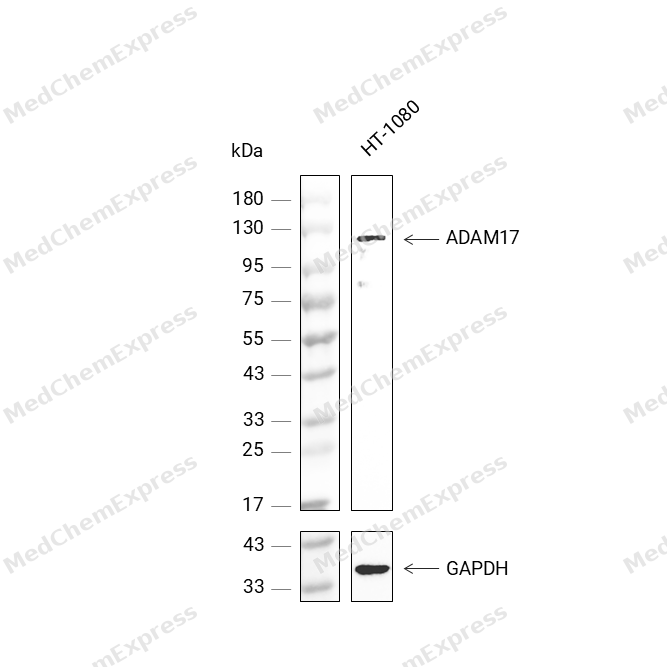 Western blot analysis was performed on protein extracts (35 μg) from HT-1080 (lane 2) using ADAM17 antibody. Proteins were transferred onto a 0.45 μm PVDF membrane using the Trans-Blot® Turbo™ system for 13 min. The membrane was then blocked with 5% nonfat milk in TBST (HY-K1025) for 1 h at room temperature. The primary antibody (1:1000) and loading control antibody GAPDH Antibody (HRP) (HY-P80954A) (1:5000) were diluted in 5% nonfat milk in TBST and incubated with the membrane overnight at 4°C. After washing, the membrane of primary antibody was incubated with HRP-conjugated goat anti-rabbit/mouse IgG secondary antibody (HY-P8001/HY-P8004) (1:5000) diluted in 5% nonfat milk in TBST for 1 h at room temperature. Protein bands were visualized using an Ultra High Sensitivity ECL detection kit (HY-K1005).


Background
-
Function
ADAM17 (A Disintegrin and Metalloprotease 17), also known as TNF-α-converting enzyme (TACE), is a membrane-associated metalloprotease that regulates cell-cell communication through ectodomain shedding of cytokines, receptors, adhesion molecules, and growth factor ligands[1][2]. Mechanistically, ADAM17 is a major sheddase for tumor necrosis factor-α (TNF-α), interleukin-6 receptor (IL-6R), and multiple epidermal growth factor receptor (EGFR) ligands, thereby coordinating inflammatory, regenerative, and proliferative signaling pathways[2][3][4]. Through the generation of soluble TNF-α and soluble IL-6R, ADAM17 functions as a central signaling hub linking immune activation with systemic inflammatory responses[2][4]. In addition, ADAM17-dependent shedding of EGFR ligands regulates EGFR signaling in epithelial tissues and contributes to processes associated with tissue homeostasis, development, and tumor progression[3][5][6]. Disease studies further demonstrate that ADAM17 participates in inflammation, cancer, and other pathological conditions through its broad substrate repertoire and downstream signaling effects[1][2][6]. Compared with the closely related metalloprotease ADAM10, ADAM17 displays distinct substrate specificity and serves as the predominant sheddase for amphiregulin, transforming growth factor-α (TGF-α), epiregulin, and heparin-binding EGF-like growth factor (HB-EGF), whereas ADAM10 preferentially processes other EGFR ligands[7][8]. This functional distinction is important for experimental design because selective modulation of ADAM17 can differentially affect TNF-α, IL-6, and EGFR signaling networks[2][7]. For research applications, ADAM17 inhibitors and blocking antibodies are widely used to investigate cytokine release, inflammatory signaling, EGFR activation, and tumor-associated microenvironmental interactions in cellular and animal models[2][9].
-
Subcellular Localization
Cell membrane; Single-pass type I membrane protein
-
Expression
Tissue_specificity:Widely expressed. Highest expression levels are found in the human heart, placenta, skeletal muscle, pancreas, spleen, thymus, prostate, testes, ovaries, and small intestine; highest expression levels are also found in the fetal brain, lungs, liver, and kidneys. It is also expressed in natural killer cells (protein level) (PubMed:24337742) .
Induction:In arthritis-affected cartilage -
Isoforms & Post-Translational Modification
P78536 has 2 isomers: P78536-1: 93021 Da (predicted); P78536-2: 78543 Da (predicted).
The precursor is cleaved by a furin endopeptidase;Phosphorylated. Stimulation by growth factor or phorbol 12-myristate 13-acetate induces phosphorylation of Ser-819 but decreases phosphorylation of Ser-791. Phosphorylation at Thr-735 by MAPK14 is required for ADAM17-mediated ectodomain shedding -
Subunit
Interacts with MAD2L1, MAPK14 and MUC1 (PubMed:12441351, PubMed:20188673). Interacts with iRhom1/RHBDF1 and iRhom2/RHBDF2 (PubMed:29897333). Interacts with FRMD8 via its interaction with iRhom1/RHBDF1 and iRhom2/RHBDF2 (PubMed:29897333). Interacts with TSPAN8 (PubMed:36078095)
-
SwissProt ID
-
Synonyms
ADAM17; CSVP; TACE; NISBD; ADAM18; ; NISBD1


Documentation
-
Data Sheet (262 KB)
-
SDS (252 KB)
- English - EN (252 KB)
- Français - FR (252 KB)
- Deutsch - DE (252 KB)
- Norwegian - NO (252 KB)
- Español - ES (252 KB)
- Swedish - SV (252 KB)
- Italian - IT (252 KB)
- Korean - KR (252 KB)
- Portuguese - PT (252 KB)
-
User Guide for Antibodies (1077 KB)
References
[1]. Zunke F, et al. The shedding protease ADAM17: Physiology and pathophysiology. Biochim Biophys Acta Mol Cell Res. 2017 Nov;1864(11 Pt B):2059-2070. [Content Brief]
[2]. Schumacher N, et al. ADAM17 orchestrates Interleukin-6, TNFα and EGF-R signaling in inflammation and cancer. Biochim Biophys Acta Mol Cell Res. 2022 Jan;1869(1):119141. [Content Brief]
[3]. Rose-John S. ADAM17, et al. Pharmacol Res. 2013;71:19-22.
[4]. Liu L, et al. ADAM17 as a promising therapeutic target: from structural basis to inhibitor discovery in human diseases. Front Pharmacol. 2025 Sep 19;16:1640090. [Content Brief]
[5]. Lee DC, et al. TACE/ADAM17 processing of EGFR ligands indicates a role as a physiological convertase. Ann N Y Acad Sci. 2003 May;995:22-38. [Content Brief]
[6]. Gnosa SP, et al. ADAM17-mediated EGFR ligand shedding directs macrophage-promoted cancer cell invasion. JCI Insight. 2022 Sep 22;7(18):e155296. [Content Brief]
[7]. Sahin U, et al. Distinct roles for ADAM10 and ADAM17 in ectodomain shedding of six EGFR ligands. J Cell Biol. 2004 Mar 1;164(5):769-79. [Content Brief]
[8]. Hosur V, et al. ADAM17 is essential for ectodomain shedding of the EGF-receptor ligand amphiregulin. FEBS Open Bio. 2018 Mar 12;8(4):702-710. [Content Brief]
[9]. Moss ML, et al. Recent Advances in ADAM17 Research: A Promising Target for Cancer and Inflammation. Mediators Inflamm. 2017;2017:9673537. [Content Brief]

 Powered by Bioz
