



Cullin 4A/4B Antibody (YA2583)
(Synonyms: CUL4B; KIAA0695; Cullin-4B; CUL-4B)
Based on 1 Customer Validation
Cullin 4A/4B Antibody (YA2583) is a Rabbit-derived and non-conjugated IgG monoclonal antibody, targeting to Cullin 4A/4B.
-
Host:
Rabbit
-
Isotype:
IgG
-
Application:
WB, IHC-P
-
Reactivity :
Human, Hamster, Rat
-
Formulation:
Supplied in 50mM Tris-Glycine(pH 7.4), 0.15M NaCl, 40% Glycerol, 0.01% Sodium azide and 0.05% BSA
-
Conjugation:
Non-conjugated



To place orders, for customer services and technical support, please contact: MedChemExpress USA
Tel: 609-228-6898 E-mail: [email protected] [email protected]





Applications
| Application |
WB

WB: Western Blot
|
IHC-P
IHC-P: Immunohistochemistry-Paraffin
|
|---|---|---|
| Dilution Ratio | 1:500-1:1000 | 1:50-1:100 |


Product Details
Cullin 4A/4B Antibody (YA2583) is a Rabbit-derived and non-conjugated IgG monoclonal antibody, targeting to Cullin 4A/4B.
-
Host Rabbit

-
Clonality Recombinant,Monoclonal

-
Species ReactivityHuman, Hamster, Rat
-
Observed Molecular WeightObserved band size: 88,104 kDa
Note: Due to possible protein modifications or aggregation, the molecular weight should be confirmed by actual measurement, and the predicted value is for reference only.

-
Calculated Molecular Weight Predicted band size: 104 kDa

A synthetic peptide of human Cullin 4B
Endogenous
Affinity Purified
Non-conjugated
Unmodified
IgG


Product Properties
-
Appearance
Liquid
-
Formulation
Supplied in 50mM Tris-Glycine(pH 7.4), 0.15M NaCl, 40% Glycerol, 0.01% Sodium azide and 0.05% BSA
-
Concentration
Batch-dependent, Please check the COA for the concentration of each lot. Check Lot Concentration
-
Storage & Stability
Stored at -20°C for 1 year. Avoid repeated freeze / thaw cycles.
-
Shipping
Shipping with blue ice.


Verification Images
-
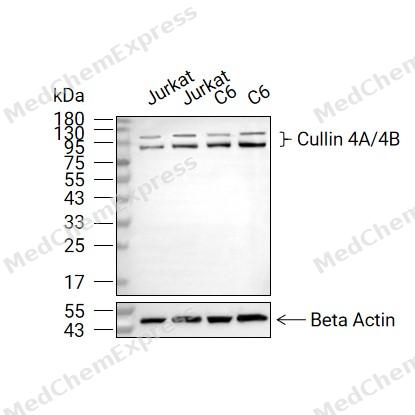 Western blot analysis of extracts from Jurkat (lane 2(20μg) and Jurkat (lane 3(40μg), C6 (lane 4(20μg) and C6 (lane 5(40μg) using Cullin 4A/4B Antibody (YA2583) (HY-P82838) Rabbit mAb. Proteins were transferred to a PVDF membrane and blocked with 5% non-fat milk in TBST for 2 hour at room temperature. The primary antibody (1/1000) and Loading control antibody (Beta Actin, HY-P80438, 1/10000) was used in 5% non-fat milk in TBST at 4°C overnight. Goat Anti-Mouse/Rabbit IgG-HRP Secondary Antibody (1/10000) was used for 1 hour at room temperature.
 -
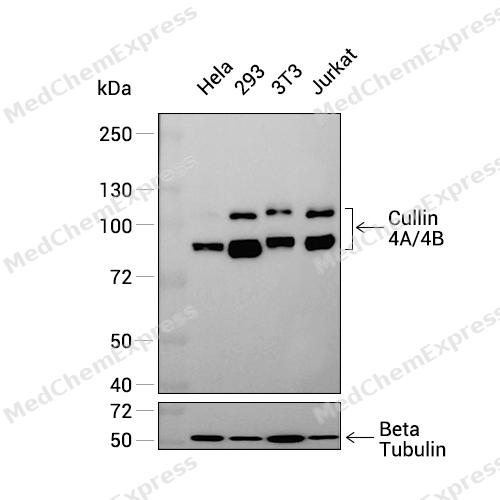
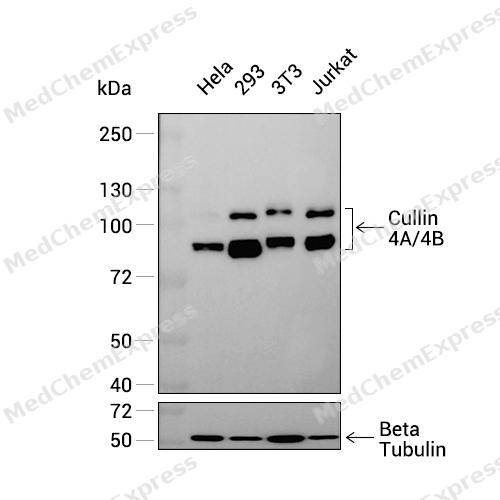 Western blot analysis was performed on extracts from Hela (lane 1, 15 μg), 293 (lane 2, 15 μg), 3T3 (lane 3, 15 μg), and Jurkat (lane 4, 15 μg) using Cullin 4A/4B Rabbit mAb.Proteins were transferred to a PVDF membrane and blocked with 5% non-fat milk in TBST at 4°C overnight.The primary antibody (1:1000 dilution) and the loading control antibody (beta-Tubulin, HY-P80487, 1:60000 dilution) were incubated in 5% non-fat milk in TBST for 1 hour at 37°C.Goat Anti-Rabbit IgG-HRP Secondary Antibody (1:20000 dilution) was then applied for 40 minutes at 37°C.
 -
 Immunohistochemical analysis of paraffin-embedded human epididymis tissue using Cullin 4A/4B Antibody (HY-P82838, 1/100). The section was pretreated using heat mediated antigen retrieval with sodium citrate buffer (pH 6.0) for 8 minutes. The tissues were blocked with quick block buffer for 0.5 hours at room temperature, washed with PBS and PBST, and then incubated with the primary antibody overnight at 4℃. The detection was performed using an HRP conjugated compact polymer system. DAB was used as the chromogen. Tissues were counterstained with hematoxylin and mounted with DPX.
 -
 Immunohistochemical analysis of paraffin-embedded human oral mucosa tissue using Cullin 4A/4B Antibody (HY-P82838, 1/100). The section was pretreated using heat mediated antigen retrieval with sodium citrate buffer (pH 6.0) for 8 minutes. The tissues were blocked with quick block buffer for 0.5 hours at room temperature, washed with PBS and PBST, and then incubated with the primary antibody overnight at 4℃. The detection was performed using an HRP conjugated compact polymer system. DAB was used as the chromogen. Tissues were counterstained with hematoxylin and mounted with DPX.
 -
 Immunohistochemical analysis of paraffin-embedded human salivary gland tissue using Cullin 4A/4B Antibody (HY-P82838, 1/100). The section was pretreated using heat mediated antigen retrieval with sodium citrate buffer (pH 6.0) for 8 minutes. The tissues were blocked with quick block buffer for 0.5 hours at room temperature, washed with PBS and PBST, and then incubated with the primary antibody overnight at 4℃. The detection was performed using an HRP conjugated compact polymer system. DAB was used as the chromogen. Tissues were counterstained with hematoxylin and mounted with DPX.
 -
 Immunohistochemical analysis of paraffin-embedded human kidney tissue using Cullin 4A/4B Antibody (HY-P82838, 1/100). The section was pretreated using heat mediated antigen retrieval with sodium citrate buffer (pH 6.0) for 8 minutes. The tissues were blocked with quick block buffer for 0.5 hours at room temperature, washed with PBS and PBST, and then incubated with the primary antibody overnight at 4℃. The detection was performed using an HRP conjugated compact polymer system. DAB was used as the chromogen. Tissues were counterstained with hematoxylin and mounted with DPX.
 -
 Immunohistochemical analysis of paraffin-embedded human placenta tissue using Cullin 4A/4B Antibody (HY-P82838, 1/100). The section was pretreated using heat mediated antigen retrieval with sodium citrate buffer (pH 6.0) for 8 minutes. The tissues were blocked with quick block buffer for 0.5 hours at room temperature, washed with PBS and PBST, and then incubated with the primary antibody overnight at 4℃. The detection was performed using an HRP conjugated compact polymer system. DAB was used as the chromogen. Tissues were counterstained with hematoxylin and mounted with DPX.
 -
 Immunohistochemical analysis of paraffin-embedded human prostate tissue using Cullin 4A/4B Antibody (HY-P82838, 1/100). The section was pretreated using heat mediated antigen retrieval with sodium citrate buffer (pH 6.0) for 8 minutes. The tissues were blocked with quick block buffer for 0.5 hours at room temperature, washed with PBS and PBST, and then incubated with the primary antibody overnight at 4℃. The detection was performed using an HRP conjugated compact polymer system. DAB was used as the chromogen. Tissues were counterstained with hematoxylin and mounted with DPX.


Background
-
Function
Cullin 4A/4B core component of multiple cullin-RING-based E3 ubiquitin-protein ligase complexes which mediate the ubiquitination and subsequent proteasomal degradation of target proteins. The functional specificity of the E3 ubiquitin-protein ligase complex depends on the variable substrate recognition subunit. CUL4B may act within the complex as a scaffold protein, contributing to catalysis through positioning of the substrate and the ubiquitin-conjugating enzyme. Plays a role as part of the E3 ubiquitin-protein ligase complex in polyubiquitination of CDT1, histone H2A, histone H3 and histone H4 in response to radiation-induced DNA damage. Targeted to UV damaged chromatin by DDB2 and may be important for DNA repair and DNA replication. A number of DCX complexes (containing either TRPC4AP or DCAF12 as substrate-recognition component) are part of the DesCEND (destruction via C-end degrons) pathway, which recognizes a C-degron located at the extreme C terminus of target proteins, leading to their ubiquitination and degradation. The DCX(AMBRA1) complex is a master regulator of the transition from G1 to S cell phase by mediating ubiquitination of phosphorylated cyclin-D (CCND1, CCND2 and CCND3). The DCX(AMBRA1) complex also acts as a regulator of Cul5-RING (CRL5) E3 ubiquitin-protein ligase complexes by mediating ubiquitination and degradation of Elongin-C (ELOC) component of CRL5 complexes. Required for ubiquitination of cyclin E (CCNE1 or CCNE2), and consequently, normal G1 cell cycle progression. Regulates the mammalian target-of-rapamycin (mTOR) pathway involved in control of cell growth, size and metabolism. Specific CUL4B regulation of the mTORC1-mediated pathway is dependent upon 26S proteasome function and requires interaction between CUL4B and MLST8. With CUL4A, contributes to ribosome biogenesis[1][2][3][4][5][6][7][8][9][10][11][12].
-
Subcellular Localization
Cytoplasm; Nucleus
-
Isoforms & Post-Translational Modification
Q13620 has 3 isomers: Q13620-2: 103982 Da (predicted); Q13620-1: 102299 Da (predicted); Q13620-3: 84017 Da (predicted).
Neddylated. Deneddylated via its interaction with the COP9 signalosome (CSN) complex -
Subunit
Component of multiple DCX (DDB1-CUL4-X-box) E3 ubiquitin-protein ligase complexes that seem to be formed of DDB1, CUL4A or CUL4B, RBX1 and a variable substrate recognition component which seems to belong to a protein family described as DCAF (Ddb1- and Cul4-associated factor) or CDW (CUL4-DDB1-associated WD40-repeat) proteins (PubMed:10230407, PubMed:16678110, PubMed:17041588, PubMed:18593899). Component of the DCX(DTL) complex with the putative substrate recognition component DTL (PubMed:17041588). Component of the DCX(DDB2) complex with the putative substrate recognition component DDB2 (PubMed:16678110). Component of DCX complexes part of the DesCEND (destruction via C-end degrons) pathway, which contain either TRPC4AP or DCAF12 as substrate-recognition component (PubMed:29779948). Component of the DCX(AMBRA1) complex with the substrate recognition component AMBRA1 (PubMed:30166453, PubMed:33854232, PubMed:33854239). Part of a complex with RBX1 and TIP120A/CAND1 (PubMed:12609982, PubMed:22118460). Interacts with RBX1, GRWD1, MLST8, SMU1, TLE2, TLE3, DCAF1, DDA1, DCAF6, DCAF17, DDB2, DCAF8, TIP120A/CAND1 and TMEM113 (PubMed:16949367, PubMed:17041588, PubMed:18235224). Interacts with cyclin E (CCNE1 or CCNE2) and with importins alpha-1 (KPNA2), alpha-3 (KPNA4), alpha-5 (KPNA1) and beta-1 (KPNB1) (PubMed:16322693, PubMed:19801544). May interact with WDR26, WDR51B, SNRNP40, WDR61, WDR76 and WDR5 (PubMed:17041588). Interacts (unneddylated form) with DCUN1D1, DCUN1D2, DCUN1D3, DCUN1D4 and DCUN1D5; these interactions promote the cullin neddylation (PubMed:23201271, PubMed:26906416)
-
SwissProt ID
-
Synonyms
CUL4B; KIAA0695; Cullin-4B; CUL-4B
-
Research Field
Cell Biology


Documentation
-
Data Sheet (235 KB)
-
SDS (251 KB)
- English - EN (251 KB)
- Français - FR (251 KB)
- Deutsch - DE (251 KB)
- Norwegian - NO (251 KB)
- Español - ES (251 KB)
- Swedish - SV (251 KB)
- Italian - IT (251 KB)
- Korean - KR (251 KB)
- Portuguese - PT (251 KB)
-
User Guide for Antibodies (1077 KB)

 Powered by Bioz
