



CXCR3 Antibody
(Synonyms: CXCR3_HUMAN; Interferon-inducible protein 10 receptor; IP-10 receptor; C-X-C chemokine receptor type 3; CD 183; CD183; CD183 antigen; G protein-coupled receptor 9; G Protein Coupled Receptor 9; Chemokine (C X C motif) receptor 3; Chemokine (C X C) receptor 3; C-X-C Chemokine receptor; CXC Motif Receptor 3; Chemokine CXC Motif Receptor 3; CKRL2; CKR L2; CKR-L2; GPR9; CXC-R3; CXCR-3; IP10 receptor.)
Based on 1 Customer Validation
CXCR3 Antibody is a Rabbit-derived and non-conjugated IgG polyclonal antibody, targeting to CXCR3.
-
Host:
Rabbit
-
Isotype:
IgG
-
Application:
WB
-
Reactivity :
Human, Mouse, Rat
-
Formulation:
Supplied in 0.01M TBS(pH7.4) with 1% BSA, 0.03% Proclin300 and 50% Glycerol.
-
Conjugation:
Non-conjugated


To place orders, for customer services and technical support, please contact: MedChemExpress USA
Tel: 609-228-6898 E-mail: [email protected] [email protected]





Applications
| Application |
WB

WB: Western Blot
|
|---|---|
| Dilution Ratio | 1:500-2000 |


Product Details
CXCR3 Antibody is a Rabbit-derived and non-conjugated IgG polyclonal antibody, targeting to CXCR3.
-
Host Rabbit

-
Clonality Polyclonal

-
Species ReactivityHuman, Mouse, Rat Predicted Reactivity: Dog,Pig,Cow,Rabbit,GuineaPig
Note: The predicted reactivity is for reference only and should not be considered a guarantee of product performance.
-
Observed Molecular WeightObserved band size: 40 kDa
Note: Due to possible protein modifications or aggregation, the molecular weight should be confirmed by actual measurement, and the predicted value is for reference only.

-
Calculated Molecular Weight Predicted band size: 40 kDa

Entrez Gene: 2833 Human ; 12766 Mouse ; 84475 Rat
SwissProt: P49682 Human ; O88410 Mouse ; Q9JII9 Rat
OMIM: 300574 Human
KLH conjugated synthetic peptide derived from mouse CXCR3: 301-367/367
Endogenous
affinity purified
Non-conjugated
Unmodified
IgG


Product Properties
-
Appearance
Solution
-
Formulation
Supplied in 0.01M TBS(pH7.4) with 1% BSA, 0.03% Proclin300 and 50% Glycerol.
-
Concentration
Batch-dependent, Please check the COA for the concentration of each lot. Check Lot Concentration
-
Storage & Stability
Stored at -20°C for 1 year. Avoid repeated freeze / thaw cycles.
-
Shipping
Shipping with blue ice.


Verification Images
-
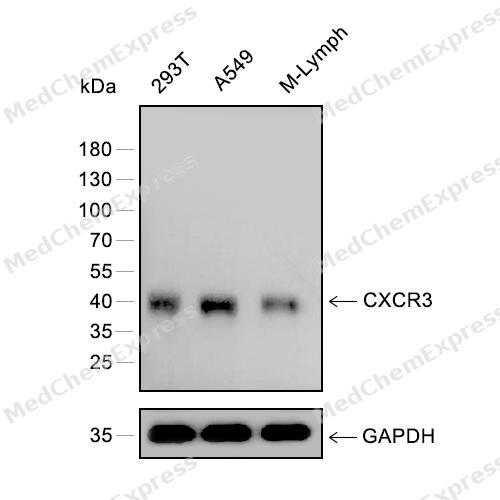 Western blot analysis of extracts from 293T (lane 1) and A549 (lane 2) and M-Lymph (lane 3) using CXCR3 antibody. Proteins were transferred to a PVDF membrane and blocked with 5% nonfat powdered milk in PBST for 2 hour at room temperature. The primary antibody (1/2000) and Loading control antibody (GAPDH, 1/3000) was diluted with 5% nonfat powdered milk in PBST at 4°C overnight. Goat Anti-Rabbit IgG-HRP Secondary Antibody (1/8,000) was incubated for 45min at room temperature.


Background
-
Function
CD183 (CXCR3) is a CXC chemokine receptor primarily expressed on activated T cells, Th1 cells, NK cells, and NKT cells. By responding to CXCL9, CXCL10, and CXCL11 signals, CD183 mediates the migration of immune cells to sites of inflammation and tumors; it serves as a key marker for studying Th1 immunity, anti-tumor immunity, immunity against infection, and autoimmune diseases.
-
Subcellular Localization
Cell membrane; Multi-pass membrane protein; Cell membrane; Multi-pass membrane protein
-
Expression
Tissue_specificity:Isomer 1 and isomer 2 are primarily expressed in the heart, kidneys, liver, and skeletal muscle. Isomer 1 is also expressed in the placenta. Isomer 2 is expressed in endothelial cells. It is also expressed in T cells (protein level) . -
Isoforms & Post-Translational Modification
CD183 (CXCR3) has 3 isomers: P49682-1: 40660 Da (predicted); P49682-2: 45523 Da (predicted); P49682-3: 28715 Da (predicted).
Sulfation on Tyr-27 and Tyr-29 is essential for CXCL10 binding and subsequent signal transduction induction;N-glycosylated -
Subunit
Homomer. Forms heteromers with ACKR4
-
SwissProt ID
-
Synonyms
CXCR3_HUMAN; Interferon-inducible protein 10 receptor; IP-10 receptor; C-X-C chemokine receptor type 3; CD 183; CD183; CD183 antigen; G protein-coupled receptor 9; G Protein Coupled Receptor 9; Chemokine (C X C motif) receptor 3; Chemokine (C X C) receptor 3; C-X-C Chemokine receptor; CXC Motif Receptor 3; Chemokine CXC Motif Receptor 3; CKRL2; CKR L2; CKR-L2; GPR9; CXC-R3; CXCR-3; IP10 receptor.


Documentation
-
Data Sheet (262 KB)
-
SDS (254 KB)
- English - EN (254 KB)
- Français - FR (254 KB)
- Deutsch - DE (254 KB)
- Norwegian - NO (254 KB)
- Español - ES (254 KB)
- Swedish - SV (254 KB)
- Italian - IT (254 KB)
- Korean - KR (254 KB)
- Portuguese - PT (254 KB)
-
User Guide for Antibodies (1077 KB)
References
[1]. Huo R, et al. CXCR3 inhibitors for therapeutic interventions: current status and perspectives. Front Pharmacol. 2025 Jul 25;16:1556196. [Content Brief]
[2]. Boyé K, et al. Ligand activation induces different conformational changes in CXCR3 receptor isoforms as evidenced by plasmon waveguide resonance (PWR). Sci Rep. 2017 Sep 6;7(1):10703. [Content Brief]
[3]. Caccuri F, et al. The Synthetic Dipeptide Pidotimod Shows a Chemokine-Like Activity through CXC Chemokine Receptor 3 (CXCR3). Int J Mol Sci. 2019 Oct 24;20(21):5287. [Content Brief]
[4]. Eiger DS, et al. Location bias contributes to functionally selective responses of biased CXCR3 agonists. Nat Commun. 2022 Oct 4;13(1):5846. [Content Brief]
[5]. Wang X, et al. Effects of CXCL4/CXCR3 on the lipopolysaccharide-induced injury in human umbilical vein endothelial cells. J Cell Physiol. 2019 Dec;234(12):22378-22385. [Content Brief]
[6]. Torraca V, et al. The CXCR3-CXCL11 signaling axis mediates macrophage recruitment and dissemination of mycobacterial infection. Dis Model Mech. 2015 Mar;8(3):253-69. [Content Brief]
[7]. Wu Q, et al. Altered CXCR3 isoform expression regulates prostate cancer cell migration and invasion. Mol Cancer. 2012 Jan 11;11:3. [Content Brief]
[8]. Sheng W, et al. Astrocyte-derived CXCL10 exacerbates endothelial cells pyroptosis and blood-brain barrier disruption via CXCR3/cGAS/AIM2 pathway after intracerebral hemorrhage. Cell Death Discov. 2025 Aug 8;11(1):373. [Content Brief]
[9]. Lee J, et al. CXCR3-CXCL11 Signaling Restricts Angiogenesis and Promotes Pericyte Recruitment. Arterioscler Thromb Vasc Biol. 2024 Dec;44(12):2577-2595. [Content Brief]
[10]. Huang YV, et al. Novel Therapeutic Approach Targeting CXCR3 to Treat Immunotherapy Myocarditis. Circ Res. 2025 Feb 28;136(5):473-490. [Content Brief]
[11]. Bodnar RJ, et al. Differential regulation of pericyte function by the CXC receptor 3. Wound Repair Regen. 2015 Nov-Dec;23(6):785-96. [Content Brief]

 Powered by Bioz
