



Endo G Antibody (YA1529)
(Synonyms: EndoG; EndonucleaseG; Mitochondrial endonuclease G; NUCG_HUMAN)
Based on 1 Customer Validation
Endo G Antibody (YA1529) is a Rabbit-derived and non-conjugated IgG monoclonal antibody, targeting to Endo G.
-
Host:
Rabbit
-
Isotype:
IgG
-
Application:
WB
-
Reactivity :
Human, Mouse, Rat
-
Formulation:
1.Supplied in rabbit IgG in phosphate buffered saline , pH 7.4, 150 mM NaCl, 0.02% sodium azide and 50% glycerol.
2.Supplied in 50 mM Tris-Glycine, pH 7.4, 0.15 M NaCl, 40% glycerol, 0.01% sodium azide and 0.05% BSA.
Please refer to the lot-specific COA for specific buffer information.
-
Conjugation:
Non-conjugated


To place orders, for customer services and technical support, please contact: MedChemExpress USA
Tel: 609-228-6898 E-mail: [email protected] [email protected]





Applications
| Application |
WB

WB: Western Blot
|
|---|---|
| Dilution Ratio | 1:500-1:1000 |


Product Details
Endo G Antibody (YA1529) is a Rabbit-derived and non-conjugated IgG monoclonal antibody, targeting to Endo G.
-
Host Rabbit

-
Clonality Recombinant,Monoclonal

-
Species ReactivityHuman, Mouse, Rat
-
Observed Molecular WeightObserved band size: 30 kDa
Note: Due to possible protein modifications or aggregation, the molecular weight should be confirmed by actual measurement, and the predicted value is for reference only.

-
Calculated Molecular Weight Predicted band size: 33 kDa

Entrez Gene: 2021 Human ; 13804 Mouse ; 362100 Rat
SwissProt: Q14249 Human ; O08600 Mouse ;
OMIM: 600440 Human
A synthesized peptide derived from human Endo G aa250-297/297.
Endogenous
Affinity Chromatography
Non-conjugated
Unmodified
IgG


Product Properties
-
Appearance
Liquid
-
Formulation
1.Supplied in rabbit IgG in phosphate buffered saline , pH 7.4, 150 mM NaCl, 0.02% sodium azide and 50% glycerol.
2.Supplied in 50 mM Tris-Glycine, pH 7.4, 0.15 M NaCl, 40% glycerol, 0.01% sodium azide and 0.05% BSA.
Please refer to the lot-specific COA for specific buffer information. -
Concentration
Batch-dependent, Please check the COA for the concentration of each lot. Check Lot Concentration
-
Storage & Stability
Stored at -20°C for 1 year. Avoid repeated freeze / thaw cycles.
-
Shipping
Shipping with blue ice.


Verification Images
-
 Western blot analysis was performed on extracts from HepG2 (lane 1, 15 μg), Hela (lane 2, 15 μg), K562 (lane 3, 15 μg), Mouse liver (lane 4, 15 μg), and Rat liver (lane 5, 15 μg) using Endo G Rabbit mAb. Proteins were transferred to a PVDF membrane and blocked with 5% non - fat milk in TBST at 4°C overnight. The primary antibody (1:1000 dilution) and the loading control antibody (beta-Actin(HRP), HY-P80993, 1:5000 dilution) was incubated in 5% non-fat milk in TBST for 1 hour at 37°C. Goat Anti - Rabbit IgG - HRP Secondary Antibody (1:20000 dilution) was then applied for 40 minutes at 37°C.
 -
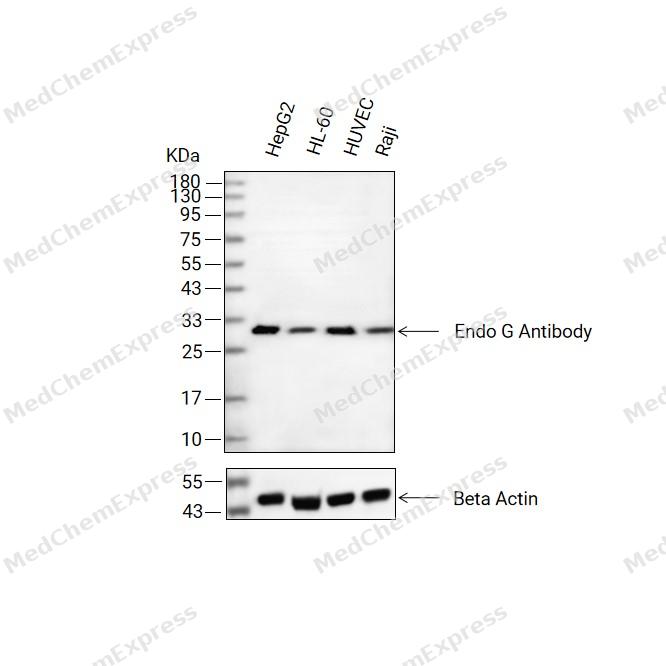
Western blot analysis of extracts from HepG2 (lane 2(20μg), HL-60 (lane 3(20μg), HUVEC (lane 4(20μg), Raji (lane 5(20μg) using Endo G Antibody. Proteins were transferred to a PVDF membrane and blocked with 5% BSA in TBST for 2 hour at room temperature. The primary antibody (1/1000) and Loading control antibody (Beta Actin, HY-P80438, 1/3000) was used in 5% BSA in TBST at 4°C overnight. Goat Anti-Mouse/Rabbit IgG-HRP Secondary Antibody (HY-P8004/HY-P8001, 1/10,000) was used for 1 hour at room temperature.


Background
-
Function
Endo G is an Endonuclease that preferentially catalyzes the cleavage of double-stranded 5-hydroxymethylcytosine (5hmC)-modified DNA. The 5hmC-modified nucleotide does not increase the binding affinity, but instead increases the efficiency of cutting and specifies the site of cleavage for the modified DNAs. Shows significantly higher affinity for four-stranded Holliday junction over duplex and single-stranded DNAs. Promotes conservative recombination when the DNA is 5hmC-modified. Promotes autophagy through the suppression of mTOR by its phosphorylation-mediated interaction with YWHAG and its endonuclease activity-mediated DNA damage response. GSK3-beta mediated phosphorylation of ENDOG enhances its interaction with YWHAG, leading to the release of TSC2 and PIK3C3 from YWHAG resulting in mTOR pathway suppression and autophagy initiation. Promotes cleavage of mtDNA in response to oxidative and nitrosative stress, in turn inducing compensatory mtDNA replication[1][2][3].
-
Subcellular Localization
Mitochondrion
-
Subunit
Homodimer; disulfide-linked (By similarity). Homodimerization is essential for enzyme activity (By similarity). Interacts with YWHAG (PubMed:33473107)
-
SwissProt ID
-
Synonyms
EndoG; EndonucleaseG; Mitochondrial endonuclease G; NUCG_HUMAN
-
Research Field
Cell Biology


Documentation
-
Data Sheet (232 KB)
-
SDS (252 KB)
- English - EN (252 KB)
- Français - FR (252 KB)
- Deutsch - DE (252 KB)
- Norwegian - NO (252 KB)
- Español - ES (252 KB)
- Swedish - SV (252 KB)
- Italian - IT (252 KB)
- Korean - KR (252 KB)
- Portuguese - PT (252 KB)
-
User Guide for Antibodies (1077 KB)

 Powered by Bioz
