



FBXO11 Antibody (YA7851)
(Synonyms: FBX11; PRMT9; UBR6; UG063H01; VIT1)
Based on 1 Customer Validation
FBXO11 Antibody (YA7851) is a Mouse-derived and non-conjugated IgG1 monoclonal antibody, targeting to FBXO11.
-
Host:
Mouse
-
Isotype:
IgG1
-
Application:
WB
-
Reactivity :
Human, Mouse, Rat
-
Formulation:
Spplied in PBS (pH 7.3) containing 1% BSA, 50% glycerol and 0.02% sodium azide.
-
Conjugation:
Non-conjugated


To place orders, for customer services and technical support, please contact: MedChemExpress USA
Tel: 609-228-6898 E-mail: [email protected] [email protected]





Applications
| Application |
WB

WB: Western Blot
|
|---|---|
| Dilution Ratio | 1:500-2000 |


Product Details
FBXO11 Antibody (YA7851) is a Mouse-derived and non-conjugated IgG1 monoclonal antibody, targeting to FBXO11.
-
Host Mouse

-
Clonality Monoclonal

-
Species ReactivityHuman, Mouse, Rat
-
Calculated Molecular Weight Predicted band size: 93.9 kDa

Human recombinant protein fragment corresponding to amino acids 1-300 of human FBXO11 produced in E.coli.
Endogenous
Affinity purified
Non-conjugated
Unmodified
IgG1


Product Properties
-
Appearance
Liquid
-
Formulation
Spplied in PBS (pH 7.3) containing 1% BSA, 50% glycerol and 0.02% sodium azide.
-
Concentration
Batch-dependent, Please check the COA for the concentration of each lot. Check Lot Concentration
-
Storage & Stability
Stored at -20°C for 1 year. Avoid repeated freeze / thaw cycles.
-
Shipping
Shipping with blue ice.


Verification Images
-
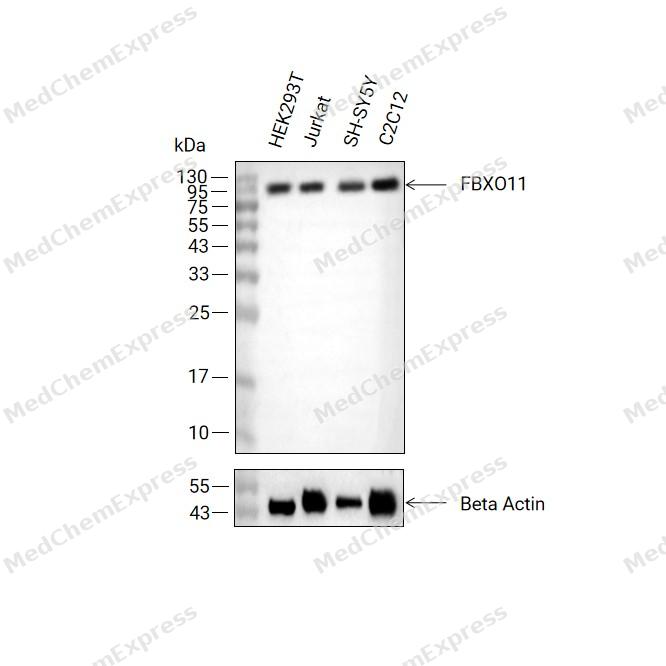 Western blot analysis of extracts from HEK293T (lane2(20μg), Jurkat (lane3(20μg), SH-SY5Y (lane4(20μg) and C2C12 (lane5(20μg) using FBXO11 Antibody (HY-P88167). Proteins were transferred to a PVDF membrane and blocked with 5% non-fat milk in TBST at 4°C overnight. The primary antibody (1/1000) and Loading control antibody (Beta Actin, HY-P80993, 1/10,000) was used in 5% non-fat milk in TBST for 2 hour at room temperature. Goat Anti-Mouse IgG-HRP Secondary Antibody (HY-P8004, 1/10,000) was used for 1 hour at room temperature.


Background
-
Function
FBXO11 is a Substrate recognition component of a SCF (SKP1-CUL1-F-box protein) E3 ubiquitin-protein ligase complex which mediates the ubiquitination and subsequent proteasomal degradation of target proteins, such as DTL/CDT2, BCL6, SNAI1 and PRDM1/BLIMP1. The SCF(FBXO11) complex mediates ubiquitination and degradation of BCL6, thereby playing a role in the germinal center B-cells terminal differentiation toward memory B-cells and plasma cells. The SCF(FBXO11) complex also mediates ubiquitination and degradation of DTL, an important step for the regulation of TGF-beta signaling, cell migration and the timing of the cell-cycle progression and exit. The SCF(FBXO11) complex also catalyzes ubiquitination and degradation of GSK3B-phosphorylated SNAI1. Binds to and neddylates phosphorylated p53/TP53, inhibiting its transcriptional activity. Plays a role in the regulatiom of erythropoiesis but not myelopoiesis or megakaryopoiesis. Mechanistically, activates erythroid genes by mediating the degradation of BAHD1, a heterochromatin-associated protein that recruits corepressors to H3K27me3 marks. Participates in macrophage cell death and inflammation in response to bacterial toxins by regulating the expression of complement 5a receptor 1/C5AR1 and IL-1beta. Acts as a critical regulator to determine the level of MHC-II by mediating the recognition of degron at the P/S/T domain of CIITA leading to its ubiquitination and subsequent degradation via the proteasome. Participates in the antiviral repsonse by initiating the activation of TBK1-IRF3-IFN-I axis. Mediates the 'Lys-63'-linked ubiquitination of TRAF3 to strengthen the interaction between TRAF3 and TBK1[1][2][3][4][5][6][7][8][9][10][11][12].
-
Subcellular Localization
Nucleus,Chromosome
-
Expression
Tissue_Specificity: Isoform 5 is expressed in keratinocytes, fibroblasts and melanocytes -
Isoforms & Post-Translational Modification
Q86XK2 has 6 isomers: Q86XK2-1: 103585 Da (predicted); Q86XK2-2: 62418 Da (predicted); Q86XK2-6: 94056 Da (predicted); Q86XK2-3: 65559 Da (predicted); Q86XK2-4: 23441 Da (predicted); Q86XK2-5: 106864 Da (predicted).
-
Subunit
Component of the SCF(FBXO11) complex consisting of CUL1, RBX1, SKP1 and FBXO11 (PubMed:23478441, PubMed:23478445)
-
SwissProt ID
-
Synonyms
FBX11; PRMT9; UBR6; UG063H01; VIT1


Documentation

 Powered by Bioz
