



FBXO22 Antibody (YA8026)
(Synonyms: FBX22; FISTC1)
Based on 1 Customer Validation
FBXO22 Antibody (YA8026) is a Mouse-derived and non-conjugated IgG1 monoclonal antibody, targeting to FBXO22.
-
Host:
Mouse
-
Isotype:
IgG1
-
Application:
WB
-
Reactivity :
Human, Mouse, Rat
-
Formulation:
Spplied in PBS (pH 7.3) containing 1% BSA, 50% glycerol and 0.02% sodium azide.
-
Conjugation:
Non-conjugated


To place orders, for customer services and technical support, please contact: MedChemExpress USA
Tel: 609-228-6898 E-mail: [email protected] [email protected]





Applications
| Application |
WB

WB: Western Blot
|
|---|---|
| Dilution Ratio | 1:500-2000 |


Product Details
FBXO22 Antibody (YA8026) is a Mouse-derived and non-conjugated IgG1 monoclonal antibody, targeting to FBXO22.
-
Host Mouse

-
Clonality Monoclonal

-
Species ReactivityHuman, Mouse, Rat
-
Calculated Molecular Weight Predicted band size: 44.3 kDa

Human recombinant protein fragment corresponding to amino acids 1-220 of human FBXO22 produced in E.coli.
Endogenous
Affinity purified
Non-conjugated
Unmodified
IgG1


Product Properties
-
Appearance
Liquid
-
Formulation
Spplied in PBS (pH 7.3) containing 1% BSA, 50% glycerol and 0.02% sodium azide.
-
Concentration
Batch-dependent, Please check the COA for the concentration of each lot. Check Lot Concentration
-
Storage & Stability
Stored at -20°C for 1 year. Avoid repeated freeze / thaw cycles.
-
Shipping
Shipping with blue ice.


Verification Images
-
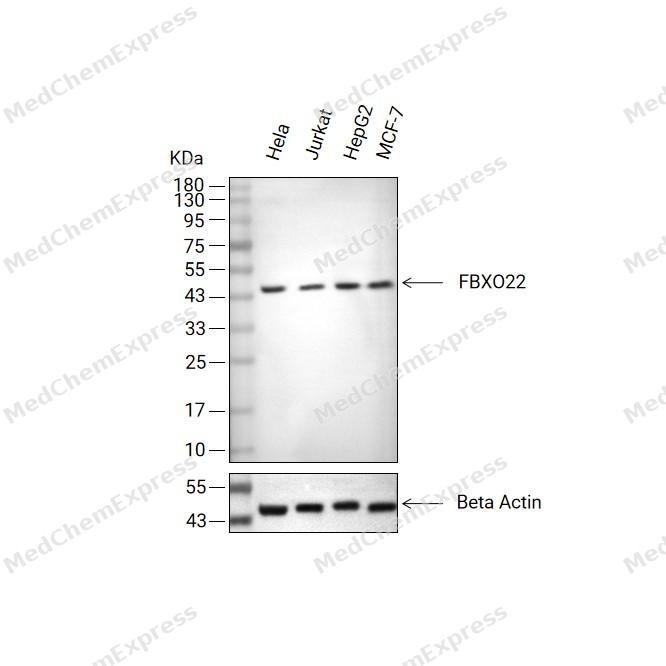 Western blot analysis of extracts from Hela(lane 2(20μg) , Jurkat(lane 3(20μg) ,HepG2(lane 4(20μg)and MCF-7( lane 5(20μg) using FBXO22 Antibody (HY-P88342). Proteins were transferred to a PVDF membrane and blocked with 5% non-fat milk in TBST for 2 hour at room temperature. The primary antibody (1/1000) and Loading control antibody (Beta Actin, HY-P80993,1/10000) was used in 5% non-fat milk in TBST at 4°C overnight. Goat Anti-Mouse IgG-HRP Secondary Antibody (HY-P8004,1/10,000) was used for 1 hour at room temperature.


Background
-
Function
FBXO22 is a Substrate-recognition component of the SCF (SKP1-CUL1-F-box protein)-type E3 ubiquitin ligase complex that is implicated in the control of various cellular processes such as cell cycle control, transcriptional regulation, DNA damage repair, and apoptosis. Promotes the proteasome-dependent degradation of key sarcomeric proteins, such as alpha-actinin (ACTN2) and filamin-C (FLNC), essential for maintenance of normal contractile function. Acts as a key regulator of histone methylation marks namely H3K9 and H3K36 methylation through the regulation of histone demethylase KDM4A protein levels. In complex with KDM4A, also regulates the abundance of TP53 by targeting methylated TP53 for degradation at the late senescent stage. Under oxidative stress, promotes the ubiquitination and degradation of BACH1. Mechanistically, reactive oxygen species (ROS) covalently modify cysteine residues on the bZIP domain of BACH1, leading to its release from chromatin and making it accessible to FBXO22. Upon amino acid depletion, mediates 'Lys-27'-linked ubiquitination of MTOR and thereby inhibits substrate recruitment to mTORC1. Also inhibits SARS-CoV-2 replication by inducing NSP5 degradation[1][2][3][4][5].
-
Subcellular Localization
Cytoplasm,Nucleus,Cytoplasm, myofibril, sarcomere, Z line
-
Expression
Tissue_Specificity: Predominantly expressed in liver, also enriched in cardiac muscle -
Isoforms & Post-Translational Modification
Q8NEZ5 has three isomers: Q8NEZ5-1: 44508 Da (predicted); Q8NEZ5-2: 4922 Da (predicted); Q8NEZ5-3: 30589 Da (predicted).
Phosphorylated by EIF2AK4 at Thr-127 causes cytoplasmic retention of FBXO22 -
Subunit
Directly interacts with SKP1 and CUL1 (PubMed:21768309, PubMed:22972877)
-
SwissProt ID
-
Synonyms
FBX22; FISTC1


Documentation

 Powered by Bioz
