



GABA B Receptor 2 Antibody (YA1733)
(Synonyms: GABBR2; GPR51; GPRC3B; Gamma-aminobutyric acid type B receptor subunit 2; GABA-B receptor 2; GABA-B-R2; GABA-BR2; GABABR2; Gb2; G-protein coupled receptor 51; HG20)
Based on 1 Customer Validation
GABA B Receptor 2 Antibody (YA1733) is a Rabbit-derived and non-conjugated IgG monoclonal antibody, targeting to GABA B Receptor 2.
-
Host:
Rabbit
-
Isotype:
IgG
-
Application:
WB, IHC-P, ICC/IF, FC
-
Reactivity :
Human, Mouse, Rat
-
Formulation:
Supplied in 50mM Tris-Glycine(pH 7.4), 0.15M NaCl, 40%Glycerol, 0.01% sodium azide and 0.05% BSA.
-
Conjugation:
Non-conjugated


To place orders, for customer services and technical support, please contact: MedChemExpress USA
Tel: 609-228-6898 E-mail: [email protected] [email protected]





Applications
| Application |
WB

WB: Western Blot
|
IHC-P
IHC-P: Immunohistochemistry-Paraffin
|
ICC/IF
ICC/IF: Immunocytochemistry/
Immunofluorescence |
FC
FC: Flow Cytometry
|
|---|---|---|---|---|
| Dilution Ratio | 1:500-1:1000 | 1:50-1:100 | 1:50-1:200 | 1:50-1:100 |


Product Details
GABA B Receptor 2 Antibody (YA1733) is a Rabbit-derived and non-conjugated IgG monoclonal antibody, targeting to GABA B Receptor 2.
-
Host Rabbit

-
Clonality Recombinant, Monoclonal

-
Species ReactivityHuman, Mouse, Rat
-
Observed Molecular WeightObserved band size: 106 kDa
Note: Due to possible protein modifications or aggregation, the molecular weight should be confirmed by actual measurement, and the predicted value is for reference only.

-
Calculated Molecular Weight Predicted band size: 106 kDa

Entrez Gene: 9568 Human ; 242425 Mouse ; 83633 Rat
SwissProt: O75899 Human ; Q80T41 Mouse ; O88871 Rat
OMIM: 617903 Human
A synthesized peptide derived from human GABA B Receptor 2 aa900-941/941.
Endogenous
Affinity Chromatography
Non-conjugated
Unmodified
IgG


Product Properties
-
Appearance
Liquid
-
Formulation
Supplied in 50mM Tris-Glycine(pH 7.4), 0.15M NaCl, 40%Glycerol, 0.01% sodium azide and 0.05% BSA.
-
Concentration
Batch-dependent, Please check the COA for the concentration of each lot. Check Lot Concentration
-
Storage & Stability
Stored at -20°C for 1 year. Avoid repeated freeze / thaw cycles.
-
Shipping
Shipping with blue ice.


Verification Images
-
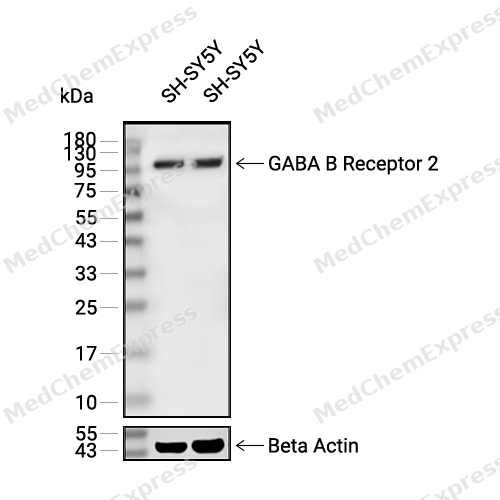 Western blot analysis of extracts from SH-SY5Y (lane 2(20μg), SH-SY5Y (lane 3(40μg), using GABA B Receptor 2 Antibody. Proteins were transferred to a PVDF membrane and blocked with 5% BSA in TBST for 2 hour at room temperature. The primary antibody and Loading control antibody (Beta Actin, HY-P80438, 1/3000) was used in 5% BSA in TBST at 4°C overnight. Goat Anti-Mouse/Rabbit IgG-HRP Secondary Antibody (HY-P8004/HY-P8001, 1/10,000) was used for 1 hour at room temperature.
 -
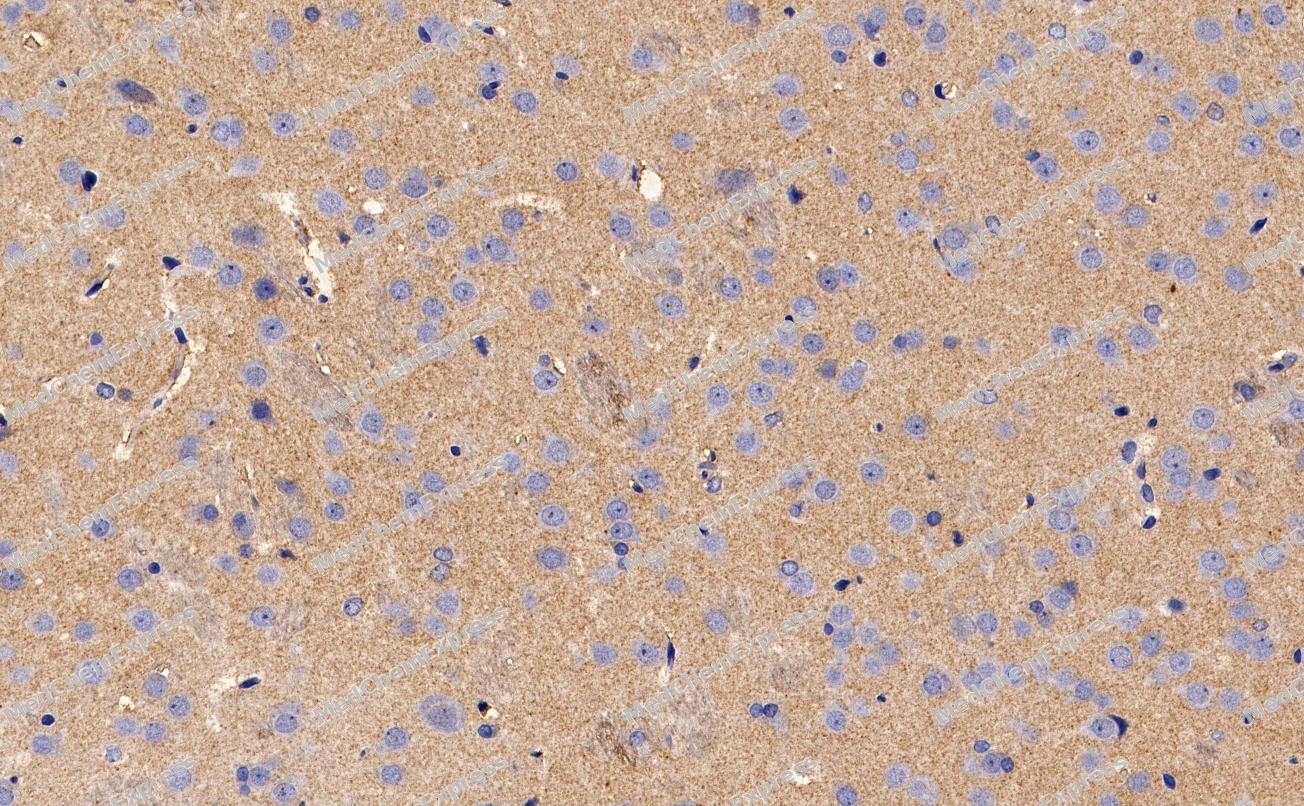 Immunohistochemical analysis of paraffin-embedded Rat brain tissue using GABA B Receptor 2 Antibody (YA1733). The section was pre-treated using heat mediated antigen retrieval with Tris-EDTA buffer (pH 9.0) for 8 minutes. The tissues were blocked in QuickBlock for 20 minutes at room temperature, washed with ddH2O and PBS, and then probed with the primary antibody (HY-P81988, 1/100) in 4℃ overnight. The detection was performed using an HRP conjugated compact polymer system. DAB was used as the chromogen. Tissues were counterstained with hematoxylin and mounted with DPX.
 -
Immunohistochemical analysis of paraffin-embedded Rat brain tissue using GABA B Receptor 2 Antibody (YA1733). The section was pre-treated using heat mediated antigen retrieval with Tris-EDTA buffer (pH 9.0) for 8 minutes. The tissues were blocked in QuickBlock for 20 minutes at room temperature, washed with ddH2O and PBS, and then probed with the primary antibody (HY-P81988, 1/100) in 4℃ overnight. The detection was performed using an HRP conjugated compact polymer system. DAB was used as the chromogen. Tissues were counterstained with hematoxylin and mounted with DPX.
-
 Immunocytochemistry analysis of Hela cells labeling GABA B Receptor 2 with GABA B Receptor 2 Antibody (HY-P81988) at 1/100 dilution. Cells were fixed in 4% paraformaldehyde for 15 minutes at room temperature, permeabilized with 0.1% Triton X-100 in PBS for 15 minutes at room temperature, then blocked with quick block buffer for 10 minutes at room temperature. Cells were then incubated with GABA B Receptor 2 Antibody (HY-P81988) at 1/100 dilution in quick block buffer overnight at 4 ℃. AF488-conjugated Goat Anti-Rabbit IgG H&L (HY-P8002, Green) was used as the secondary antibody at 1/1,000 dilution. PBS instead of the primary antibody was used as the secondary antibody only control. The Nuclear counterstain was DAPI (Blue).
 -
 Immunocytochemistry analysis of U2OS cells labeling GABA B Receptor 2 with GABA B Receptor 2 Antibody (HY-P81988) at 1/100 dilution. Cells were fixed in 4% paraformaldehyde for 15 minutes at room temperature, permeabilized with 0.1% Triton X-100 in PBS for 15 minutes at room temperature, then blocked with quick block buffer for 10 minutes at room temperature. Cells were then incubated with GABA B Receptor 2 Antibody (HY-P81988) at 1/100 dilution in quick block buffer overnight at 4 ℃. AF488-conjugated Goat Anti-Rabbit IgG H&L (HY-P8002, Green) was used as the secondary antibody at 1/1,000 dilution. PBS instead of the primary antibody was used as the secondary antibody only control. The Nuclear counterstain was DAPI (Blue).
 -
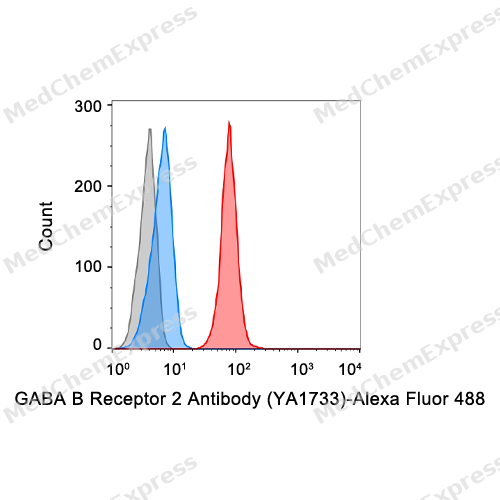 Flow cytometric analysis of 1X10^6 SH-SY5Y cells labeling GABA B Receptor 2 Antibody (YA1733) (HY-P81988, red). Cells were fixed with 4% paraformaldehyde. Then stained with the primary antibody at 1/50 dilution for an hour at 4℃. Alexa Fluor® 488-conjugated AffiniPure Goat Anti-Rabbit IgG H&L (HY-P8002) was used as the secondary antibody at 1/1,000 dilution for 30 minutes at 4℃. Rabbit IgG Isotype Control (HY-P80879, blue) was used as the isotype control, cells without incubation with primary antibody were used as the unlabeled control (black).


Background
-
Function
GABA B Receptor 2 component of a heterodimeric G-protein coupled receptor for GABA, formed by GABBR1 and GABBR2. Within the heterodimeric GABA receptor, only GABBR1 seems to bind agonists, while GABBR2 mediates coupling to G proteins. Ligand binding causes a conformation change that triggers signaling via guanine nucleotide-binding proteins (G proteins) and modulates the activity of down-stream effectors, such as adenylate cyclase. Signaling inhibits adenylate cyclase, stimulates phospholipase A2, activates potassium channels, inactivates voltage-dependent calcium-channels and modulates inositol phospholipid hydrolysis. Plays a critical role in the fine-tuning of inhibitory synaptic transmission. Pre-synaptic GABA receptor inhibits neurotransmitter release by down-regulating high-voltage activated calcium channels, whereas postsynaptic GABA receptor decreases neuronal excitability by activating a prominent inwardly rectifying potassium (Kir) conductance that underlies the late inhibitory postsynaptic potentials. Not only implicated in synaptic inhibition but also in hippocampal long-term potentiation, slow wave sleep, muscle relaxation and antinociception (Probable)[1][2][3][4][5][6][7][8][9].
-
Subcellular Localization
Cell membrane; Multi-pass membrane protein; Postsynaptic cell membrane; Multi-pass membrane protein
-
Expression
Tissue_specificity:Highly expressed in brain, especially in cerebral cortex, thalamus, hippocampus, frontal, occipital and temporal lobe, occipital pole and cerebellum, followed by corpus callosum, caudate nucleus, spinal cord, amygdala and medulla (PubMed:10087195, PubMed:10328880, PubMed:10727622, PubMed:9872744) . Weakly expressed in heart, testis and skeletal muscle (PubMed:10087195, PubMed:10727622) -
Subunit
Heterodimer of GABBR1 and GABBR2 (PubMed:10773016, PubMed:10906333, PubMed:15617512, PubMed:18165688, PubMed:22660477, PubMed:24305054, PubMed:9872316, PubMed:9872744). Homodimers may form, but are inactive (PubMed:15617512). Interacts (via C-terminus) with ATF4 (via leucine zipper domain) (By similarity)
-
SwissProt ID
-
Synonyms
GABBR2; GPR51; GPRC3B; Gamma-aminobutyric acid type B receptor subunit 2; GABA-B receptor 2; GABA-B-R2; GABA-BR2; GABABR2; Gb2; G-protein coupled receptor 51; HG20
-
Research Field
Neuroscience


Documentation
-
Data Sheet (258 KB)
-
SDS (252 KB)
- English - EN (252 KB)
- Français - FR (252 KB)
- Deutsch - DE (252 KB)
- Norwegian - NO (252 KB)
- Español - ES (252 KB)
- Swedish - SV (252 KB)
- Italian - IT (252 KB)
- Korean - KR (252 KB)
- Portuguese - PT (252 KB)
-
User Guide for Antibodies (1077 KB)

 Powered by Bioz
