



GABA B Receptor 1 Antibody (YA2418)
(Synonyms: GABA-B receptor 1; GABA-B-R1; GABAB R1; GABAB subunit 1c; GABABR1; GABBR1 3; Gamma aminobutyric acid (GABA) B receptor 1; Gb1; GPRC3A)
Based on 1 Customer Validation
GABA B Receptor 1 Antibody (YA2418) is a Rabbit-derived and non-conjugated IgG monoclonal antibody, targeting to GABA B Receptor 1.
-
Host:
Rabbit
-
Isotype:
IgG
-
Application:
WB
-
Reactivity :
Human, Mouse, Rat
-
Formulation:
Supplied in 50mM Tris-Glycine(pH 7.4), 0.15M NaCl, 40%Glycerol, 0.01% sodium azide and 0.05% BSA.
-
Conjugation:
Non-conjugated


To place orders, for customer services and technical support, please contact: MedChemExpress USA
Tel: 609-228-6898 E-mail: [email protected] [email protected]





Applications
| Application |
WB

WB: Western Blot
|
|---|---|
| Dilution Ratio | 1:500-1:1000 |


Product Details
GABA B Receptor 1 Antibody (YA2418) is a Rabbit-derived and non-conjugated IgG monoclonal antibody, targeting to GABA B Receptor 1.
-
Host Rabbit

-
Clonality Recombinant, Monoclonal

-
Species ReactivityHuman, Mouse, Rat
-
Observed Molecular WeightObserved band size: 108 kDa
Note: Due to possible protein modifications or aggregation, the molecular weight should be confirmed by actual measurement, and the predicted value is for reference only.

-
Calculated Molecular Weight Predicted band size: 108 kDa

Entrez Gene: 2550 Human ; 54393 Mouse ; 81657 Rat
SwissProt: Q9UBS5 Human ; Q9WV18 Mouse ; Q9Z0U4 Rat
OMIM: 620502 Human
A synthesized peptide derived from human GABA B Receptor 1 aa50-110.
Endogenous
Affinity Chromatography
Non-conjugated
Unmodified
IgG


Product Properties
-
Appearance
Liquid
-
Formulation
Supplied in 50mM Tris-Glycine(pH 7.4), 0.15M NaCl, 40%Glycerol, 0.01% sodium azide and 0.05% BSA.
-
Concentration
Batch-dependent, Please check the COA for the concentration of each lot. Check Lot Concentration
-
Storage & Stability
Stored at -20°C for 1 year. Avoid repeated freeze / thaw cycles.
-
Shipping
Shipping with blue ice.


Verification Images
-
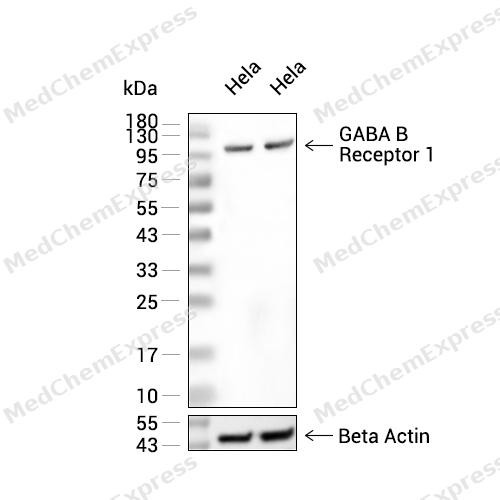 Western blot analysis of extracts from Hela (lane 2(20μg), Hela (lane 3(40μg), using GABA B Receptor 1 Antibody. Proteins were transferred to a PVDF membrane and blocked with 5% BSA in TBST for 2 hour at room temperature. The primary antibody and Loading control antibody (Beta Actin, HY-P80438, 1/3000) was used in 5% BSA in TBST at 4°C overnight. Goat Anti-Mouse/Rabbit IgG-HRP Secondary Antibody (HY-P8004/HY-P8001, 1/10,000) was used for 1 hour at room temperature.


Background
-
Function
GABA B Receptor 1 component of a heterodimeric G-protein coupled receptor for GABA, formed by GABBR1 and GABBR2. Within the heterodimeric GABA receptor, only GABBR1 seems to bind agonists, while GABBR2 mediates coupling to G proteins. Ligand binding causes a conformation change that triggers signaling via guanine nucleotide-binding proteins (G proteins) and modulates the activity of down-stream effectors, such as adenylate cyclase. Signaling inhibits adenylate cyclase, stimulates phospholipase A2, activates potassium channels, inactivates voltage-dependent calcium-channels and modulates inositol phospholipid hydrolysis. Calcium is required for high affinity binding to GABA. Plays a critical role in the fine-tuning of inhibitory synaptic transmission. Pre-synaptic GABA receptor inhibits neurotransmitter release by down-regulating high-voltage activated calcium channels, whereas postsynaptic GABA receptor decreases neuronal excitability by activating a prominent inwardly rectifying potassium (Kir) conductance that underlies the late inhibitory postsynaptic potentials. Not only implicated in synaptic inhibition but also in hippocampal long-term potentiation, slow wave sleep, muscle relaxation and antinociception (Probable). Activated by (-)-baclofen, cgp27492 and blocked by phaclofen; Isoform 1E may regulate the formation of functional GABBR1/GABBR2 heterodimers by competing for GABBR2 binding. This could explain the observation that certain small molecule ligands exhibit differential affinity for central versus peripheral sites[1][2][3][4][5][6][7][8][9][10][11].
-
Subcellular Localization
Cell membrane; Multi-pass membrane protein; Postsynaptic cell membrane; Multi-pass membrane protein; Cell projection, dendrite; Secreted
-
Expression
Tissue_specificity:Highly expressed in brain (PubMed:9753614, PubMed:9844003, PubMed:9872744) . Weakly expressed in heart, small intestine and uterus. Isoform 1A: Mainly expressed in granular cell and molecular layer (PubMed:9844003) . Isoform 1B: Mainly expressed in Purkinje cells (PubMed:9844003) . Isoform 1E: Predominantly expressed in peripheral tissues as kidney, lung, trachea, colon, small intestine, stomach, bone marrow, thymus and mammary gland (PubMed:10906333) -
Isoforms & Post-Translational Modification
Q9UBS5 has 5 isomers: Q9UBS5-1: 108320 Da (predicted); Q9UBS5-2: 95148 Da (predicted); Q9UBS5-3: 101543 Da (predicted); Q9UBS5-4: 104665 Da (predicted); Q9UBS5-5: 65082 Da (predicted).
-
Subunit
Heterodimer of GABBR1 and GABBR2 (PubMed:10773016, PubMed:15617512, PubMed:18165688, PubMed:22660477, PubMed:24305054, PubMed:9872316, PubMed:9872744). Homodimers may form, but are inactive (PubMed:15617512, PubMed:9872316). Isoform 1E (without C-terminal intracellular domain) is unable to dimerize via a coiled-coil interaction with GABBR2 (PubMed:10906333). Interacts (via C-terminus) with ATF4 (via leucine zipper domain) (By similarity). Interacts with JAKMIP1 (PubMed:14718537)
-
SwissProt ID
-
Synonyms
GABA-B receptor 1; GABA-B-R1; GABAB R1; GABAB subunit 1c; GABABR1; GABBR1 3; Gamma aminobutyric acid (GABA) B receptor 1; Gb1; GPRC3A
-
Research Field
Neuroscience


Documentation
-
Data Sheet (258 KB)
-
SDS (252 KB)
- English - EN (252 KB)
- Français - FR (252 KB)
- Deutsch - DE (252 KB)
- Norwegian - NO (252 KB)
- Español - ES (252 KB)
- Swedish - SV (252 KB)
- Italian - IT (252 KB)
- Korean - KR (252 KB)
- Portuguese - PT (252 KB)
-
User Guide for Antibodies (1077 KB)

 Powered by Bioz
