



GC1q R Antibody (YA2311)
(Synonyms: C1QBP; GC1QBP; HABP1; SF2P32; Complement component 1 Q subcomponent-binding protein; mitochondrial; GC1q-R protein; Glycoprotein gC1qBP; C1qBP; Hyaluronan-binding protein 1; Mitochondrial matrix protein p32; p33)Based on 1 Customer Validation
GC1q R Antibody (YA2311) is a Rabbit-derived and non-conjugated IgG monoclonal antibody, targeting to GC1q R.
-
Host:
Rabbit
-
Isotype:
IgG
-
Application:
WB, IP
-
Reactivity :
Human, Mouse, Rat
-
Formulation:
Supplied in 50mM Tris-Glycine(pH 7.4), 0.15M NaCl, 40% Glycerol, 0.01% Sodium azide and 0.05% BSA
-
Conjugation:
Non-conjugated


To place orders, for customer services and technical support, please contact: MedChemExpress USA
Tel: 609-228-6898 E-mail: [email protected] [email protected]





Applications
| Application |
WB

WB: Western Blot
|
IP
IP: Immunoprecipitation
|
|---|---|---|
| Dilution Ratio | 1:500-1:1000 | 1:20 |


Product Details
GC1q R Antibody (YA2311) is a Rabbit-derived and non-conjugated IgG monoclonal antibody, targeting to GC1q R.
-
Host Rabbit

-
Clonality Recombinant,Monoclonal

-
Species ReactivityHuman, Mouse, Rat
-
Observed Molecular WeightObserved band size: 31 kDa
Note: Due to possible protein modifications or aggregation, the molecular weight should be confirmed by actual measurement, and the predicted value is for reference only.

-
Calculated Molecular Weight Predicted band size: 31 kDa

SwissProt: Q07021 Human ; O35658 Mouse ; O35796 Rat
OMIM: 617713 Human
A synthetic peptide of human C1QBP
Endogenous
Affinity Purified
Non-conjugated
Unmodified
IgG


Product Properties
-
Appearance
Solution
-
Formulation
Supplied in 50mM Tris-Glycine(pH 7.4), 0.15M NaCl, 40% Glycerol, 0.01% Sodium azide and 0.05% BSA
-
Concentration
Batch-dependent, Please check the COA for the concentration of each lot. Check Lot Concentration
-
Storage & Stability
Stored at -20°C for 1 year. Avoid repeated freeze / thaw cycles.
-
Shipping
Shipping with blue ice.


Verification Images
-
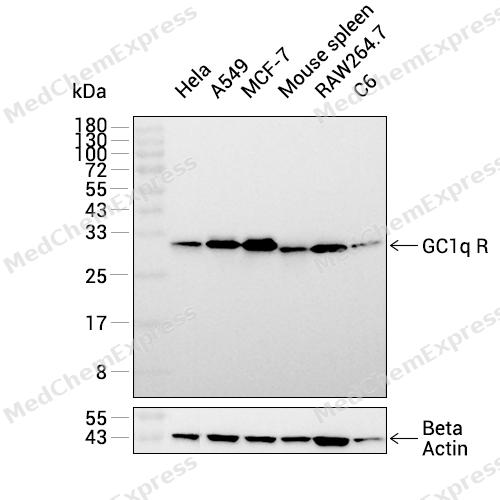
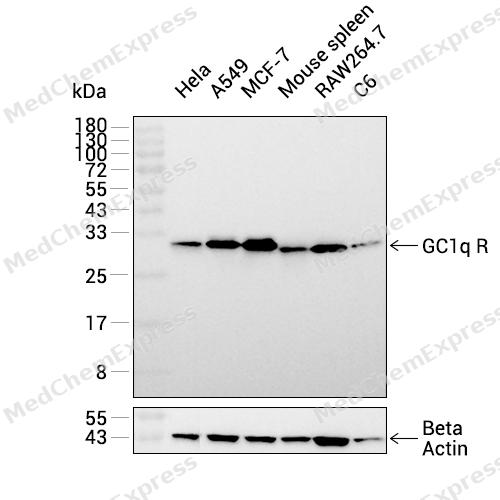 Western blot analysis was performed on extracts from Hela (lane 1, 15 μg), A549 (lane 2, 15 μg), MCF-7 (lane 3, 15 μg), Mouse spleen (lane 4, 15 μg), RAW264.7 (lane 5, 15 μg), and C6 (lane 6, 15 μg) using GC1q R Rabbit mAb.Proteins were transferred to a PVDF membrane and blocked with 5% non-fat milk in TBST at 4°C overnight.The primary antibody (1:1000 dilution) and the loading control antibody (beta-Actin, HY-P83730, 1:20000 dilution) were incubated in 5% non-fat milk in TBST for 1 hour at 37°C.Goat Anti-Rabbit IgG-HRP Secondary Antibody (1:20000 dilution) was then applied for 40 minutes at 37°C.
 -
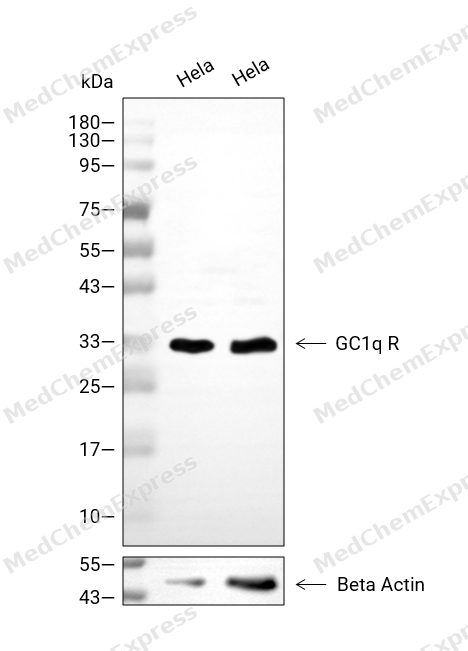 Western blot analysis of extracts from Hela (lane 2(20μg), Hela (lane 3(40μg), using GC1q R Antibody. Proteins were transferred to a PVDF membrane and blocked with 5% BSA in TBST for 2 hour at room temperature. The primary antibody and Loading control antibody (Beta Actin, HY-P80438, 1/3000) was used in 5% BSA in TBST at 4°C overnight. Goat Anti-Mouse/Rabbit IgG-HRP Secondary Antibody (HY-P8004/HY-P8001, 1/10,000) was used for 1 hour at room temperature.


Background
-
Function
GC1q R multifunctional and multicompartmental protein involved in inflammation and infection processes, ribosome biogenesis, protein synthesis in mitochondria, regulation of apoptosis, transcriptional regulation and pre-mRNA splicing. At the cell surface is thought to act as an endothelial receptor for plasma proteins of the complement and kallikrein-kinin cascades. Putative receptor for C1q; specifically binds to the globular 'heads' of C1q thus inhibiting C1; may perform the receptor function through a complex with C1qR/CD93. In complex with cytokeratin-1/KRT1 is a high affinity receptor for kininogen-1/HMWK. Can also bind other plasma proteins, such as coagulation factor XII leading to its autoactivation. May function to bind initially fluid kininogen-1 to the cell membrane. The secreted form may enhance both extrinsic and intrinsic coagulation pathways. It is postulated that the cell surface form requires docking with transmembrane proteins for downstream signaling which might be specific for a cell-type or response. By acting as C1q receptor is involved in chemotaxis of immature dendritic cells and neutrophils and is proposed to signal through CD209/DC-SIGN on immature dendritic cells, through integrin alpha-4/beta-1 during trophoblast invasion of the decidua, and through integrin beta-1 during endothelial cell adhesion and spreading. Signaling involved in inhibition of innate immune response is implicating the PI3K-AKT/PKB pathway. Required for protein synthesis in mitochondria. In mitochondrial translation may be involved in formation of functional 55S mitoribosomes; the function seems to involve its RNA-binding activity. Acts as a RNA modification reader, which specifically recognizes and binds mitochondrial RNAs modified by C5-methylcytosine (m5C) in response to stress, and promotes recruitment of the mitochondrial degradosome complex, leading to their degradation. May be involved in the nucleolar ribosome maturation process; the function may involve the exchange of FBL for RRP1 in the association with pre-ribosome particles. Involved in regulation of RNA splicing by inhibiting the RNA-binding capacity of SRSF1 and its phosphorylation. Is required for the nuclear translocation of splicing factor U2AF1L4. Involved in regulation of CDKN2A- and HRK-mediated apoptosis. Stabilizes mitochondrial CDKN2A isoform smARF. May be involved in regulation of FOXC1 transcriptional activity and NFY/CCAAT-binding factor complex-mediated transcription. May play a role in antibacterial defense as it can bind to cell surface hyaluronan and inhibit Streptococcus pneumoniae hyaluronate lyase. May be involved in modulation of the immune response; ligation by HCV core protein is resulting in suppression of interleukin-12 production in monocyte-derived dendritic cells. Involved in regulation of antiviral response by inhibiting RIGI- and IFIH1-mediated signaling pathways probably involving its association with MAVS after viral infection. Acts as a regulator of DNA repair via homologous recombination by inhibiting the activity of MRE11: interacts with unphosphorylated MRE11 and RAD50 in absence of DNA damage, preventing formation and activity of the MRN complex. Following DNA damage, dissociates from phosphorylated MRE11, allowing formation of the MRN complex; (Microbial infection) Involved in HIV-1 replication, presumably by contributing to splicing of viral RNA; (Microbial infection) In infection processes acts as an attachment site for microbial proteins, including Listeria monocytogenes internalin B (InlB) and Staphylococcus aureus protein A; (Microbial infection) Involved in replication of Rubella virus[1][2][3][4][5][6][7][8][9][10][11][12][13][14][15][16][17][18][19][20][21][22][23][24].
-
Subcellular Localization
Mitochondrion matrix; Nucleus; Nucleus, nucleolus; Cell membrane; Peripheral membrane protein; Extracellular side; Secreted; Cytoplasm
-
Expression
Tissue_specificity:Expressed on cell surface of peripheral blood cells (at protein level) ; Surface expression is reported for macrophages and monocyte-derived dendritic cells
Induction:Enhanced cell surface expression upon platelet and monocyte activation -
Subunit
Homotrimer; three monomers form a donut-shaped structure with an unusually asymmetric charge distribution on the surface. Interacts with CDK13, HRK, VTN, NFYB, ADRA1B, FOXC1, DDX21, DDX50, NCL, SRSF1, SRSF9 and CDKN2A isoform smARF.
-
SwissProt ID
-
Synonyms
C1QBP; GC1QBP; HABP1; SF2P32; Complement component 1 Q subcomponent-binding protein; mitochondrial; GC1q-R protein; Glycoprotein gC1qBP; C1qBP; Hyaluronan-binding protein 1; Mitochondrial matrix protein p32; p33
-
Research Field
Epigenetics and Nuclear Signaling


Documentation
-
Data Sheet (266 KB)
-
SDS (252 KB)
- English - EN (252 KB)
- Français - FR (252 KB)
- Deutsch - DE (252 KB)
- Norwegian - NO (252 KB)
- Español - ES (252 KB)
- Swedish - SV (252 KB)
- Italian - IT (252 KB)
- Korean - KR (252 KB)
- Portuguese - PT (252 KB)
-
User Guide for Antibodies (1077 KB)
References
[1]. Petersen-Mahrt SK, et al. The splicing factor-associated protein, p32, regulates RNA splicing by inhibiting ASF/SF2 RNA binding and phosphorylation. EMBO J. 1999 Feb 15;18(4):1014-24. [Content Brief]
[2]. Joseph K, et al. Cytokeratin 1 and gC1qR mediate high molecular weight kininogen binding to endothelial cells. Clin Immunol. 1999 Sep;92(3):246-55. [Content Brief]
[3]. Nguyen T, et al. Staphylococcus aureus protein A recognizes platelet gC1qR/p33: a novel mechanism for staphylococcal interactions with platelets. Infect Immun. 2000 Apr;68(4):2061-8. [Content Brief]
[4]. Kittlesen DJ, et al. Interaction between complement receptor gC1qR and hepatitis C virus core protein inhibits T-lymphocyte proliferation. J Clin Invest. 2000 Nov;106(10):1239-49. [Content Brief]
[5]. Feng X, et al. Cooperation of C1q receptors and integrins in C1q-mediated endothelial cell adhesion and spreading. J Immunol. 2002 Mar 1;168(5):2441-8. [Content Brief]
[6]. Chattopadhyay C, et al. Human p32, interacts with B subunit of the CCAAT-binding factor, CBF/NF-Y, and inhibits CBF-mediated transcription activation in vitro. Nucleic Acids Res. 2004;32(12):3632-41. [Content Brief]
[7]. Vegh Z, et al. Chemotaxis of human monocyte-derived dendritic cells to complement component C1q is mediated by the receptors gC1qR and cC1qR. Mol Immunol. 2006 Mar;43(9):1402-7. [Content Brief]
[8]. Waggoner SN, et al. gC1q receptor ligation selectively down-regulates human IL-12 production through activation of the phosphoinositide 3-kinase pathway. J Immunol. 2005 Oct 1;175(7):4706-14. [Content Brief]
[9]. Waggoner SN, et al. HCV core protein interaction with gC1q receptor inhibits Th1 differentiation of CD4+ T cells via suppression of dendritic cell IL-12 production. J Leukoc Biol. 2007 Dec;82(6):1407-19. [Content Brief]
[10]. Huang L, et al. Human p32 is a novel FOXC1-interacting protein that regulates FOXC1 transcriptional activity in ocular cells. Invest Ophthalmol Vis Sci. 2008 Dec;49(12):5243-9. [Content Brief]
[11]. Yadav G, et al. Evidence for inhibitory interaction of hyaluronan-binding protein 1 (HABP1/p32/gC1qR) with Streptococcus pneumoniae hyaluronidase. J Biol Chem. 2009 Feb 6;284(6):3897-905. [Content Brief]
[12]. Xu L, et al. Inhibition of RIG-I and MDA5-dependent antiviral response by gC1qR at mitochondria. Proc Natl Acad Sci U S A. 2009 Feb 3;106(5):1530-5. [Content Brief]
[13]. Agostinis C, et al. An alternative role of C1q in cell migration and tissue remodeling: contribution to trophoblast invasion and placental development. J Immunol. 2010 Oct 1;185(7):4420-9. [Content Brief]
[14]. Yoshikawa H, et al. Splicing factor 2-associated protein p32 participates in ribosome biogenesis by regulating the binding of Nop52 and fibrillarin to preribosome particles. Mol Cell Proteomics. 2011 Aug;10(8):M110.006148. [Content Brief]
[15]. Pixley RA, et al. Interaction of high-molecular-weight kininogen with endothelial cell binding proteins suPAR, gC1qR and cytokeratin 1 determined by surface plasmon resonance (BiaCore). Thromb Haemost. 2011 Jun;105(6):1053-9. [Content Brief]
[16]. Hosszu KK, et al. DC-SIGN, C1q, and gC1qR form a trimolecular receptor complex on the surface of monocyte-derived immature dendritic cells. Blood. 2012 Aug 9;120(6):1228-36. [Content Brief]
[17]. Feichtinger RG, et al. Biallelic C1QBP Mutations Cause Severe Neonatal-, Childhood-, or Later-Onset Cardiomyopathy Associated with Combined Respiratory-Chain Deficiencies. Am J Hum Genet. 2017 Oct 5;101(4):525-538. [Content Brief]
[18]. Herwald H, et al. Isolation and characterization of the kininogen-binding protein p33 from endothelial cells. Identity with the gC1q receptor. J Biol Chem. 1996 May 31;271(22):13040-7. [Content Brief]
[19]. Joseph K, et al. Identification of the zinc-dependent endothelial cell binding protein for high molecular weight kininogen and factor XII: identity with the receptor that binds to the globular "heads" of C1q (gC1q-R). Proc Natl Acad Sci U S A. 1996 Aug 6;93(16):8552-7. [Content Brief]
[20]. Leigh LE, et al. C1q-mediated chemotaxis by human neutrophils: involvement of gClqR and G-protein signalling mechanisms. Biochem J. 1998 Feb 15;330 ( Pt 1)(Pt 1):247-54. [Content Brief]
[21]. Ghebrehiwet B, et al. Isolation, cDNA cloning, and overexpression of a 33-kD cell surface glycoprotein that binds to the globular "heads" of C1q. J Exp Med. 1994 Jun 1;179(6):1809-21. [Content Brief]
[22]. Kim S, et al. RNA 5-methylcytosine marks mitochondrial double-stranded RNAs for degradation and cytosolic release. Mol Cell. 2024 Aug 8;84(15):2935-2948.e7. [Content Brief]
[23]. Reef S, et al. The autophagic inducer smARF interacts with and is stabilized by the mitochondrial p32 protein. Oncogene. 2007 Oct 11;26(46):6677-83. [Content Brief]
[24]. Bai Y, et al. C1QBP Promotes Homologous Recombination by Stabilizing MRE11 and Controlling the Assembly and Activation of MRE11/RAD50/NBS1 Complex. Mol Cell. 2019 Sep 19;75(6):1299-1314.e6. [Content Brief]

 Powered by Bioz
