



DFNA5/GSDME Antibody (YA398)
(Synonyms: DFNA5; ICERE-1; GSDME)Based on 1 Customer Validation
DFNA5/GSDME Antibody (YA398) is a Rabbit-derived and non-conjugated IgG monoclonal antibody, targeting to DFNA5/GSDME.
-
Host:
Rabbit
-
Isotype:
IgG
-
Application:
WB, IP
-
Reactivity :
Human
-
Formulation:
Supplied in 50 mM Tris-Glycine (pH 7.4), 0.15 M NaCl, 40% Glycerol and 0.05% BSA. Preservative: 0.01% Sodium azide
-
Conjugation:
Non-conjugated


To place orders, for customer services and technical support, please contact: MedChemExpress USA
Tel: 609-228-6898 E-mail: [email protected] [email protected]





Applications
| Application |
WB

WB: Western Blot
|
IP
IP: Immunoprecipitation
|
|---|---|---|
| Dilution Ratio | 1:500-1:1000 | 1:20 |


Product Details
DFNA5/GSDME Antibody (YA398) is a Rabbit-derived and non-conjugated IgG monoclonal antibody, targeting to DFNA5/GSDME.
-
Host Rabbit

-
Clonality Recombinant,Monoclonal

-
Species ReactivityHuman
-
Observed Molecular WeightObserved band size: 55 kDa
Note: Due to possible protein modifications or aggregation, the molecular weight should be confirmed by actual measurement, and the predicted value is for reference only.

-
Calculated Molecular Weight Predicted band size: 55 kDa

Synthetic peptide corresponding to Human DFNA5/GSDME.The exact sequence is proprietary to MCE.
Endogenous
affinity purified
Non-conjugated
Unmodified
IgG


Product Properties
-
Appearance
Solution
-
Formulation
Supplied in 50 mM Tris-Glycine (pH 7.4), 0.15 M NaCl, 40% Glycerol and 0.05% BSA. Preservative: 0.01% Sodium azide
-
Concentration
Batch-dependent, Please check the COA for the concentration of each lot. Check Lot Concentration
-
Storage & Stability
Stored at -20°C for 1 year. Avoid repeated freeze / thaw cycles.
-
Shipping
Shipping with blue ice.


Verification Images
-
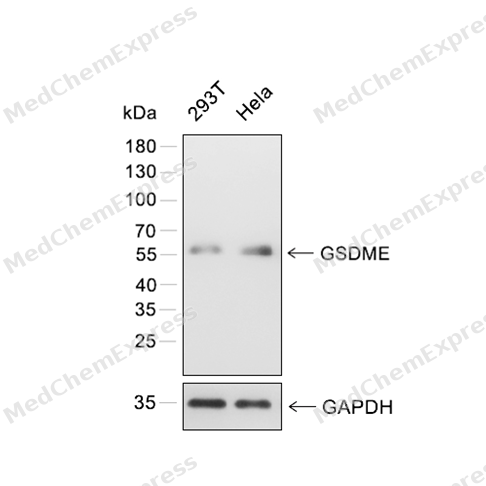 Western blot analysis of extracts from 293T (lane 1) and Hela (lane 2) using GSDME antibody. Proteins were transferred to a PVDF membrane and blocked with 5% nonfat powdered milk in PBST for 2 hour at room temperature. The primary antibody (1/1000) and Loading control antibody (GAPDH, 1/3000) was diluted with 5% nonfat powdered milk in PBST at 4°C overnight. Goat Anti-Rabbit IgG-HRP Secondary Antibody (1/8,000) was incubated for 45min at room temperature.


Background
-
Function
DFNA5/GSDME is a Precursor of a pore-forming protein that converts non-inflammatory apoptosis to pyroptosis. This form constitutes the precursor of the pore-forming protein: upon cleavage, the released N-terminal moiety (Gasdermin-E, N-terminal) binds to membranes and forms pores, triggering pyroptosis; Pore-forming protein produced by cleavage by CASP3 or granzyme B (GZMB), which converts non-inflammatory apoptosis to pyroptosis or promotes granzyme-mediated pyroptosis, respectively. After cleavage, moves to the plasma membrane, homooligomerizes within the membrane and forms pores of 10-15 nanometers (nm) of inner diameter, allowing the release of mature interleukins (IL1B and IL16) and triggering pyroptosis. Binds to inner leaflet lipids, bisphosphorylated phosphatidylinositols, such as phosphatidylinositol (4,5)-bisphosphate. Cleavage by CASP3 switches CASP3-mediated apoptosis induced by TNF or danger signals, such as chemotherapy drugs, to pyroptosis. Mediates secondary necrosis downstream of the mitochondrial apoptotic pathway and CASP3 activation as well as in response to viral agents. Exhibits bactericidal activity. Cleavage by GZMB promotes tumor suppressor activity by triggering robust anti-tumor immunity. Suppresses tumors by mediating granzyme-mediated pyroptosis in target cells of natural killer (NK) cells: cleavage by granzyme B (GZMB), delivered to target cells from NK-cells, triggers pyroptosis of tumor cells and tumor suppression. May play a role in the p53/TP53-regulated cellular response to DNA damage; (Microbial infection) Pore-forming protein, which promotes maternal placental pyroptosis in response to Zika virus infection, contributing to adverse fetal outcomes[1][2][3][4][5][6][7][8][9][10].
-
Subcellular Localization
Cell membrane; Multi-pass membrane protein; Cytoplasm, cytosol
-
Expression
Tissue_specificity:It is expressed in the cochlea (PubMed: 9771715) . It is expressed at low levels in the heart, brain, placenta, lungs, liver, skeletal muscle, kidneys, and pancreas, with the highest expression in the placenta (PubMed: 9771715) . -
Isoforms & Post-Translational Modification
O60443 has 3 isomers: O60443-1: 54555 Da (predicted); O60443-2: 10906 Da (predicted); O60443-3: 36043 Da (predicted).
Cleavage at Asp-270 by CASP3 (mature and uncleaved precursor forms) or granzyme B (GZMB) relieves autoinhibition and is sufficient to initiate pyroptosis;Succination by the Krebs cycle intermediate fumarate, which leads to S-(2-succinyl)cysteine residues, inhibits processing by caspases, and ability to initiate pyroptosis (PubMed:32820063). Succination modification is catalyzed by a non-enzymatic reaction caused by an accumulation of fumarate (PubMed:32820063);Ubiquitinated at Lys-120 and Lys-189 via 'Lys-48'-linked polyubiquitin chains, leading to proteasomal degradation. Deubiquitinated by USP48, leading to increased stability;Palmitoylated -
Subunit
Homooligomer; homooligomeric ring-shaped pore complex containing 27-28 subunits when inserted in the membrane
-
SwissProt ID
-
Synonyms
DFNA5; ICERE-1; GSDME
-
Research Field
Neuroscience


Documentation
-
Data Sheet (262 KB)
-
SDS (251 KB)
- English - EN (251 KB)
- Français - FR (251 KB)
- Deutsch - DE (251 KB)
- Norwegian - NO (251 KB)
- Español - ES (251 KB)
- Swedish - SV (251 KB)
- Italian - IT (251 KB)
- Korean - KR (251 KB)
- Portuguese - PT (251 KB)
-
User Guide for Antibodies (1077 KB)
References
[1]. Ding J, et al. Pore-forming activity and structural autoinhibition of the gasdermin family. Nature. 2016 Jul 7;535(7610):111-6. [Content Brief]
[2]. Wang Y, et al. Chemotherapy drugs induce pyroptosis through caspase-3 cleavage of a gasdermin. Nature. 2017 Jul 6;547(7661):99-103. [Content Brief]
[3]. Zhou B, et al. Gasdermin E permits interleukin-1 beta release in distinct sublytic and pyroptotic phases. Cell Rep. 2021 Apr 13;35(2):108998. [Content Brief]
[4]. Planès R, et al. Human NLRP1 is a sensor of pathogenic coronavirus 3CL proteases in lung epithelial cells. Mol Cell. 2022 Jul 7;82(13):2385-2400.e9. [Content Brief]
[5]. Ren Y, et al. USP48 Stabilizes Gasdermin E to Promote Pyroptosis in Cancer. Cancer Res. 2023 Apr 4;83(7):1074-1093. [Content Brief]
[6]. Zhang Z, et al. Gasdermin E suppresses tumour growth by activating anti-tumour immunity. Nature. 2020 Mar;579(7799):415-420. [Content Brief]
[7]. Rogers C, et al. Cleavage of DFNA5 by caspase-3 during apoptosis mediates progression to secondary necrotic/pyroptotic cell death. Nat Commun. 2017 Jan 3;8:14128. [Content Brief]
[8]. Op de Beeck K, et al. The DFNA5 gene, responsible for hearing loss and involved in cancer, encodes a novel apoptosis-inducing protein. Eur J Hum Genet. 2011 Sep;19(9):965-73. [Content Brief]
[9]. Liu Y, et al. Gasdermin E-mediated target cell pyroptosis by CAR T cells triggers cytokine release syndrome. Sci Immunol. 2020 Jan 17;5(43):. [Content Brief]
[10]. Masuda Y, et al. The potential role of DFNA5, a hearing impairment gene, in p53-mediated cellular response to DNA damage. J Hum Genet. 2006;51(8):652-664. [Content Brief]

 Powered by Bioz
