



HDAC1 Antibody (YA395)
(Synonyms: RPD3L1, HDAC1, Histone deacetylase 1, HD1, Protein deacetylase HDAC1, Protein deacylase HDAC1)
Based on 1 Customer Validation
HDAC1 Antibody is a non-conjugated and Rabbit origined IgG monoclonal antibody, targeting to HDAC1. It can be used as a loading control antibody.
-
Host:
Rabbit
-
Isotype:
IgG
-
Application:
WB, IHC-P, ICC/IF
-
Reactivity :
Human, Mouse
-
Formulation:
Supplied in 1*TBS (pH7.4), 0.05% BSA and 40% Glycerol. Preservative: 0.05% Sodium Azide.
-
Conjugation:
Non-conjugated


To place orders, for customer services and technical support, please contact: MedChemExpress USA
Tel: 609-228-6898 E-mail: [email protected] [email protected]





Applications
| Application |
WB

WB: Western Blot
|
IHC-P
IHC-P: Immunohistochemistry-Paraffin
|
ICC/IF
ICC/IF: Immunocytochemistry/
Immunofluorescence |
|---|---|---|---|
| Dilution Ratio | 1:500-1:2000 | 1:50-1:800 | 1:50 |


Product Details
HDAC1 Antibody is a non-conjugated and Rabbit origined IgG monoclonal antibody, targeting to HDAC1. It can be used as a loading control antibody.
-
Host Rabbit

-
Clonality Recombinant,Monoclonal

-
Species ReactivityHuman, Mouse
-
Observed Molecular WeightObserved band size: 65 kDa
Note: Due to possible protein modifications or aggregation, the molecular weight should be confirmed by actual measurement, and the predicted value is for reference only.

-
Calculated Molecular Weight Predicted band size: 55 kDa

Entrez Gene: 3065 Human ; 433759 Mouse ; 297893 Rat
SwissProt: Q13547 Human ; O09106 Mouse ; Q4QQW4 Rat
OMIM: 601241 Human
Synthetic peptide corresponding to Human HDAC1.AA range:420-460.
Endogenous
Protein A affinity purified.
Non-conjugated
Unmodified
IgG


Product Properties
-
Appearance
Solution
-
Formulation
Supplied in 1*TBS (pH7.4), 0.05% BSA and 40% Glycerol. Preservative: 0.05% Sodium Azide.
-
Concentration
Batch-dependent, Please check the COA for the concentration of each lot. Check Lot Concentration
-
Storage & Stability
Stored at -20°C for 1 year. Avoid repeated freeze / thaw cycles.
-
Shipping
Shipping with blue ice.


Verification Images
-
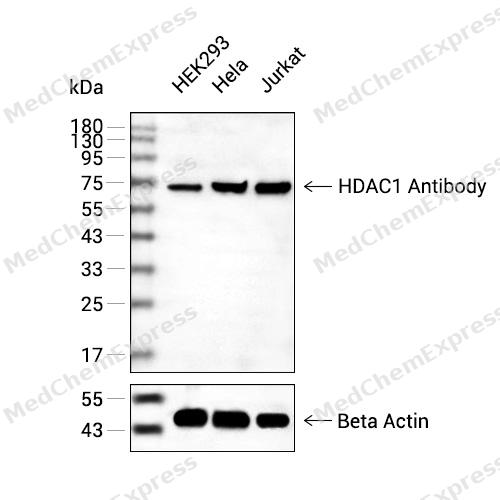 Western blot analysis of extracts from HEK293(lane2(20μg) , Hela(lane 3(20μg) and Jurkat(lane 4(20ug) using HDAC1 Antibody (HY-P80149) Rabbit mAb. Proteins were transferred to a PVDF membrane and blocked with 5% non-fat milk in TBST for 2 hour at room temperature. The primary antibody (1/1000) and Loading control antibody (Beta Actin, HY-P80438, 1/10000) was used in 5% non-fat milk in TBST at 4°C overnight. Goat Anti-Mouse/Rabbit IgG-HRP Secondary Antibody (1/10000) was used for 1 hour at room temperature.
 -
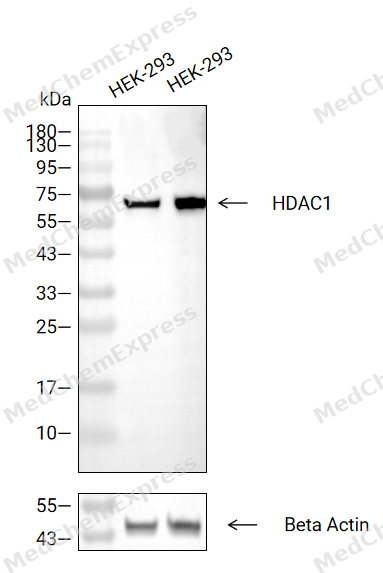 Western blot analysis of extracts from HEK-293(lane 2(20μg), HEK-293 (lane 3(40μg),using HDAC1 Antibody. Proteins were transferred to a PVDF membrane and blocked with 5% BSA in TBST for 2 hour at room temperature. The primary antibody and Loading control antibody (Beta Actin, HY-P80438, 1/3000) was used in 5% BSA in TBST at 4°C overnight. Goat Anti-Mouse/Rabbit IgG-HRP Secondary Antibody (HY-P8004/HY-P8001, 1/10,000) was used for 1 hour at room temperature.
 -
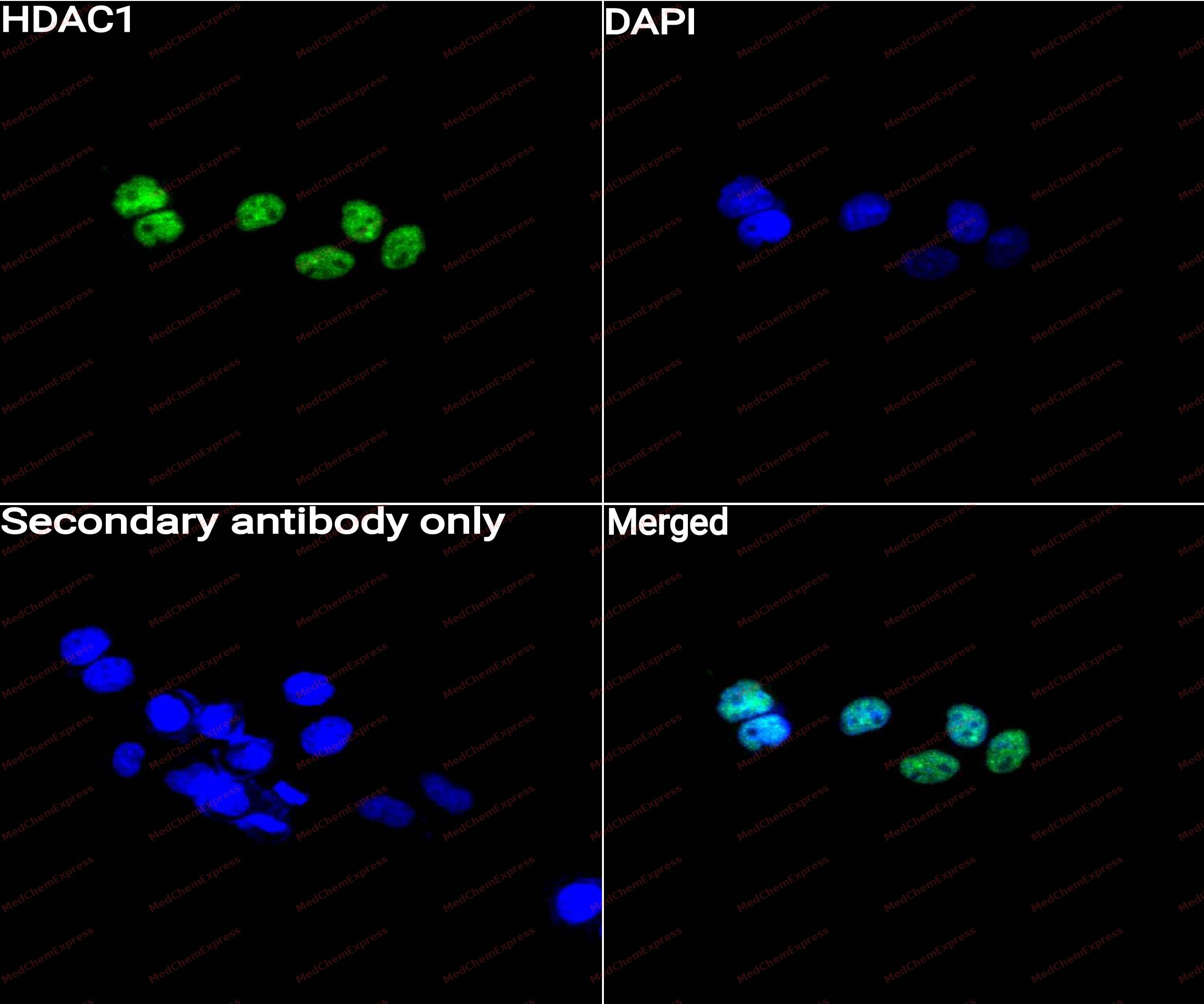 Immunocytochemistry analysis of Hela cells labeling HDAC1with HDAC1 Antibody (HY-P80149) at 1/50 dilution. Cells were fixed in 4% paraformaldehyde for 15 minutes at room temperature, permeabilized with 0.1% Triton X-100 for 10 minutes at room temperature, then blocked with QuickBlock™ Blocking Buffer for Immunol Staining for 10 min at room temperature. Cells were then incubated with HDAC1 Antibody (HY-P80149) at 1/50 dilution in QuickBlock™ Blocking Buffer for Immunol Staining at 4 ℃. Alexa Fluor® 488-conjugated AffiniPure Goat Anti-Rabbit IgG H&L(HY-P8002, Green) was used as the secondary antibody at 1/1,000 dilution. PBS instead of the primary antibody was used as the secondary antibody only control. The Nuclear counterstain was DAPI (Blue).
 -
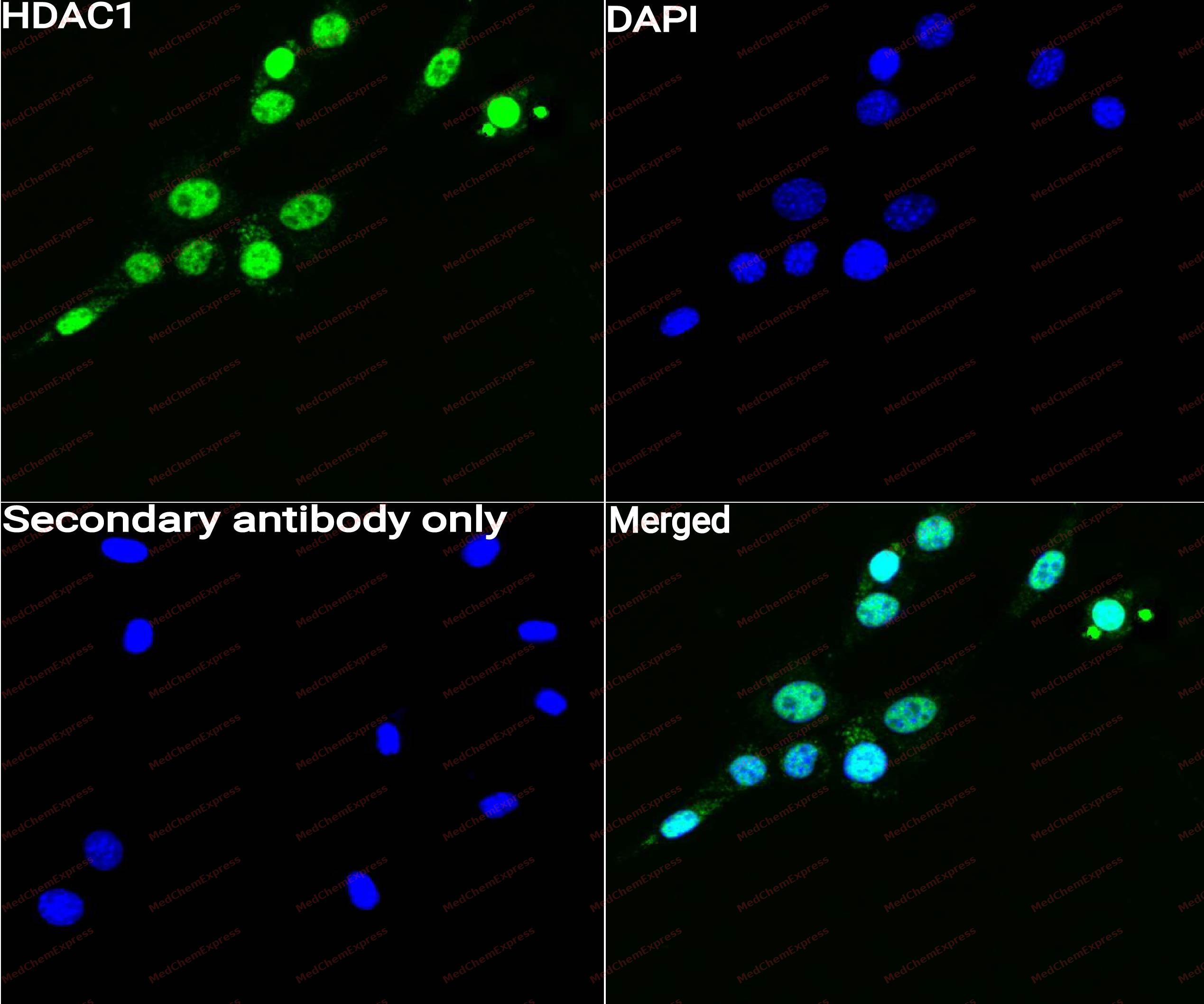 Immunocytochemistry analysis of NIH3T3 cells labeling HDAC1 with HDAC1 Antibody (HY-P80149) at 1/50 dilution. Cells were fixed in 4% paraformaldehyde for 15 minutes at room temperature, permeabilized with 0.1% Triton X-100 for 10 minutes at room temperature, then blocked with QuickBlock™ Blocking Buffer for Immunol Staining for 10 min at room temperature. Cells were then incubated with HDAC1Antibody (HY-P80149)at 1/50 dilution in QuickBlock™ Blocking Buffer for Immunol Staining at 4 ℃. Alexa Fluor® 488-conjugated AffiniPure Goat Anti-Rabbit IgG H&L(HY-P8002,Green) was used as the secondary antibody at 1/1,000 dilution. PBS instead of the primary antibody was used as the secondary antibody only control. The Nuclear counterstain was DAPI (Blue).
 -
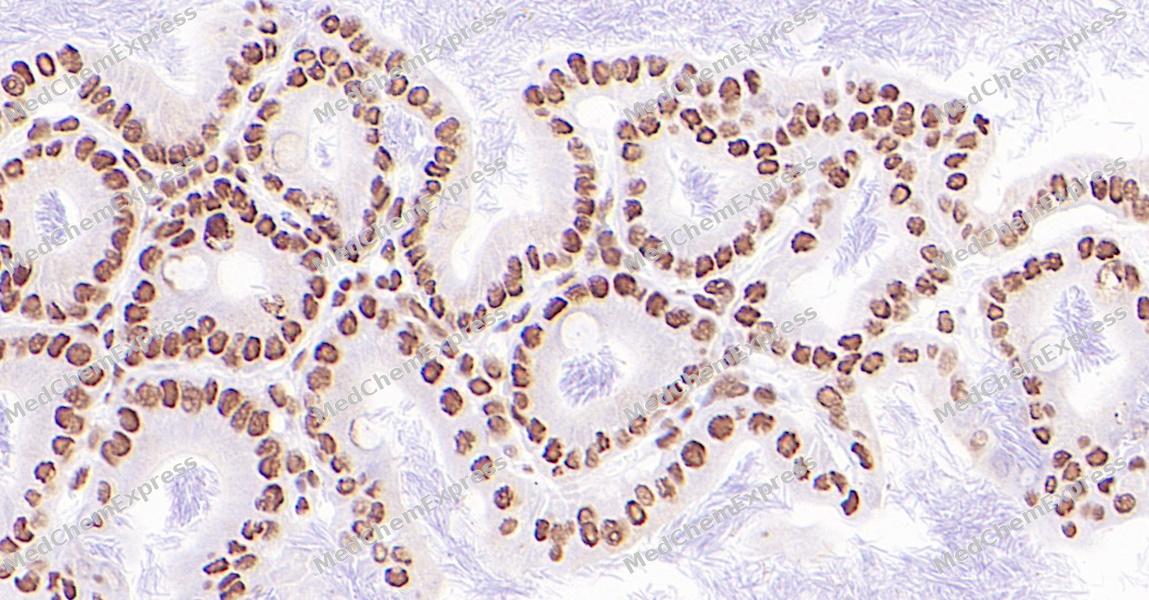 Immunohistochemical analysis of paraffin-embedded mouse colon tissue using HDAC1 Antibody. The section was pre-treated using heat mediated antigen retrieval with sodium citrate buffer (pH 6.0) for 8 minutes. The tissues were blocked in QuickBlock for 20 minutes at room temperature, washed with ddH2O and PBS, and then probed with the primary antibody (HY-P80149, 1:200) in 4℃ overnight. The detection was performed using an HRP conjugated compact polymer system. DAB was used as the chromogen. Tissues were counterstained with hematoxylin and mounted with DPX.
 -
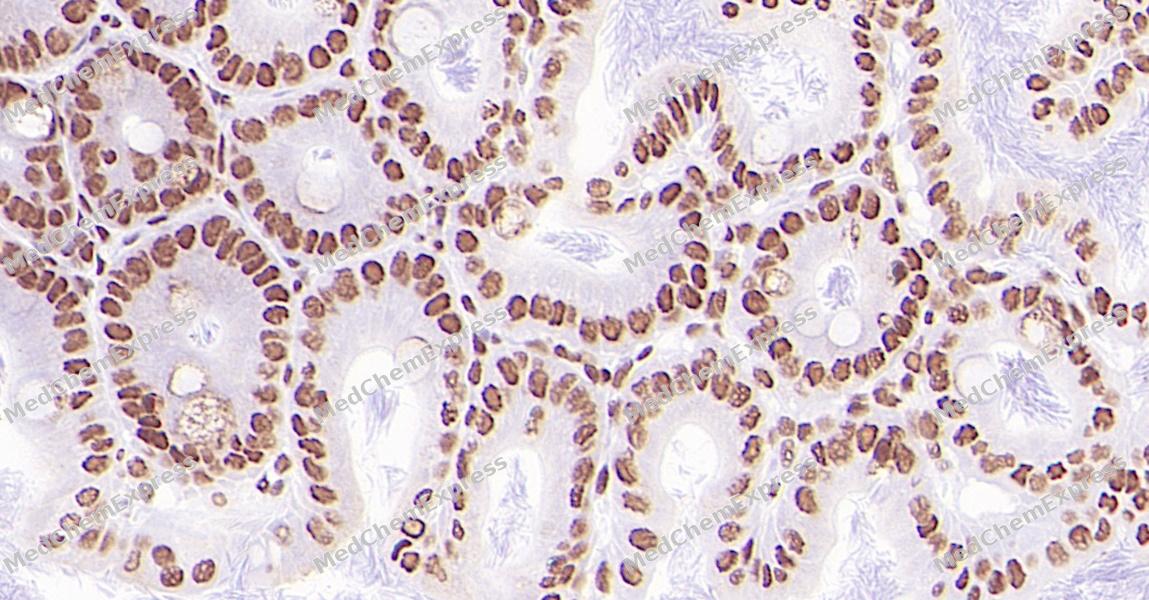 Immunohistochemical analysis of paraffin-embedded mouse colon tissue using HDAC1 Antibody. The section was pre-treated using heat mediated antigen retrieval with sodium citrate buffer (pH 6.0) for 8 minutes. The tissues were blocked in QuickBlock for 20 minutes at room temperature, washed with ddH2O and PBS, and then probed with the primary antibody (HY-P80149, 1:200) in 4℃ overnight. The detection was performed using an HRP conjugated compact polymer system. DAB was used as the chromogen. Tissues were counterstained with hematoxylin and mounted with DPX.


Background
-
Function
HDAC1 is a class I histone deacetylase that supports transcriptional repression through histone deacetylase activity[1]. Mechanistically, HDAC1/2 form core catalytic components of corepressor complexes that modulate gene expression, linking chromatin regulation to proliferation and stem-cell self-renewal[2]. In human tumor cells, HDAC1 knockdown causes G1 or G2/M arrest, growth inhibition, loss of mitotic cells, and increased apoptosis[3]. In embryonic stem cells, HDAC1, but not HDAC2, is required for optimal corepressor-complex activity and cell-fate determination during differentiation[4]. Compared with HDAC2, HDAC1 shows nonredundant disease relevance in glioma stem cells, where its loss is not compensated by HDAC2 and affects the glioma stem-cell phenotype in a p53-dependent manner[5]. For experimental applications, selective HDAC1/2 inhibition suppresses colorectal cancer cells through apoptosis induction and cell-cycle regulation, supporting inhibitor use in pathway-focused cancer models[6].
-
Subcellular Localization
Nucleus
-
Expression
Tissue_specificity:It is widely present in the body, with higher concentrations in the heart, pancreas, and testes, and lower concentrations in the kidneys and brain. -
Subunit
Part of the core histone deacetylase (HDAC) complex composed of HDAC1, HDAC2, RBBP4 and RBBP7, the core complex associates with SIN3, SAP18 and SAP30 to form the SIN3 HDAC complex (PubMed:12493763, PubMed:12724404, PubMed:19061646).
-
SwissProt ID
-
Synonyms
RPD3L1, HDAC1, Histone deacetylase 1, HD1, Protein deacetylase HDAC1, Protein deacylase HDAC1
-
Research Field
Epigenetics and Nuclear Signaling


Documentation
-
Data Sheet (263 KB)
-
SDS (251 KB)
- English - EN (251 KB)
- Français - FR (251 KB)
- Deutsch - DE (251 KB)
- Norwegian - NO (251 KB)
- Español - ES (251 KB)
- Swedish - SV (251 KB)
- Italian - IT (251 KB)
- Korean - KR (251 KB)
- Portuguese - PT (251 KB)
-
User Guide for Antibodies (1077 KB)
References
[1]. Hassig CA, et al. A role for histone deacetylase activity in HDAC1-mediated transcriptional repression. Proc Natl Acad Sci U S A. 1998 Mar 31;95(7):3519-24. [Content Brief]
[2]. Jamaladdin S, et al. Histone deacetylase (HDAC) 1 and 2 are essential for accurate cell division and the pluripotency of embryonic stem cells. Proc Natl Acad Sci U S A. 2014 Jul 8;111(27):9840-5. [Content Brief]
[3]. Senese S, et al. Role for histone deacetylase 1 in human tumor cell proliferation. Mol Cell Biol. 2007 Jul;27(13):4784-95. [Content Brief]
[4]. Dovey OM, et al. Histone deacetylase 1 (HDAC1), but not HDAC2, controls embryonic stem cell differentiation. Proc Natl Acad Sci U S A. 2010 May 4;107(18):8242-7. [Content Brief]
[5]. Lo Cascio C, et al. Nonredundant, isoform-specific roles of HDAC1 in glioma stem cells. JCI Insight. 2021 Sep 8;6(17):e149232. [Content Brief]
[6]. Lee HY, et al. A novel HDAC1/2 inhibitor suppresses colorectal cancer through apoptosis induction and cell cycle regulation. Chem Biol Interact. 2022 Jan 25;352:109778. [Content Brief]

 Powered by Bioz
