



HDAC3 Antibody (YA392)
(Synonyms: Histone deacetylase 3, HD3, Protein deacetylase HDAC3, Protein deacylase HDAC3, RPD3-2, SMAP45, HDAC3)
Based on 1 Customer Validation
HDAC3 Antibody (YA392) is a Rabbit-derived and non-conjugated IgG monoclonal antibody, targeting to HDAC3.
-
Host:
Rabbit
-
Isotype:
IgG
-
Application:
WB, ICC/IF, IHC-P, IP
-
Reactivity :
Human, Mouse, Rat
-
Formulation:
Supplied in 1*TBS (pH7.4), 0.05% BSA and 40% Glycerol. Preservative: 0.05% Sodium Azide.
-
Conjugation:
Non-conjugated


To place orders, for customer services and technical support, please contact: MedChemExpress USA
Tel: 609-228-6898 E-mail: [email protected] [email protected]





Applications
| Application |
WB

WB: Western Blot
|
ICC/IF
ICC/IF: Immunocytochemistry/
Immunofluorescence |
IHC-P
IHC-P: Immunohistochemistry-Paraffin
|
IP
IP: Immunoprecipitation
|
|---|---|---|---|---|
| Dilution Ratio | 1:1000-1:5000 | 1:50 | 1:50-1:1000 | Use at an assay dependent concentration. |


Product Details
HDAC3 Antibody (YA392) is a Rabbit-derived and non-conjugated IgG monoclonal antibody, targeting to HDAC3.
-
Host Rabbit

-
Clonality Recombinant,Monoclonal

-
Species ReactivityHuman, Mouse, Rat
-
Observed Molecular WeightObserved band size: 49 kDa
Note: Due to possible protein modifications or aggregation, the molecular weight should be confirmed by actual measurement, and the predicted value is for reference only.

-
Calculated Molecular Weight Predicted band size: 49 kDa

Entrez Gene: 8841 Human ; 15183 Mouse ; 84578 Rat
SwissProt: O15379 Human ; O88895 Mouse ; Q6P6W3 Rat
OMIM: 605166 Human
Synthetic peptide within C-terminal human HDAC3.
Endogenous
Protein A affinity purified.
Non-conjugated
Unmodified
IgG


Product Properties
-
Appearance
Solution
-
Formulation
Supplied in 1*TBS (pH7.4), 0.05% BSA and 40% Glycerol. Preservative: 0.05% Sodium Azide.
-
Concentration
Batch-dependent, Please check the COA for the concentration of each lot. Check Lot Concentration
-
Storage & Stability
Stored at -20°C for 1 year. Avoid repeated freeze / thaw cycles.
-
Shipping
Shipping with blue ice.


Verification Images
-
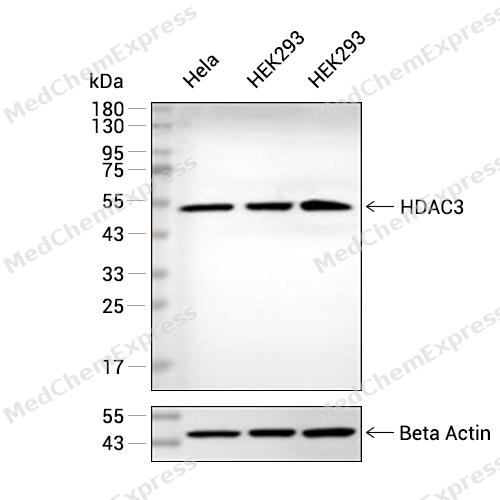 Western blot analysis of extracts from Hela(lane 2(20μg) , HEK293 (lane 3(20μg) and NIH3T3 (lane 4(20μg) using HDAC3(HY-P80152) Rabbit mAb. Proteins were transferred to a PVDF membrane and blocked with 5% non-fat milk in TBST for 2 hour at room temperature. The primary antibody (1/1000) and Loading control antibody (Beta Actin, HY-P80438, 1/10000) was used in 5% non-fat milk in TBST at 4°C overnight. Goat Anti-Mouse IgG-HRP Secondary Antibody (1/10000) was used for 1 hour at room temperature.
 -
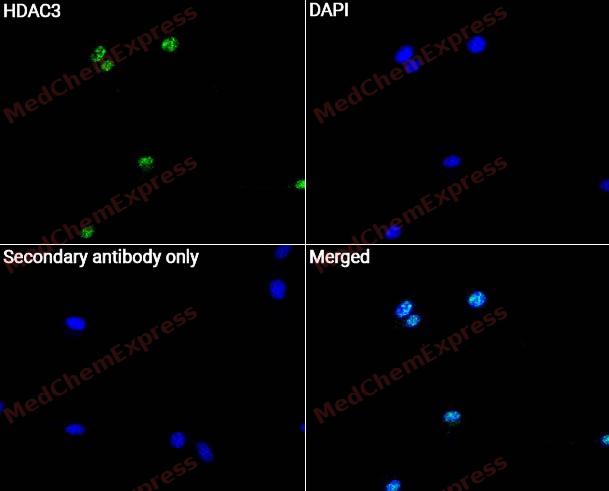 Immunocytochemistry analysis of NIH/3T3 cells labeling HDAC3 with HDAC3 Antibody (HY-P80152) at 1/50 dilution. Cells were fixed in 4% paraformaldehyde for 15 minutes at room temperature, permeabilized with 0.1% Triton X-100 for 10 minutes at room temperature, then blocked with QuickBlock™ Blocking Buffer for Immunol Staining for 10 min at room temperature. Cells were then incubated with HDAC3 Antibody (HY-P80152) at 1/50 dilution in QuickBlock™ Blocking Buffer for Immunol Staining at 4 ℃. Alexa Fluor® 488-conjugated AffiniPure Goat Anti-Rabbit IgG H&L(HY-P8002, Green) was used as the secondary antibody at 1/1,000 dilution. PBS instead of the primary antibody was used as the secondary antibody only control. The Nuclear counterstain was DAPI (Blue).
 -
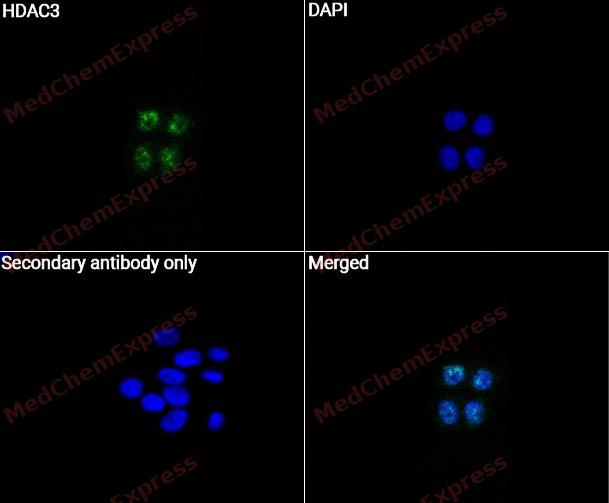 Immunocytochemistry analysis of Hela cells labeling HDAC3 with HDAC3 Antibody (HY-P80152)at 1/50 dilution. Cells were fixed in 4% paraformaldehyde for 15 minutes at room temperature, permeabilized with 0.1% Triton X-100 for 10 minutes at room temperature, then blocked with QuickBlock™ Blocking Buffer for Immunol Staining for 10 min at room temperature. Cells were then incubated with HDAC3 Antibody (HY-P80152) at 1/50 dilution in QuickBlock™ Blocking Buffer for Immunol Staining at 4 ℃. Alexa Fluor® 488-conjugated AffiniPure Goat Anti-Rabbit IgG H&L(HY-P8002, Green) was used as the secondary antibody at 1/1,000 dilution. PBS instead of the primary antibody was used as the secondary antibody only control. The Nuclear counterstain was DAPI (Blue).
 -
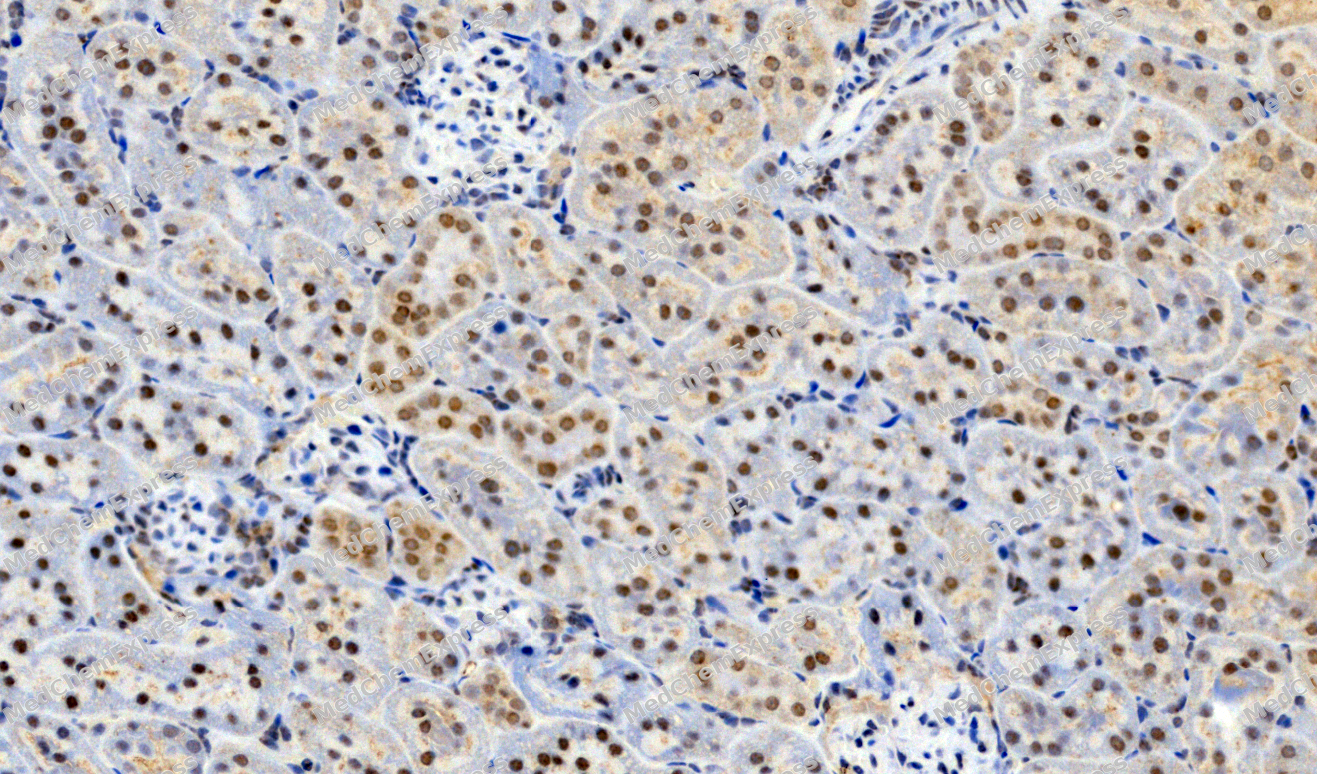 Immunohistochemical analysis of paraffin-embedded Rat kidney tissue using HDAC3 Antibody. The section was pre-treated using heat mediated antigen retrieval with Tris-EDTA buffer (pH 9.0) for 8 minutes. The tissues were blocked in QuickBlock for 20 minutes at room temperature, washed with ddH2O and PBS, and then probed with the primary antibody (HY-P80152, 1/400) in 4℃ overnight. The detection was performed using an HRP conjugated compact polymer system. DAB was used as the chromogen. Tissues were counterstained with hematoxylin and mounted with DPX.
 -
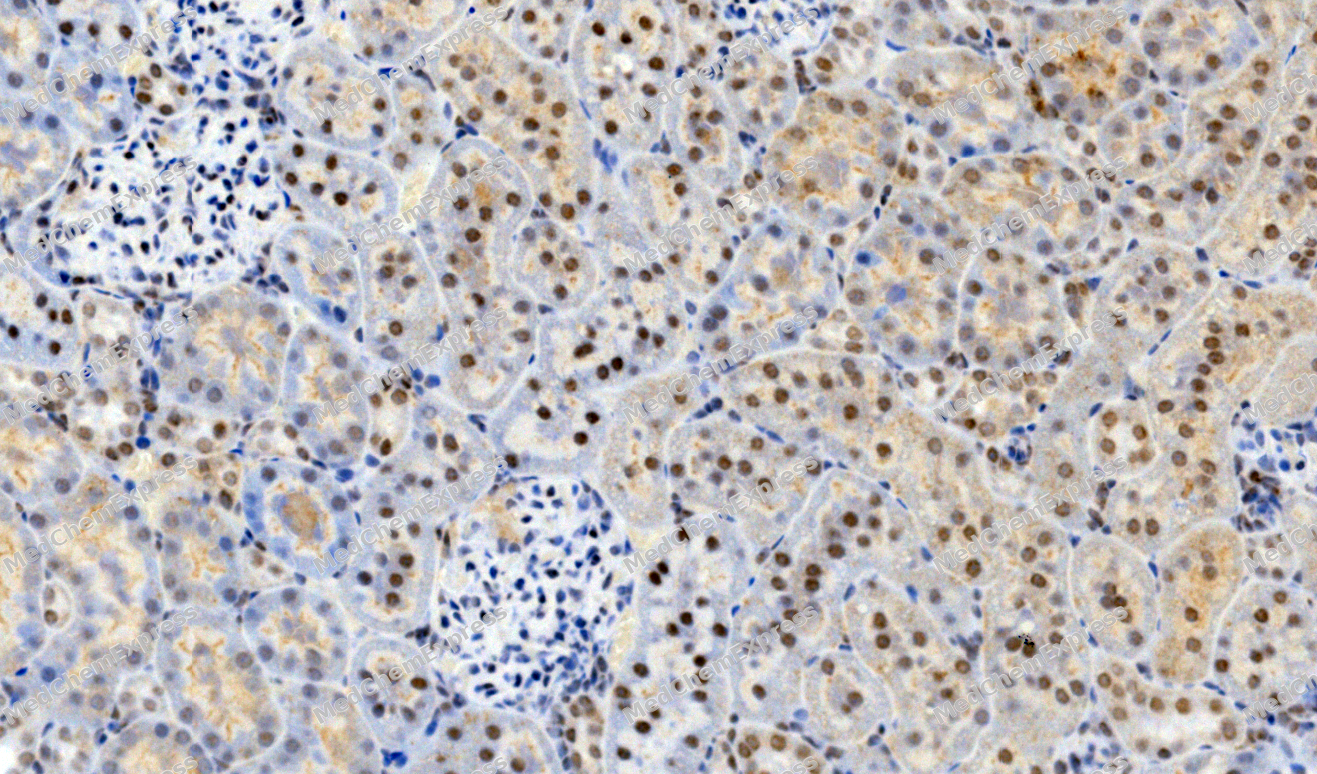 Immunohistochemical analysis of paraffin-embedded Rat kidney tissue using HDAC3 Antibody. The section was pre-treated using heat mediated antigen retrieval with Tris-EDTA buffer (pH 9.0) for 8 minutes. The tissues were blocked in QuickBlock for 20 minutes at room temperature, washed with ddH2O and PBS, and then probed with the primary antibody (HY-P80152, 1/400) in 4℃ overnight. The detection was performed using an HRP conjugated compact polymer system. DAB was used as the chromogen. Tissues were counterstained with hematoxylin and mounted with DPX.


Background
-
Function
HDAC3 (histone deacetylase 3) is a class I histone deacetylase that functions as a central epigenetic regulator of chromatin structure and transcriptional repression through its association with nuclear receptor corepressor complexes containing NCOR and SMRT[1][2]. Mechanistically, HDAC3 forms an enzymatically active complex with NCOR/SMRT and associated cofactors, enabling histone deacetylation and coordinated control of gene expression programs involved in metabolism, circadian regulation, and cellular homeostasis[2][3][4]. HDAC3 also participates in signal-responsive transcriptional regulation, including repression of the JNK pathway and modulation of inflammatory gene expression, linking epigenetic regulation to cellular stress and immune responses[5][6]. In disease models, dysregulation of HDAC3-dependent transcriptional networks has been associated with metabolic disorders, cardiovascular pathology, inflammatory diseases, and cancer-related transcriptional abnormalities[4][6]. HDAC3 is additionally required for normal embryonic development, organ function, and maintenance of metabolic processes, highlighting its broad physiological significance[4]. Compared with related class I HDAC isoforms, HDAC3 is distinguished by its obligate functional interaction with the NCOR/SMRT corepressor complex and its dependence on corepressor-mediated activation for full biological activity[1][2][7]. Structural and genetic studies further demonstrate that disruption of HDAC3-corepressor interactions compromises HDAC3 function in vivo, emphasizing a unique regulatory mechanism not shared to the same extent by other HDAC family members[7][3]. For experimental applications, selective HDAC3 inhibitors are widely used to investigate epigenetic control of inflammation, metabolism, and disease-associated transcriptional programs, while offering greater isoform specificity than pan-HDAC inhibition strategies[6][4].
-
Subcellular Localization
Nucleus; Chromosome; Cytoplasm; Cytoplasm, cytosol
-
Expression
Tissue_specificity:Broad expression
Induction:Up-regulated by disturbed flow in umbilical vein endothelial cells in vitro (PubMed:25190803) -
Subunit
Interacts with HDAC7 and HDAC9 (PubMed:10655483, PubMed:11466315). Interacts with DAXX, KDM4A, HDAC10 and DACH1 (PubMed:10669754, PubMed:11861901, PubMed:14525983, PubMed:15927959). Found in a complex with NCOR1 and NCOR2 (PubMed:10860984, PubMed:22230954). Component of the N-Cor repressor complex, at least composed of NCOR1, NCOR2, HDAC3, TBL1X, TBL1R, CORO2A and GPS2 (PubMed:11931768). Interacts with BCOR, MJD2A/JHDM3A, NRIP1, PRDM6 and SRY (PubMed:10898795, PubMed:11006275, PubMed:15297880). Interacts with BTBD14B (By similarity). Interacts with GLIS2 (By similarity). Interacts (via the DNA-binding domain) with NR2C1; the interaction recruits phosphorylated NR2C1 to PML bodies for sumoylation (By similarity). Component of the Notch corepressor complex (PubMed:19409814). Interacts with CBFA2T3 and NKAP (PubMed:11533236, PubMed:19409814). Interacts with APEX1; the interaction is not dependent on the acetylated status of APEX1 (PubMed:14633989). Interacts with ZMYND15 (By similarity). Interacts with SMRT/NCOR2 and BCL6 on DNA enhancer elements (PubMed:23911289). Interacts with INSM1 (PubMed:16569215, PubMed:18417529). Interacts with XBP1 isoform 1; the interaction occurs in endothelial cell (EC) under disturbed flow (PubMed:25190803). Interacts (via C-terminus) with CCAR2 (via N-terminus) (PubMed:21030595). Interacts with and deacetylates MEF2D (PubMed:21030595). Interacts with BEND3 (PubMed:21914818). Interacts with NKAPL (By similarity). Interacts with DHX36; this interaction occurs in a RNA-dependent manner (PubMed:18279852). Interacts weakly with CRY1; this interaction is enhanced in the presence of FBXL3 (By similarity). Interacts with FBXL3 and BMAL1 (By similarity). Interacts with NCOR1 (By similarity). Interacts with RARA (PubMed:28167758). Interacts with SETD5 (By similarity)
-
SwissProt ID
-
Synonyms
Histone deacetylase 3, HD3, Protein deacetylase HDAC3, Protein deacylase HDAC3, RPD3-2, SMAP45, HDAC3
-
Research Field
Epigenetics and Nuclear Signaling


Documentation
-
Data Sheet (263 KB)
-
SDS (251 KB)
- English - EN (251 KB)
- Français - FR (251 KB)
- Deutsch - DE (251 KB)
- Norwegian - NO (251 KB)
- Español - ES (251 KB)
- Swedish - SV (251 KB)
- Italian - IT (251 KB)
- Korean - KR (251 KB)
- Portuguese - PT (251 KB)
-
User Guide for Antibodies (1077 KB)
References
[1]. Wen YD, et al. The histone deacetylase-3 complex contains nuclear receptor corepressors. Proc Natl Acad Sci U S A. 2000 Jun 20;97(13):7202-7. [Content Brief]
[2]. Fischle W, et al. Enzymatic activity associated with class II HDACs is dependent on a multiprotein complex containing HDAC3 and SMRT/N-CoR. Mol Cell. 2002 Jan;9(1):45-57. [Content Brief]
[3]. Watson PJ, et al. Structure of HDAC3 bound to co-repressor and inositol tetraphosphate. Nature. 2012 Jan 9;481(7381):335-40. [Content Brief]
[4]. He R, et al. The role of HDAC3 and its inhibitors in regulation of oxidative stress and chronic diseases. Cell Death Discov. 2023 Apr 18;9(1):131. [Content Brief]
[5]. Zhang J, et al. The N-CoR-HDAC3 nuclear receptor corepressor complex inhibits the JNK pathway through the integral subunit GPS2. Mol Cell. 2002 Mar;9(3):611-23. [Content Brief]
[6]. Watson N, et al. The role of HDAC3 in inflammation: mechanisms and therapeutic implications. Front Immunol. 2024 Jul 10;15:1419685. [Content Brief]
[7]. Rabezanahary H, et al. Live virus neutralizing antibodies against pre and post Omicron strains in food and retail workers in Québec, Canada. Heliyon. 2024 May 21;10(10):e31026. [Content Brief]

 Powered by Bioz
