



HLA-B Antibody (YA2612)
(Synonyms: HLA B; HLAB)
Based on 1 Customer Validation
HLA-B Antibody (YA2612) is a Rabbit-derived and non-conjugated IgG monoclonal antibody, targeting to HLA-B.
-
Host:
Rabbit
-
Isotype:
IgG
-
Application:
WB, IHC-P
-
Reactivity :
Human
-
Formulation:
Supplied in 50mM Tris-Glycine(pH 7.4), 0.15M NaCl, 40%Glycerol, 0.01% sodium azide and 0.05% BSA.
-
Conjugation:
Non-conjugated


To place orders, for customer services and technical support, please contact: MedChemExpress USA
Tel: 609-228-6898 E-mail: [email protected] [email protected]





Applications
| Application |
WB

WB: Western Blot
|
IHC-P
IHC-P: Immunohistochemistry-Paraffin
|
|---|---|---|
| Dilution Ratio | 1:500-1:1000 | 1:50-1:100 |


Product Details
HLA-B Antibody (YA2612) is a Rabbit-derived and non-conjugated IgG monoclonal antibody, targeting to HLA-B.
-
Host Rabbit

-
Clonality Recombinant,Monoclonal

-
Species ReactivityHuman
-
Observed Molecular WeightObserved band size: 40 kDa
Note: Due to possible protein modifications or aggregation, the molecular weight should be confirmed by actual measurement, and the predicted value is for reference only.

-
Calculated Molecular Weight Predicted band size: 40 kDa

A synthesized peptide derived from human HLA B (aa30-53).
Endogenous
Affinity Purified
Non-conjugated
Unmodified
IgG


Product Properties
-
Appearance
Solution
-
Formulation
Supplied in 50mM Tris-Glycine(pH 7.4), 0.15M NaCl, 40%Glycerol, 0.01% sodium azide and 0.05% BSA.
-
Concentration
Batch-dependent, Please check the COA for the concentration of each lot. Check Lot Concentration
-
Storage & Stability
Stored at -20°C for 1 year. Avoid repeated freeze / thaw cycles.
-
Shipping
Shipping with blue ice.


Verification Images
-
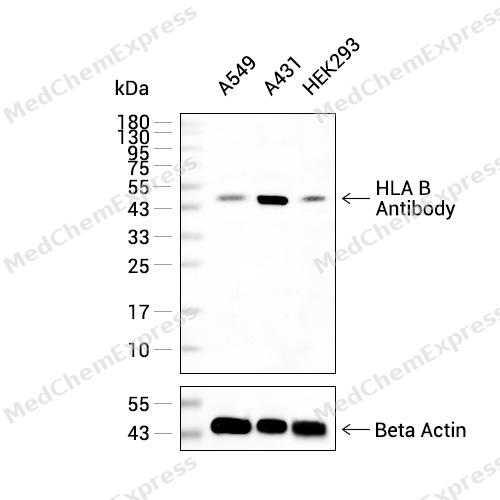 Western blot analysis of extracts from A549(lane 2(20ug),A431(lane 3(20ug) and HEK293(lane 4(20ug) using HLA B Antibody (HY-P82867) Rabbit mAb. Proteins were transferred to a PVDF membrane and blocked with 5% non-fat milk in TBST for 2 hour at room temperature. The primary antibody (1/1000) and Loading control antibody (Beta Actin, HY-P80438, 1/10000) was used in 5% non-fat milk in TBST at 4°C overnight. Goat Anti-Mouse/Rabbit IgG-HRP Secondary Antibody (1/10000) was used for 1 hour at room temperature.
 -
 Immunohistochemical analysis of paraffin-embedded human salivary gland tissue using HLA-B Antibody (HY-P82867, 1/100). The section was pretreated using heat mediated antigen retrieval with sodium citrate buffer (pH 6.0) for 8 minutes. The tissues were blocked with quick block buffer for 0.5 hours at room temperature, washed with PBS and PBST, and then incubated with the primary antibody overnight at 4℃. The detection was performed using an HRP conjugated compact polymer system. DAB was used as the chromogen. Tissues were counterstained with hematoxylin and mounted with DPX.
 -
 Immunohistochemical analysis of paraffin-embedded human small intestine tissue using HLA-B Antibody (HY-P82867, 1/100). The section was pretreated using heat mediated antigen retrieval with sodium citrate buffer (pH 6.0) for 8 minutes. The tissues were blocked with quick block buffer for 0.5 hours at room temperature, washed with PBS and PBST, and then incubated with the primary antibody overnight at 4℃. The detection was performed using an HRP conjugated compact polymer system. DAB was used as the chromogen. Tissues were counterstained with hematoxylin and mounted with DPX.
 -
 Immunohistochemical analysis of paraffin-embedded human kidney tissue using HLA-B Antibody (HY-P82867, 1/100). The section was pretreated using heat mediated antigen retrieval with sodium citrate buffer (pH 6.0) for 8 minutes. The tissues were blocked with quick block buffer for 0.5 hours at room temperature, washed with PBS and PBST, and then incubated with the primary antibody overnight at 4℃. The detection was performed using an HRP conjugated compact polymer system. DAB was used as the chromogen. Tissues were counterstained with hematoxylin and mounted with DPX.
 -
 Immunohistochemical analysis of paraffin-embedded human oral mucosa tissue using HLA-B Antibody (HY-P82867, 1/100). The section was pretreated using heat mediated antigen retrieval with sodium citrate buffer (pH 6.0) for 8 minutes. The tissues were blocked with quick block buffer for 0.5 hours at room temperature, washed with PBS and PBST, and then incubated with the primary antibody overnight at 4℃. The detection was performed using an HRP conjugated compact polymer system. DAB was used as the chromogen. Tissues were counterstained with hematoxylin and mounted with DPX.
 -
 Immunohistochemical analysis of paraffin-embedded human epididymis tissue using HLA-B Antibody (HY-P82867, 1/100). The section was pretreated using heat mediated antigen retrieval with sodium citrate buffer (pH 6.0) for 8 minutes. The tissues were blocked with quick block buffer for 0.5 hours at room temperature, washed with PBS and PBST, and then incubated with the primary antibody overnight at 4℃. The detection was performed using an HRP conjugated compact polymer system. DAB was used as the chromogen. Tissues were counterstained with hematoxylin and mounted with DPX.
 -
 Immunohistochemical analysis of paraffin-embedded human prostate tissue using HLA-B Antibody (HY-P82867, 1/100). The section was pretreated using heat mediated antigen retrieval with sodium citrate buffer (pH 6.0) for 8 minutes. The tissues were blocked with quick block buffer for 0.5 hours at room temperature, washed with PBS and PBST, and then incubated with the primary antibody overnight at 4℃. The detection was performed using an HRP conjugated compact polymer system. DAB was used as the chromogen. Tissues were counterstained with hematoxylin and mounted with DPX.
 -
 Immunohistochemical analysis of paraffin-embedded human nasopharynx tissue using HLA-B Antibody (HY-P82867, 1/100). The section was pretreated using heat mediated antigen retrieval with sodium citrate buffer (pH 6.0) for 8 minutes. The tissues were blocked with quick block buffer for 0.5 hours at room temperature, washed with PBS and PBST, and then incubated with the primary antibody overnight at 4℃. The detection was performed using an HRP conjugated compact polymer system. DAB was used as the chromogen. Tissues were counterstained with hematoxylin and mounted with DPX.


Background
-
Function
HLA-B is an Antigen-presenting major histocompatibility complex class I (MHCI) molecule. In complex with B2M/beta 2 microglobulin displays primarily viral and tumor-derived peptides on antigen-presenting cells for recognition by alpha-beta T cell receptor (TCR) on HLA-B-restricted CD8-positive T cells, guiding antigen-specific T cell immune response to eliminate infected or transformed cells. May also present self-peptides derived from the signal sequence of secreted or membrane proteins, although T cells specific for these peptides are usually inactivated to prevent autoreactivity. Both the peptide and the MHC molecule are recognized by TCR, the peptide is responsible for the fine specificity of antigen recognition and MHC residues account for the MHC restriction of T cells. Typically presents intracellular peptide antigens of 8 to 13 amino acids that arise from cytosolic proteolysis via constitutive proteasome and IFNG-induced immunoproteasome. Can bind different peptides containing allele-specific binding motifs, which are mainly defined by anchor residues at position 2 and 9; Allele B*07:02: Displays peptides sharing a common signature motif, namely a Pro residue at position 2 and mainly a Leu anchor residue at the C-terminus. Presents a long peptide (APRGPHGGAASGL) derived from the cancer-testis antigen CTAG1A/NY-ESO-1, eliciting a polyclonal CD8-positive T cell response against tumor cells. Presents viral epitopes derived from HIV-1 gag-pol (TPQDLNTML) and Nef (RPQVPLRPM). Presents an immunodominant epitope derived from SARS-CoV-2 N/nucleoprotein (SPRWYFYYL). Displays self-peptides including a peptide derived from the signal sequence of HLA-DPB1 (APRTVALTA); Allele B*08:01: Presents to CD8-positive T cells viral epitopes derived from EBV/HHV-4 EBNA3 (QAKWRLQTL), eliciting cytotoxic T cell response; Allele B*13:02: Presents multiple HIV-1 epitopes derived from gag (RQANFLGKI, GQMREPRGSDI), nef (RQDILDLWI), gag-pol (RQYDQILIE, GQGQWTYQI) and rev (LQLPPLERL), all having in common a Gln residue at position 2 and mainly hydrophobic amino acids Leu, Ile or Val at the C-terminus. Associated with successful control of HIV-1 infection; Allele B*18:01: Preferentially presents octomeric and nonameric peptides sharing a common motif, namely a Glu at position 2 and Phe or Tyr anchor residues at the C-terminus. Presents an EBV/HHV-4 epitope derived from BZLF1 (SELEIKRY). May present to CD8-positive T cells an antigenic peptide derived from MAGEA3 (MEVDPIGHLY), triggering an anti-tumor immune response. May display a broad repertoire of self-peptides with a preference for peptides derived from RNA-binding proteins; Allele B*27:05: Presents to CD8-positive T cells immunodominant viral epitopes derived from HCV POLG (ARMILMTHF), HIV-1 gag (KRWIILGLNK), IAV NP (SRYWAIRTR), SARS-CoV-2 N/nucleoprotein (QRNAPRITF), EBV/HHV-4 EBNA4 (HRCQAIRKK) and EBV/HHV-4 EBNA6 (RRIYDLIEL), conferring longterm protection against viral infection. Can present self-peptides derived from cytosolic and nuclear proteins. All peptides carry an Arg at position 2. The peptide-bound form interacts with NK cell inhibitory receptor KIR3DL1 and inhibits NK cell activation in a peptide-specific way, being particularly sensitive to the nature of the amino acid side chain at position 8 of the antigenic peptide. KIR3DL1 fails to recognize HLA-B*27:05 in complex with B2M and EBV/HHV-4 EBNA6 (RRIYDLIEL) peptide, which can lead to increased activation of NK cells during infection. May present an altered repertoire of peptides in the absence of TAP1-TAP2 and TAPBPL; Allele B*40:01: Presents immunodominant viral epitopes derived from EBV/HHV-4 LMP2 (IEDPPFNSL) and SARS-CoV-2 N/nucleoprotein (MEVTPSGTWL), triggering memory CD8-positive T cell response. Displays self-peptides sharing a signature motif, namely a Glu at position 2 and a Leu anchor residue at the C-terminus; Allele B*41:01: Displays self-peptides sharing a signature motif, namely a Glu at position 2 and Ala or Pro anchor residues at the C-terminus; Allele B*44:02: Presents immunodominant viral epitopes derived from EBV/HHV-4 EBNA4 (VEITPYKPTW) and EBNA6 (AEGGVGWRHW, EENLLDFVRF), triggering memory CD8-positive T cell response. Displays self-peptides sharing a signature motif, namely a Glu at position 2 and Phe, Tyr or Trp anchor residues at the C-terminus; Allele B*45:01: Displays self-peptides sharing a signature motif, namely a Glu at position 2 and Ala or Pro anchor residues at the C-terminus; Allele B*46:01: Preferentially presents nonameric peptides sharing a signature motif, namely Ala and Leu at position 2 and Tyr, Phe, Leu, or Met anchor residues at the C-terminus. The peptide-bound form interacts with KIR2DL3 and inhibits NK cell cytotoxic response in a peptide-specific way; Allele B*47:01: Displays self-peptides sharing a signature motif, namely an Asp at position 2 and Leu or Met anchor residues at the C-terminus; Allele B*49:01: Displays self-peptides sharing a signature motif, namely a Glu at position 2 and Ile or Val anchor residues at the C-terminus; Allele B*50:01: Displays self-peptides sharing a signature motif, namely a Glu at position 2 and Ala or Pro anchor residues at the C-terminus; Allele B*51:01: Presents an octomeric HIV-1 epitope derived from gag-pol (TAFTIPSI) to the public TRAV17/TRBV7-3 TCR clonotype, strongly suppressing HIV-1 replication; Allele B*54:01: Displays peptides sharing a common signature motif, namely a Pro residue at position 2 and Ala anchor residue at the C-terminus; Allele B*55:01: Displays peptides sharing a common signature motif, namely a Pro residue at position 2 and Ala anchor residue at the C-terminus; Allele B*56:01: Displays peptides sharing a common signature motif, namely a Pro residue at position 2 and Ala anchor residue at the C-terminus; Allele B*57:01: The peptide-bound form recognizes KIR3DL1 and inhibits NK cell cytotoxic response. Presents HIV gag peptides (immunodominant KAFSPEVIPMF and subdominant KALGPAATL epitopes) predominantly to CD8-positive T cell clones expressing a TRAV41-containing TCR, triggering HLA-B-restricted T cell responses; Allele B*67:01: Displays peptides sharing a common signature motif, namely a Pro residue at position 2 and Leu anchor residue at the C-terminus[1][2][3][4][5][6][7][8][9][10][11][12][13][14][15][16][17].
-
Subcellular Localization
Cell membrane; Single-pass type I membrane protein; Endoplasmic reticulum membrane; Single-pass type I membrane protein
-
Subunit
Heterotrimer that consists of an alpha chain HLA-B, a beta chain B2M and a peptide (peptide-HLA-B-B2M) (PubMed:15657948, PubMed:17057332, PubMed:22020283, PubMed:24600035, PubMed:25808313, PubMed:29531227). Early in biogenesis, HLA-B-B2M dimer interacts with the components of the peptide-loading complex composed of TAPBP, TAP1-TAP2, TAPBPL, PDIA3/ERP57 and CALR (PubMed:26416272, PubMed:26439010, PubMed:9036970, PubMed:9620674). Interacts with TAP1-TAP2 transporter via TAPBP; this interaction is obligatory for the loading of peptide epitopes delivered to the ER by TAP1-TAP2 transporter (PubMed:9036970, PubMed:9620674). Interacts with TAPBPL; TAPBPL binds peptide-free HLA-B-B2M complexes or those loaded with low affinity peptides, likely facilitating peptide exchange for higher affinity peptides (PubMed:26439010). Only optimally assembled peptide-HLA-B-B2M trimer translocates to the surface of antigen-presenting cells, where it interacts with TCR and CD8 coreceptor on the surface of T cells. HLA-B (via polymorphic alpha-1 and alpha-2 domains) interacts with antigen-specific TCR (via CDR1, CDR2 and CDR3 domains) (PubMed:24600035, PubMed:29531227). One HLA-B molecule (mainly via nonpolymorphic alpha-3 domain) interacts with one CD8A homodimer (via CDR-like loop); this interaction ensures peptide-HLA-B-B2M recognition by CD8-positive T cells only (PubMed:29531227). Allele B*57:01 interacts (via Bw4 motif) with KIR3DL1 (via Ig-like C2-type domain); this interaction may interfere with peptide binding (PubMed:22020283, PubMed:25480565). Allele B*46:01 interacts with KIR2DL3 (PubMed:28514659)
-
SwissProt ID
-
Synonyms
HLA B; HLAB
-
Research Field
Immunology


Documentation
-
Data Sheet (263 KB)
-
SDS (251 KB)
- English - EN (251 KB)
- Français - FR (251 KB)
- Deutsch - DE (251 KB)
- Norwegian - NO (251 KB)
- Español - ES (251 KB)
- Swedish - SV (251 KB)
- Italian - IT (251 KB)
- Korean - KR (251 KB)
- Portuguese - PT (251 KB)
-
User Guide for Antibodies (1077 KB)
References
[1]. Schmidt J, et al. Rapid antigen processing and presentation of a protective and immunodominant HLA-B*27-restricted hepatitis C virus-specific CD8+ T-cell epitope. PLoS Pathog. 2012;8(11):e1003042. [Content Brief]
[2]. Kløverpris HN, et al. A molecular switch in immunodominant HIV-1-specific CD8 T-cell epitopes shapes differential HLA-restricted escape. Retrovirology. 2015 Feb 20;12:20. [Content Brief]
[3]. Chan KF, et al. Divergent T-cell receptor recognition modes of a HLA-I restricted extended tumour-associated peptide. Nat Commun. 2018 Mar 12;9(1):1026. [Content Brief]
[4]. Peh CA, et al. HLA-B27-restricted antigen presentation in the absence of tapasin reveals polymorphism in mechanisms of HLA class I peptide loading. Immunity. 1998 May;8(5):531-42. [Content Brief]
[5]. Hillen N, et al. Essential differences in ligand presentation and T cell epitope recognition among HLA molecules of the HLA-B44 supertype. Eur J Immunol. 2008 Nov;38(11):2993-3003. [Content Brief]
[6]. Barber LD, et al. Overlap in the repertoires of peptides bound in vivo by a group of related class I HLA-B allotypes. Curr Biol. 1995 Feb 1;5(2):179-90. [Content Brief]
[7]. Motozono C, et al. Molecular basis of a dominant T cell response to an HIV reverse transcriptase 8-mer epitope presented by the protective allele HLA-B*51:01. J Immunol. 2014 Apr 1;192(7):3428-34. [Content Brief]
[8]. Peng Y, et al. Broad and strong memory CD4(+) and CD8(+) T cells induced by SARS-CoV-2 in UK convalescent individuals following COVID-19. Nat Immunol. 2020 Nov;21(11):1336-1345. [Content Brief]
[9]. Hickman HD, et al. Toward a definition of self: proteomic evaluation of the class I peptide repertoire. J Immunol. 2004 Mar 1;172(5):2944-52. [Content Brief]
[10]. Rist MJ, et al. HLA peptide length preferences control CD8+ T cell responses. J Immunol. 2013 Jul 15;191(2):561-71. [Content Brief]
[11]. Bilsborough J, et al. A MAGE-3 peptide presented by HLA-B44 is also recognized by cytolytic T lymphocytes on HLA-B18. Tissue Antigens. 2002 Jul;60(1):16-24. [Content Brief]
[12]. Berkhoff EG, et al. A mutation in the HLA-B*2705-restricted NP383-391 epitope affects the human influenza A virus-specific cytotoxic T-lymphocyte response in vitro. J Virol. 2004 May;78(10):5216-22. [Content Brief]
[13]. Schneidewind A, et al. Structural and functional constraints limit options for cytotoxic T-lymphocyte escape in the immunodominant HLA-B27-restricted epitope in human immunodeficiency virus type 1 capsid. J Virol. 2008 Jun;82(11):5594-605. [Content Brief]
[14]. Dazert E, et al. Loss of viral fitness and cross-recognition by CD8+ T cells limit HCV escape from a protective HLA-B27-restricted human immune response. J Clin Invest. 2009 Feb;119(2):376-86. [Content Brief]
[15]. Jardetzky TS, et al. Identification of self peptides bound to purified HLA-B27. Nature. 1991 Sep 26;353(6342):326-9. [Content Brief]
[16]. Stewart-Jones GB, et al. Crystal structures and KIR3DL1 recognition of three immunodominant viral peptides complexed to HLA-B*2705. Eur J Immunol. 2005 Feb;35(2):341-51. [Content Brief]
[17]. Peruzzi M, et al. A p70 killer cell inhibitory receptor specific for several HLA-B allotypes discriminates among peptides bound to HLA-B*2705. J Exp Med. 1996 Oct 1;184(4):1585-90. [Content Brief]

 Powered by Bioz
