



PAKγ Antibody (YA7384)
PAKγ Antibody (YA7384) is a Rabbit-derived and non-conjugated IgG, Kappa monoclonal antibody, targeting to PAKγ.
-
Host:
Rabbit
-
Isotype:
IgG,Kappa
-
Application:
WB, IHC-P, ICC/IF, ELISA
-
Reactivity :
Human, Mouse, Rat
-
Formulation:
Supplied in PBS (pH7.4) containing 50% glycerol, 0.05% Proclin 300, 0.05%BSA
-
Conjugation:
Non-conjugated


To place orders, for customer services and technical support, please contact: MedChemExpress USA
Tel: 609-228-6898 E-mail: [email protected] [email protected]





Applications
| Application |
IHC-P

IHC-P: Immunohistochemistry-Paraffin
|
WB
WB: Western Blot
|
ICC/IF
ICC/IF: Immunocytochemistry/
Immunofluorescence |
ELISA
ELISA: Enzyme Linked Immunosorbent Assay
|
|---|---|---|---|---|
| Dilution Ratio | 1:200-1:1000 | 1:2000-1:10000 | 1:200-1:1000 | 1:5000-1:20000 |


Product Details
PAKγ Antibody (YA7384) is a Rabbit-derived and non-conjugated IgG, Kappa monoclonal antibody, targeting to PAKγ.
-
Host Rabbit

-
Clonality Monoclonal,Recombinant

-
Species ReactivityHuman, Mouse, Rat
-
Observed Molecular WeightObserved band size: 58 kDa
Note: Due to possible protein modifications or aggregation, the molecular weight should be confirmed by actual measurement, and the predicted value is for reference only.

-
Calculated Molecular Weight Predicted band size: 58 kDa

The exact sequence is proprietary to MCE.
Endogenous
Protein A affinity purified
Non-conjugated
Unmodified
IgG,Kappa


Product Properties
-
Appearance
Liquid
-
Formulation
Supplied in PBS (pH7.4) containing 50% glycerol, 0.05% Proclin 300, 0.05%BSA
-
Storage & Stability
Stored at -20°C for 1 year. Avoid repeated freeze / thaw cycles.
-
Shipping
Shipping with blue ice.


Verification Images
-
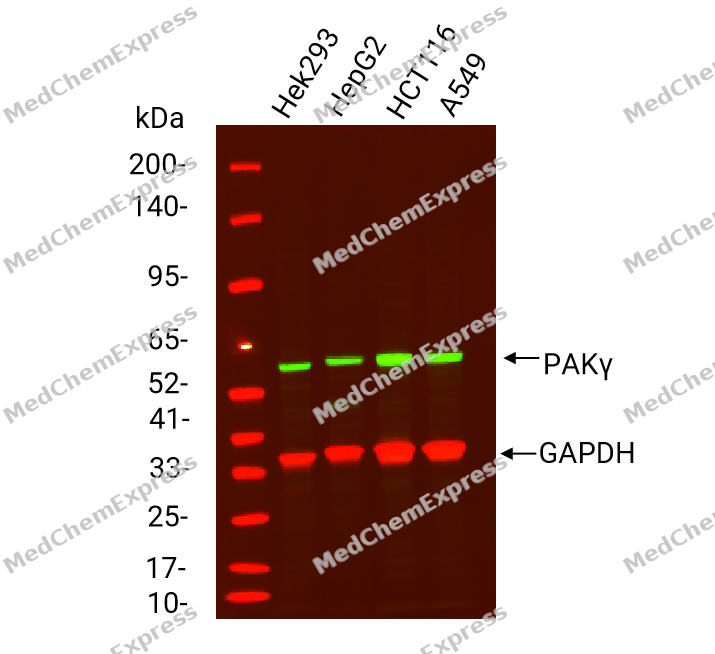 Western blot analysis was performed on extracts from Hek293 (lane 1, 20μg), HepG2 (lane 2, 20μg), HCT116 (lane 3, 20μg), A594 (lane 4, 20μg), using PAKγ Antibody (YA7384) . Proteins were transferred to a PVDF membrane and blocked with 5% non-fat milk in TBST at 25°C for 1hour.The primary antibody (1:2000 dilution) and the loading control antibody (GAPDH, HY-P83944, 1:3000 dilution) were incubated in 5% non-fat milk in TBST for overnight. AF800-conjugated Goat Anti-Rabbit IgG H&L(HY-P810687, 1:1000 dilution) and AF680-conjugated Goat Anti-Mouse IgG H&L(HY-P89186 , 1:10000 dilution) was then applied for 1 hour at 37°C, protect from light.


Background
-
Function
PAKγ is a Serine/threonine protein kinase that plays a role in a variety of different signaling pathways including cytoskeleton regulation, cell motility, cell cycle progression, apoptosis or proliferation. Acts as a downstream effector of the small GTPases CDC42 and RAC1. Activation by the binding of active CDC42 and RAC1 results in a conformational change and a subsequent autophosphorylation on several serine and/or threonine residues. Full-length PAK2 stimulates cell survival and cell growth. Phosphorylates MAPK4 and MAPK6 and activates the downstream target MAPKAPK5, a regulator of F-actin polymerization and cell migration. Phosphorylates JUN and plays an important role in EGF-induced cell proliferation. Phosphorylates many other substrates including histone H4 to promote assembly of H3.3 and H4 into nucleosomes, BAD, ribosomal protein S6, or MBP. Phosphorylates CASP7, thereby preventing its activity. Additionally, associates with ARHGEF7 and GIT1 to perform kinase-independent functions such as spindle orientation control during mitosis. On the other hand, apoptotic stimuli such as DNA damage lead to caspase-mediated cleavage of PAK2, generating PAK-2p34, an active p34 fragment that translocates to the nucleus and promotes cellular apoptosis involving the JNK signaling pathway. Caspase-activated PAK2 phosphorylates MKNK1 and reduces cellular translation[1][2][3][4][5][6][7][8][9][10][11][12][13].
-
Subcellular Localization
Cytoplasm,Nucleus,Nucleus,Cytoplasm, perinuclear region,Membrane
-
Expression
Tissue_Specificity: Ubiquitously expressed. Higher levels seen in skeletal muscle, ovary, thymus and spleen -
Isoforms & Post-Translational Modification
Q13177: 524 amino acids, molecular weight 58043 Da.
-
Subunit
Interacts tightly with GTP-bound but not GDP-bound CDC42/p21 and RAC1 (PubMed:20696164)
-
SwissProt ID


Documentation

 Powered by Bioz
