



RIP3 Antibody (YA6043)
(Synonyms: Receptor-interacting serine/threonine-protein kinase 3, RIPK3,RIP3)
Based on 1 Customer Validation
RIP3 Antibody (YA6043) is a Rabbit-derived and non-conjugated IgG monoclonal antibody, targeting to RIP3.
-
Host:
Rabbit
-
Isotype:
IgG
-
Application:
WB, ICC/IF, IP, ELISA
-
Reactivity :
Mouse
-
Formulation:
Supplied in PBS, 50% glycerol, 0.05% Proclin 300, 0.05%BSA
-
Conjugation:
Non-conjugated


To place orders, for customer services and technical support, please contact: MedChemExpress USA
Tel: 609-228-6898 E-mail: [email protected] [email protected]





Applications
| Application |
WB

WB: Western Blot
|
ICC/IF
ICC/IF: Immunocytochemistry/
Immunofluorescence |
ELISA
ELISA: Enzyme Linked Immunosorbent Assay
|
IP
IP: Immunoprecipitation
|
|---|---|---|---|---|
| Dilution Ratio | 1:2000-1:10000 | 1:200-1:1000 | 1:5000-1:20000 | 1:50-1:200 |


Product Details
RIP3 Antibody (YA6043) is a Rabbit-derived and non-conjugated IgG monoclonal antibody, targeting to RIP3.
-
Host Rabbit

-
Clonality Monoclonal

-
Species ReactivityMouse
-
Observed Molecular WeightObserved band size: 50 kDa
Note: Due to possible protein modifications or aggregation, the molecular weight should be confirmed by actual measurement, and the predicted value is for reference only.

-
Calculated Molecular Weight Predicted band size: 50 kDa

Protein A
Non-conjugated
Unmodified
IgG


Product Properties
-
Appearance
Liquid
-
Formulation
Supplied in PBS, 50% glycerol, 0.05% Proclin 300, 0.05%BSA
-
Concentration
Batch-dependent, Please check the COA for the concentration of each lot. Check Lot Concentration
-
Storage & Stability
Stored at -20°C for 1 year. Avoid repeated freeze / thaw cycles.
-
Shipping
Shipping with blue ice.


Verification Images
-
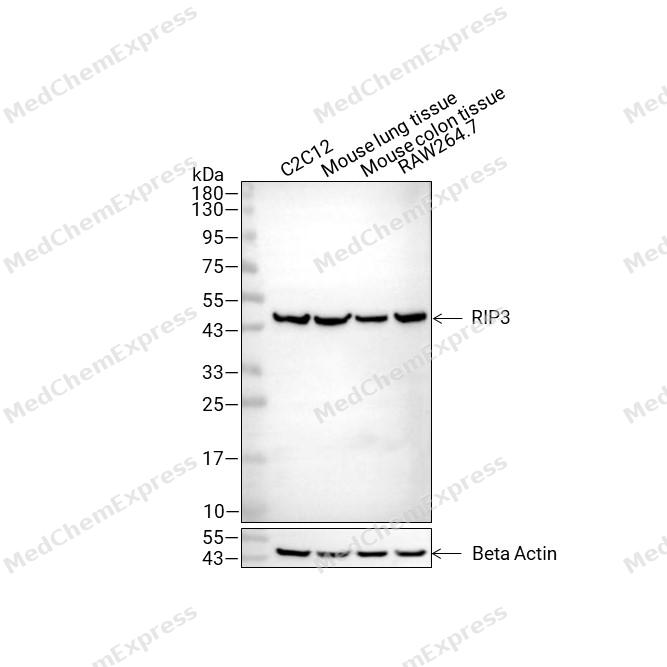 Western blot analysis of extracts from C2C12 (lane2(20μg), Mouse lung tissue (lane3(20μg), Mouse colon tissue (lane4(20μg) and RAW264.7 (lane5(20μg) using RIP3 Antibody (HY-P86351). Proteins were transferred to a PVDF membrane and blocked with 5% non-fat milk in TBST for 2 hour at room temperature. The primary antibody (1/5000) and Loading control antibody (Beta Actin, HY-P80993, 1/10,000) was used in 5% non-fat milk in TBST at 4°C overnight. Goat Anti-Rabbit IgG-HRP Secondary Antibody (HY-P8001 ,1/10,000) was used for 1 hour at room temperature.


Background
-
Function
RIP3 is a Serine/threonine-protein kinase that activates necroptosis and apoptosis, two parallel forms of cell death. Necroptosis, a programmed cell death process in response to death-inducing TNF-alpha family members, is triggered by RIPK3 following activation by ZBP1. Activated RIPK3 forms a necrosis-inducing complex and mediates phosphorylation of MLKL, promoting MLKL localization to the plasma membrane and execution of programmed necrosis characterized by calcium influx and plasma membrane damage. In addition to TNF-induced necroptosis, necroptosis can also take place in the nucleus in response to orthomyxoviruses infection: following ZBP1 activation, which senses double-stranded Z-RNA structures, nuclear RIPK3 catalyzes phosphorylation and activation of MLKL, promoting disruption of the nuclear envelope and leakage of cellular DNA into the cytosol. Also regulates apoptosis: apoptosis depends on RIPK1, FADD and CASP8, and is independent of MLKL and RIPK3 kinase activity. Phosphorylates RIPK1: RIPK1 and RIPK3 undergo reciprocal auto- and trans-phosphorylation. In some cell types, also able to restrict viral replication by promoting cell death-independent responses. In response to Zika virus infection in neurons, promotes a cell death-independent pathway that restricts viral replication: together with ZBP1, promotes a death-independent transcriptional program that modifies the cellular metabolism via up-regulation expression of the enzyme ACOD1/IRG1 and production of the metabolite itaconate. Itaconate inhibits the activity of succinate dehydrogenase, generating a metabolic state in neurons that suppresses replication of viral genomes. RIPK3 binds to and enhances the activity of three metabolic enzymes: GLUL, GLUD1, and PYGL. These metabolic enzymes may eventually stimulate the tricarboxylic acid cycle and oxidative phosphorylation, which could result in enhanced ROS production; (Microbial infection) In case of herpes simplex virus 1/HHV-1 infection, forms heteromeric amyloid structures with HHV-1 protein RIR1/ICP6 which may inhibit RIPK3-mediated necroptosis, thereby preventing host cell death pathway and allowing viral evasion[1][2][3][4][5][6][7][8][9][10].
-
Subcellular Localization
Cytoplasm, cytosol; Nucleus
-
Expression
Tissue_specificity:Highly expressed in the pancreas. Detected at lower levels in heart, placenta, lung and kidney; Expression is significantly increased in colon and lung cancers -
Isoforms & Post-Translational Modification
Q9Y572 has 3 isomers: Q9Y572-1: 56887 Da (predicted); Q9Y572-2: 27574 Da (predicted); Q9Y572-3: 25326 Da (predicted).
(Microbial infection) Proteolytically cleaved by S.flexneri OspD3 within the RIP homotypic interaction motif (RHIM), leading to its degradation and inhibition of necroptosis;RIPK1 and RIPK3 undergo reciprocal auto- and trans-phosphorylation (PubMed:19524513). Autophosphorylated following interaction with ZBP1 (By similarity). Phosphorylation of Ser-199 plays a role in the necroptotic function of RIPK3 (PubMed:11734559, PubMed:19524512). Autophosphorylates at Ser-227 following activation by ZBP1: phosphorylation at these sites is a hallmark of necroptosis and is required for binding MLKL (PubMed:22265413). Phosphorylation at Thr-182 is important for its kinase activity, interaction with PELI1 and PELI1-mediated 'Lys-48'-linked polyubiquitination and for its ability to mediate TNF-induced necroptosis (PubMed:29883609);Polyubiquitinated with 'Lys-48' and 'Lys-63'-linked chains by BIRC2/c-IAP1 and BIRC3/c-IAP2, leading to activation of NF-kappa-B (PubMed:21931591). Polyubiquitinated with 'Lys-48'-linked chains by PELI1 leading to its subsequent proteasome-dependent degradation. Ubiquitinated by STUB1 leading to its subsequent proteasome-dependent degradation (PubMed:29883609). Deubiquitinated by USP22 (PubMed:33369872) -
Subunit
Interacts (via RIP homotypic interaction motif) with RIPK1 (via RIP homotypic interaction motif); this interaction induces RIPK1 phosphorylation and formation of a RIPK1-RIPK3 necrosis-inducing complex (PubMed:10339433, PubMed:11734559, PubMed:19524512, PubMed:29681455).
-
SwissProt ID
-
Synonyms
Receptor-interacting serine/threonine-protein kinase 3, RIPK3,RIP3


Documentation
-
Data Sheet (235 KB)
-
SDS (251 KB)
- English - EN (251 KB)
- Français - FR (251 KB)
- Deutsch - DE (251 KB)
- Norwegian - NO (251 KB)
- Español - ES (251 KB)
- Swedish - SV (251 KB)
- Italian - IT (251 KB)
- Korean - KR (251 KB)
- Portuguese - PT (251 KB)
-
User Guide for Antibodies (1077 KB)

 Powered by Bioz
