



SREBP-1 Antibody
(Synonyms: SREBF1; BHLHD1; SREBP1; Sterol regulatory element-binding protein 1; SREBP-1; Class D basic helix-loop-helix protein 1; bHLHd1; Sterol regulatory element-binding transcription factor 1)Based on 3 publication(s) in Google Scholar
SREBP-1 Antibody is a Rabbit-derived and non-conjugated IgG polyclonal antibody, targeting to SREBP-1.
-
Host:
Rabbit
-
Isotype:
IgG
-
Application:
WB, ELISA
-
Reactivity :
Human, Mouse, Rat
-
Formulation:
Supplied in 1*PBS (pH 7.3), 50% glycerol and 0.5% BSA. Preservative: 0.02% sodium azide.
-
Conjugation:
Non-conjugated


To place orders, for customer services and technical support, please contact: MedChemExpress USA
Tel: 609-228-6898 E-mail: [email protected] [email protected]



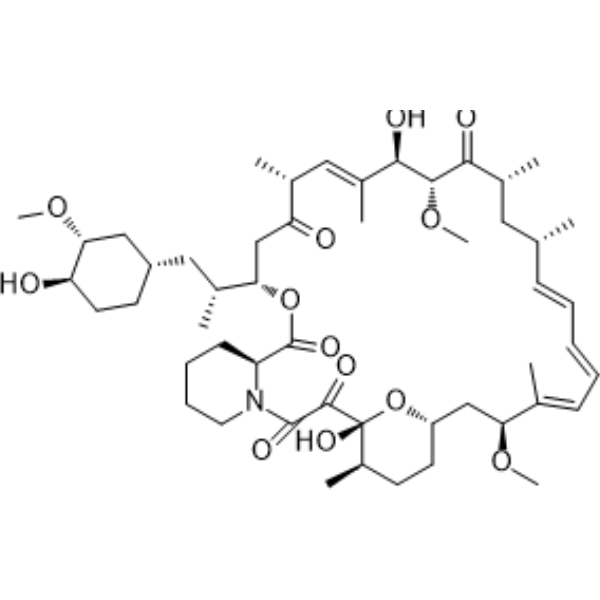
Publications Citing Use of MedChemExpress (MCE) SREBP-1 Antibody
More

Applications
| Application |
WB

WB: Western Blot
|
ELISA
ELISA: Enzyme Linked Immunosorbent Assay
|
|---|---|---|
| Dilution Ratio | 1:500-1:1000 | 1:10000 |


Product Details
SREBP-1 Antibody is a Rabbit-derived and non-conjugated IgG polyclonal antibody, targeting to SREBP-1.
-
Host Rabbit

-
Clonality Polyclonal

-
Species ReactivityHuman, Mouse, Rat
-
Observed Molecular WeightObserved band size: 122 kDa
Note: Due to possible protein modifications or aggregation, the molecular weight should be confirmed by actual measurement, and the predicted value is for reference only.

-
Calculated Molecular Weight Predicted band size: 122 kDa

Entrez Gene: 6720 Human ; 20787 Mouse ; 78968 Rat
SwissProt: P36956 Human ; Q9WTN3 Mouse ; P56720 Rat
OMIM: 619016 Human
Synthetic peptide corresponding to Human SREBP-1.The exact sequence is proprietary to MCE.
Endogenous
affinity purified
Non-conjugated
Unmodified
IgG


Product Properties
-
Appearance
Solution
-
Formulation
Supplied in 1*PBS (pH 7.3), 50% glycerol and 0.5% BSA. Preservative: 0.02% sodium azide.
-
Concentration
Batch-dependent, Please check the COA for the concentration of each lot. Check Lot Concentration
-
Storage & Stability
Stored at -20°C for 1 year. Avoid repeated freeze / thaw cycles.
-
Shipping
Shipping with blue ice.


Publications (3)
-
Journal Impact Factor
-
Most Recent
-
Metabolism
Natural polyketide enterocin inhibits ASGR1 to enhance cholesterol efflux and regulate hepatic lipid metabolism. [Abstract]2026 Apr:177:156511. PMID: 41580117 -
Int Immunopharmacol
N-acetylglucosamine ameliorates the transition from acute kidney injury to chronic kidney disease by reducing the accumulation of lipid droplets. [Abstract]2026 May 15:177:116463. PMID: 41850183


Verification Images
-
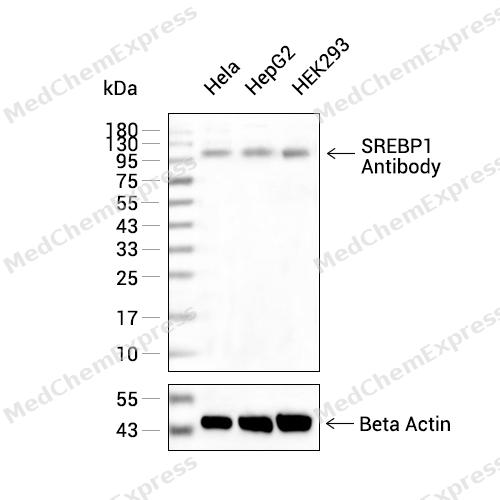 Western blot analysis of extracts from Hela(lane 2(20μg) , HepG2(lane 3(20ug) and HEK293(lane 4(40ug) using SREBP1 Antibody (HY-P80900) Rabbit mAb. Proteins were transferred to a PVDF membrane and blocked with 5% non-fat milk in TBST for 2 hour at room temperature. The primary antibody (1/1000) and Loading control antibody (Beta Actin, HY-P80438, 1/10000) was used in 5% non-fat milk in TBST at 4°C overnight. Goat Anti-Mouse/Rabbit IgG-HRP Secondary Antibody (1/10000) was used for 1 hour at room temperature.


Background
-
Function
SREBP-1 is a Precursor of the transcription factor form (Processed sterol regulatory element-binding protein 1), which is embedded in the endoplasmic reticulum membrane. Low sterol concentrations promote processing of this form, releasing the transcription factor form that translocates into the nucleus and activates transcription of genes involved in cholesterol biosynthesis and lipid homeostasis; Key transcription factor that regulates expression of genes involved in cholesterol biosynthesis and lipid homeostasis. Binds to the sterol regulatory element 1 (SRE-1) (5'-ATCACCCCAC-3'). Has dual sequence specificity binding to both an E-box motif (5'-ATCACGTGA-3') and to SRE-1 (5'-ATCACCCCAC-3'). Regulates the promoters of genes involved in cholesterol biosynthesis and the LDL receptor (LDLR) pathway of sterol regulation; Isoform expressed only in select tissues, which has higher transcriptional activity compared to SREBP-1C. Able to stimulate both lipogenic and cholesterogenic gene expression. Has a role in the nutritional regulation of fatty acids and triglycerides in lipogenic organs such as the liver. Required for innate immune response in macrophages by regulating lipid metabolism; Predominant isoform expressed in most tissues, which has weaker transcriptional activity compared to isoform SREBP-1A. Primarily controls expression of lipogenic gene. Strongly activates global lipid synthesis in rapidly growing cells; The absence of Golgi proteolytic processing requirement makes this isoform constitutively active in transactivation of lipogenic gene promoters; The absence of Golgi proteolytic processing requirement makes this isoform constitutively active in transactivation of lipogenic gene promoters[1][2][3][4].
-
Subcellular Localization
Endoplasmic reticulum membrane; Multi-pass membrane protein; Golgi apparatus membrane; Multi-pass membrane protein; Cytoplasmic vesicle, COPII-coated vesicle membrane; Multi-pass membrane protein; Nucleus; Nucleus; Nucleus
-
Expression
Tissue_specificity:This gene is expressed in various tissues, with the highest abundance in the liver and adrenal glands (PubMed:8402897) . In fetal tissues, the highest expression levels are found in the lungs and liver (PubMed:8402897) ; it is dominant in hepatocellular carcinoma cell lines (PubMed:8402897) . This gene is also expressed in the kidneys, brain, white adipose tissue, and muscle (PubMed:8402897) ; it is primarily expressed in the liver and adipose tissue (PubMed:8402897) . This gene is also expressed in the kidneys, brain, white adipose tissue, and muscle (PubMed:8402897) . -
Isoforms & Post-Translational Modification
P36956 has 6 isomers: P36956-1: 121675 Da (predicted); P36956-2: 113562 Da (predicted); P36956-3: 111102 Da (predicted); P36956-4: 124635 Da (predicted); P36956-5: 48276 Da (predicted); P36956-6: 45816 Da (predicted).
Processed in the Golgi apparatus, releasing the protein from the membrane (PubMed:32322062, PubMed:8626610). At low cholesterol the SCAP-SREBP complex is recruited into COPII vesicles for export from the endoplasmic reticulum (PubMed:32322062, PubMed:8626610). In the Golgi, complex SREBPs are cleaved sequentially by site-1 (MBTPS1, S1P) and site-2 (MBTPS2, S2P) protease (PubMed:32322062, PubMed:8626610). The first cleavage by site-1 protease occurs within the luminal loop, the second cleavage by site-2 protease occurs within the first transmembrane domain, releasing the transcription factor from the Golgi membrane (PubMed:32322062);Phosphorylated by AMPK, leading to suppress protein processing and nuclear translocation, and repress target gene expression (By similarity). Phosphorylation at Ser-402 by SIK1 represses activity possibly by inhibiting DNA-binding (By similarity);SCAP-free SREBF1 is ubiquitinated by the BCR(ARMC5) complex, leading to its degradation;Ubiquitinated; the nuclear form has a rapid turnover and is rapidly ubiquitinated and degraded by the proteasome in the nucleus -
Subunit
Forms a tight complex with SCAP, the SCAP-SREBP complex, in the endoplasmic reticulum membrane and the Golgi apparatus (PubMed:32322062). Interacts with PAQR3; the interaction anchors the SCAP-SREBP complex to the Golgi apparatus in low cholesterol conditions (PubMed:26311497)
-
SwissProt ID
-
Synonyms
SREBF1; BHLHD1; SREBP1; Sterol regulatory element-binding protein 1; SREBP-1; Class D basic helix-loop-helix protein 1; bHLHd1; Sterol regulatory element-binding transcription factor 1
-
Research Field
Epigenetics and Nuclear Signaling
Documentation
-
Data Sheet (261 KB)
-
SDS (252 KB)
- English - EN (252 KB)
- Français - FR (252 KB)
- Deutsch - DE (252 KB)
- Norwegian - NO (252 KB)
- Español - ES (252 KB)
- Swedish - SV (252 KB)
- Italian - IT (252 KB)
- Korean - KR (252 KB)
- Portuguese - PT (252 KB)
-
User Guide for Antibodies (1077 KB)
References
[1]. Xu D, et al. The gluconeogenic enzyme PCK1 phosphorylates INSIG1/2 for lipogenesis. Nature. 2020 Apr;580(7804):530-535. [Content Brief]
[2]. Amemiya-Kudo M, et al. Transcriptional activities of nuclear SREBP-1a, -1c, and -2 to different target promoters of lipogenic and cholesterogenic genes. J Lipid Res. 2002 Aug;43(8):1220-35. [Content Brief]
[3]. Yokoyama C, et al. SREBP-1, a basic-helix-loop-helix-leucine zipper protein that controls transcription of the low density lipoprotein receptor gene. Cell. 1993 Oct 8;75(1):187-97. [Content Brief]
[4]. Wang H, et al. Mutations in SREBF1, Encoding Sterol Regulatory Element Binding Transcription Factor 1, Cause Autosomal-Dominant IFAP Syndrome. Am J Hum Genet. 2020 Jul 2;107(1):34-45. [Content Brief]

 Powered by Bioz
