



PPAR alpha Antibody
(Synonyms: PPARA; NR1C1; PPAR; Peroxisome proliferator-activated receptor alpha; PPAR-alpha; Nuclear receptor subfamily 1 group C member 1)Based on 1 publication(s) in Google Scholar
PPAR alpha Antibody is a Rabbit-derived and non-conjugated IgG polyclonal antibody, targeting to PPAR alpha.
-
Host:
Rabbit
-
Isotype:
IgG
-
Application:
WB, IHC-F, IHC-P, ICC/IF, ELISA
-
Reactivity :
Human, Mouse, Rat
-
Formulation:
Supplied in 1*PBS (pH 7.3), 50% glycerol and 0.5% BSA. Preservative: 0.02% sodium azide.
-
Conjugation:
Non-conjugated


To place orders, for customer services and technical support, please contact: MedChemExpress USA
Tel: 609-228-6898 E-mail: [email protected] [email protected]



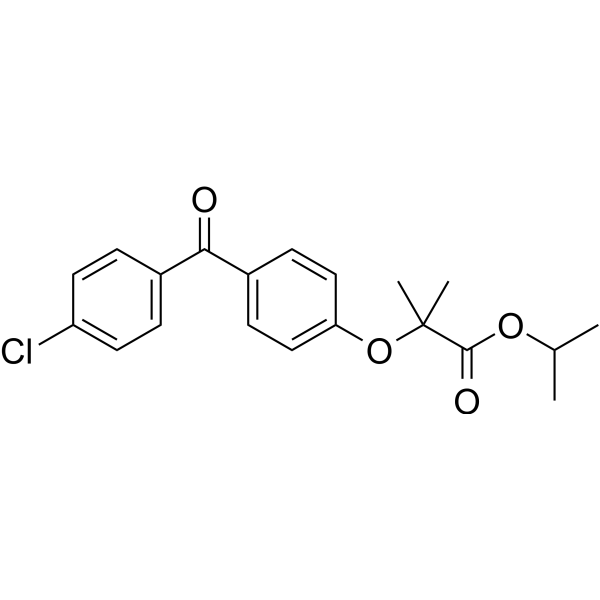
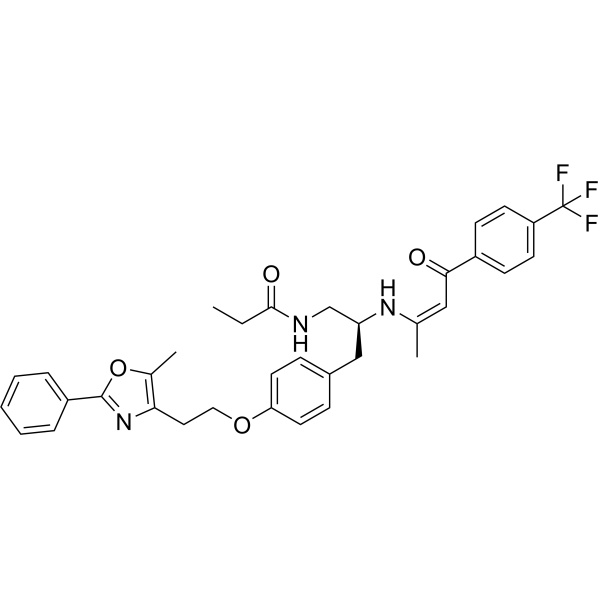

Publications Citing Use of MedChemExpress (MCE) PPAR alpha Antibody
More
 1 Publications Citing Use of MCE PPAR alpha Antibody (1)
-
WB


Applications
| Application |
WB

WB: Western Blot
|
IHC-P
IHC-P: Immunohistochemistry-Paraffin
|
IHC-F
IHC-F: Immunohistochemistry-Frozen
|
ICC/IF
ICC/IF: Immunocytochemistry/
Immunofluorescence |
ELISA
ELISA: Enzyme Linked Immunosorbent Assay
|
|---|---|---|---|---|---|
| Dilution Ratio | 1:500-1:1000 | 1:50-1:100 | 1:50-1:100 | 1:50-1:200 | 1:10000 |


Product Details
PPAR alpha Antibody is a Rabbit-derived and non-conjugated IgG polyclonal antibody, targeting to PPAR alpha.
-
Host Rabbit

-
Clonality Polyclonal

-
Species ReactivityHuman, Mouse, Rat
-
Observed Molecular WeightObserved band size: 52 kDa
Note: Due to possible protein modifications or aggregation, the molecular weight should be confirmed by actual measurement, and the predicted value is for reference only.

-
Calculated Molecular Weight Predicted band size: 52 kDa

Entrez Gene: 5465 Human ; 19013 Mouse ; 25747 Rat
SwissProt: Q07869 Human ; P23204 Mouse ; P37230 Rat
OMIM: 170998 Human
Synthetic peptide corresponding to Human PPAR-alpha.AA range:6-55.
Endogenous
affinity purified
Non-conjugated
Unmodified
IgG


Product Properties
-
Appearance
Solution
-
Formulation
Supplied in 1*PBS (pH 7.3), 50% glycerol and 0.5% BSA. Preservative: 0.02% sodium azide.
-
Concentration
Batch-dependent, Please check the COA for the concentration of each lot. Check Lot Concentration
-
Storage & Stability
Stored at -20°C for 1 year. Avoid repeated freeze / thaw cycles.
-
Shipping
Shipping with blue ice.


Publications (1)
-
Journal Impact Factor
-
Most Recent
-
Chem Res Toxicol
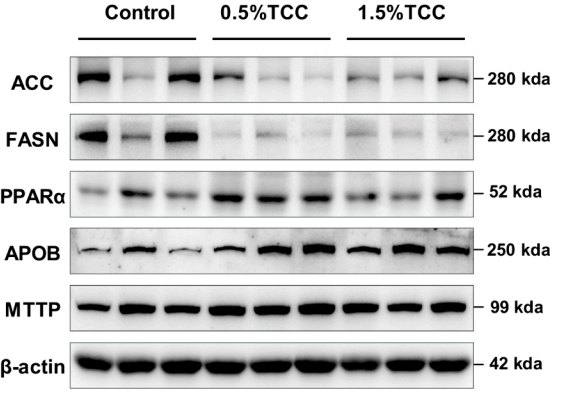
Triclocarban Disrupts Hepatic Lipid Homeostasis and Promotes Endoplasmic Reticulum Stress in Mice: A Multiomics Investigation. [Abstract]2025 Aug 12. PMID: 40795079
PPAR alpha Antibody purchased from MedChemExpress. Usage Cited in: Chem Res Toxicol. 2025 Aug 12. [Abstract]
WB detection of PPAR alpha.


Verification Images
-
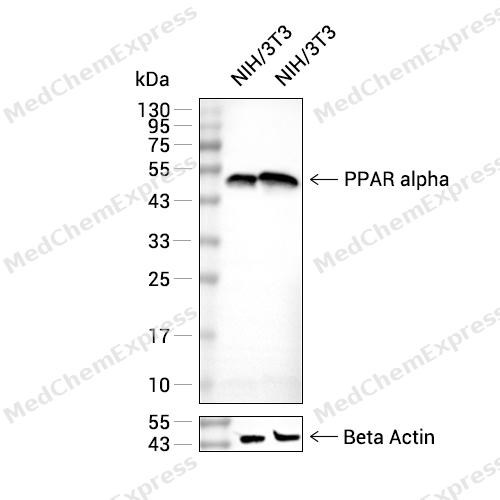 Western blot analysis of extracts from NIH/3T3 (lane 2(20μg), NIH/3T3 (lane 3(40μg), using PPAR alpha Antibody. Proteins were transferred to a PVDF membrane and blocked with 5% BSA in TBST for 2 hour at room temperature. The primary antibody and Loading control antibody (Beta Actin, HY-P80438, 1/3000) was used in 5% BSA in TBST at 4°C overnight. Goat Anti-Mouse/Rabbit IgG-HRP Secondary Antibody (HY-P8004/HY-P8001, 1/10,000) was used for 1 hour at room temperature.
 -
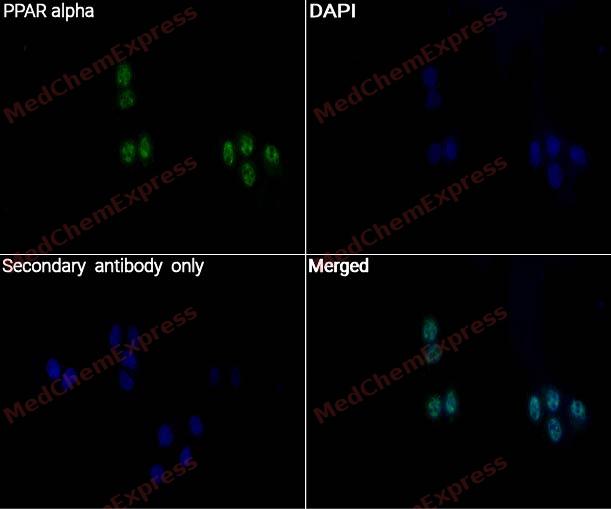 Immunocytochemistry analysis of Hela cells labeling PPAR alpha with PPAR alpha Antibody (HY-P80871) at 1/50 dilution. Cells were fixed in 4% paraformaldehyde for 15 minutes at room temperature, then blocked with QuickBlock™ Blocking Buffer for Immunol Staining for 10 min at room temperature. Cells were then incubated with PPAR alpha Antibody (HY-P80871) at 1/50 dilution in QuickBlock™ Blocking Buffer for Immunol Staining at 4 ℃. Alexa Fluor® 488-conjugated AffiniPure Goat Anti-Rabbit IgG H&L(HY-P8002, Green) was used as the secondary antibody at 1/1,000 dilution. PBS instead of the primary antibody was used as the secondary antibody only control. The Nuclear counterstain was DAPI (Blue).
 -
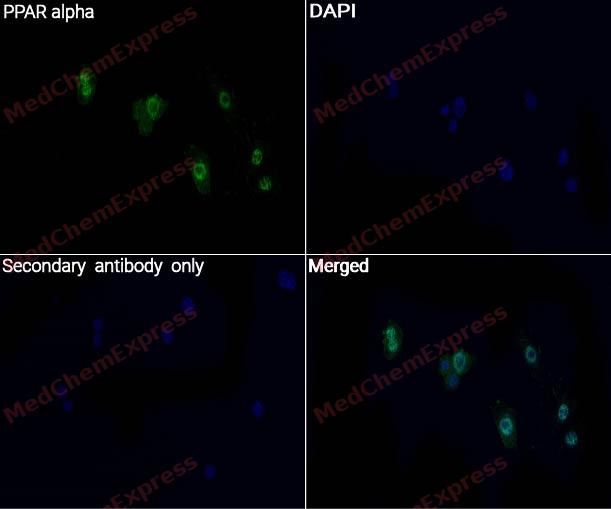 Immunocytochemistry analysis of 3T3-L1 cells labeling PPAR alpha with PPAR alpha Antibody (HY-P80871) at 1/50 dilution. Cells were fixed in 4% paraformaldehyde for 15 minutes at room temperature, then blocked with QuickBlock™ Blocking Buffer for Immunol Staining for 10 min at room temperature. Cells were then incubated with PPAR alpha Antibody (HY-P80871) at 1/50 dilution in QuickBlock™ Blocking Buffer for Immunol Staining at 4 ℃. Alexa Fluor® 488-conjugated AffiniPure Goat Anti-Rabbit IgG H&L(HY-P8002, Green) was used as the secondary antibody at 1/1,000 dilution. PBS instead of the primary antibody was used as the secondary antibody only control. The Nuclear counterstain was DAPI (Blue).
 -
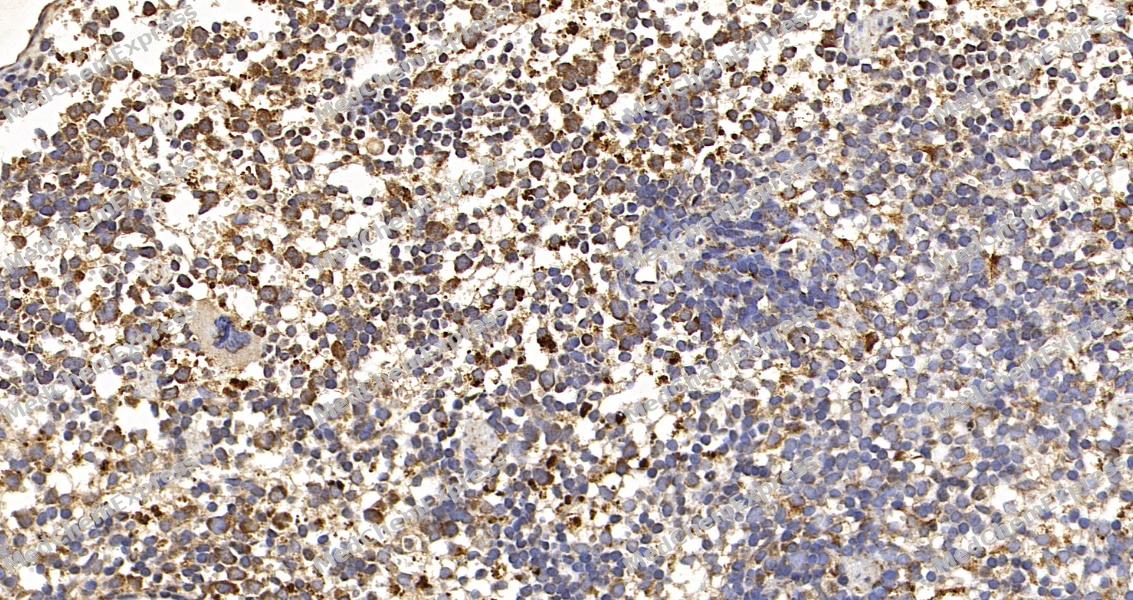 Immunohistochemical analysis of paraffin-embedded mouse spleen tissue using PPAR alpha Antibody. The section was pre-treated using heat mediated antigen retrieval with sodium citrate buffer (pH 6.0) for 8 minutes. The tissues were blocked in QuickBlock for 20 minutes at room temperature, washed with ddH2O and PBS, and then probed with the primary antibody at 1/100 dilution in 4℃ overnight. The detection was performed using an HRP conjugated compact polymer system. DAB was used as the chromogen. Tissues were counterstained with hematoxylin and mounted with DPX.
 -
Immunohistochemical analysis of paraffin-embedded mouse spleen tissue using PPAR alpha Antibody. The section was pre-treated using heat mediated antigen retrieval with sodium citrate buffer (pH 6.0) for 8 minutes. The tissues were blocked in QuickBlock for 20 minutes at room temperature, washed with ddH2O and PBS, and then probed with the primary antibody at 1/100 dilution in 4℃ overnight. The detection was performed using an HRP conjugated compact polymer system. DAB was used as the chromogen. Tissues were counterstained with hematoxylin and mounted with DPX.


Background
-
Function
PPAR alpha is a Ligand-activated transcription factor. Key regulator of lipid metabolism. Activated by the endogenous ligand 1-palmitoyl-2-oleoyl-sn-glycerol-3-phosphocholine (16:0/18:1-GPC). Activated by oleylethanolamide, a naturally occurring lipid that regulates satiety. Receptor for peroxisome proliferators such as hypolipidemic drugs and fatty acids. Regulates the peroxisomal beta-oxidation pathway of fatty acids. Functions as a transcription activator for the ACOX1 and P450 genes. Transactivation activity requires heterodimerization with RXRA and is antagonized by NR2C2. May be required for the propagation of clock information to metabolic pathways regulated by PER2
-
Subcellular Localization
Nucleus
-
Expression
Tissue_specificity:Skeletal muscle, liver, heart, and kidneys. Expressed in monocytes (PubMed: 28167758) .
Induction:Down-regulated by aging -
Isoforms & Post-Translational Modification
Q07869 has 2 isomers: Q07869-1: 52225 Da (predicted); Q07869-2: 18942 Da (predicted).
Ubiquitinated by E3 ubiquitin-protein ligase HUWE1; leading to proteasomal degradation;Phosphorylated -
Subunit
Heterodimer; with RXRA. This heterodimerization is required for DNA binding and transactivation activity. Interacts with NCOA3 coactivator. Interacts with CITED2; the interaction stimulates its transcriptional activity.
-
SwissProt ID
-
Synonyms
PPARA; NR1C1; PPAR; Peroxisome proliferator-activated receptor alpha; PPAR-alpha; Nuclear receptor subfamily 1 group C member 1
-
Research Field
Epigenetics and Nuclear Signaling
Documentation
-
Data Sheet (235 KB)
-
SDS (252 KB)
- English - EN (252 KB)
- Français - FR (252 KB)
- Deutsch - DE (252 KB)
- Norwegian - NO (252 KB)
- Español - ES (252 KB)
- Swedish - SV (252 KB)
- Italian - IT (252 KB)
- Korean - KR (252 KB)
- Portuguese - PT (252 KB)
-
User Guide for Antibodies (1077 KB)

 Powered by Bioz
