



UBE2D3 Antibody (YA2333)
(Synonyms: Ubiquitin Conjugating Enzyme E2 D3; UBE2D3; UBC4/5; UBCH5C; E2(17)KB3)
Based on 1 Customer Validation
Ubiquitin Conjugating Enzyme E2 D3 Antibody (YA2333) is a Rabbit-derived and non-conjugated IgG monoclonal antibody, targeting to Ubiquitin Conjugating Enzyme E2 D3.
-
Host:
Rabbit
-
Isotype:
IgG
-
Application:
WB, IP
-
Reactivity :
Human, Mouse, Rat
-
Formulation:
Supplied in 50mM Tris-Glycine(pH 7.4), 0.15M NaCl, 40% Glycerol, 0.01% Sodium azide and 0.05% BSA
-
Conjugation:
Non-conjugated


To place orders, for customer services and technical support, please contact: MedChemExpress USA
Tel: 609-228-6898 E-mail: [email protected] [email protected]





Applications
| Application |
WB

WB: Western Blot
|
IP
IP: Immunoprecipitation
|
|---|---|---|
| Dilution Ratio | 1:500-1:1000 | 1:20 |


Product Details
Ubiquitin Conjugating Enzyme E2 D3 Antibody (YA2333) is a Rabbit-derived and non-conjugated IgG monoclonal antibody, targeting to Ubiquitin Conjugating Enzyme E2 D3.
-
Host Rabbit

-
Clonality Recombinant,Monoclonal

-
Species ReactivityHuman, Mouse, Rat
-
Observed Molecular WeightObserved band size: 17 kDa
Note: Due to possible protein modifications or aggregation, the molecular weight should be confirmed by actual measurement, and the predicted value is for reference only.

-
Calculated Molecular Weight Predicted band size: 17 kDa

Entrez Gene: 7323 Human ; 66105 Mouse ; 81920 Rat
SwissProt: P61077 Human ; P61079 Mouse ; P61078 Rat
OMIM: 602963 Human
A synthetic peptide of human UBE2D3
Endogenous
Affinity Purified
Non-conjugated
Unmodified
IgG


Product Properties
-
Appearance
Liquid
-
Formulation
Supplied in 50mM Tris-Glycine(pH 7.4), 0.15M NaCl, 40% Glycerol, 0.01% Sodium azide and 0.05% BSA
-
Concentration
Batch-dependent, Please check the COA for the concentration of each lot. Check Lot Concentration
-
Storage & Stability
Stored at -20°C for 1 year. Avoid repeated freeze / thaw cycles.
-
Shipping
Shipping with blue ice.


Verification Images
-
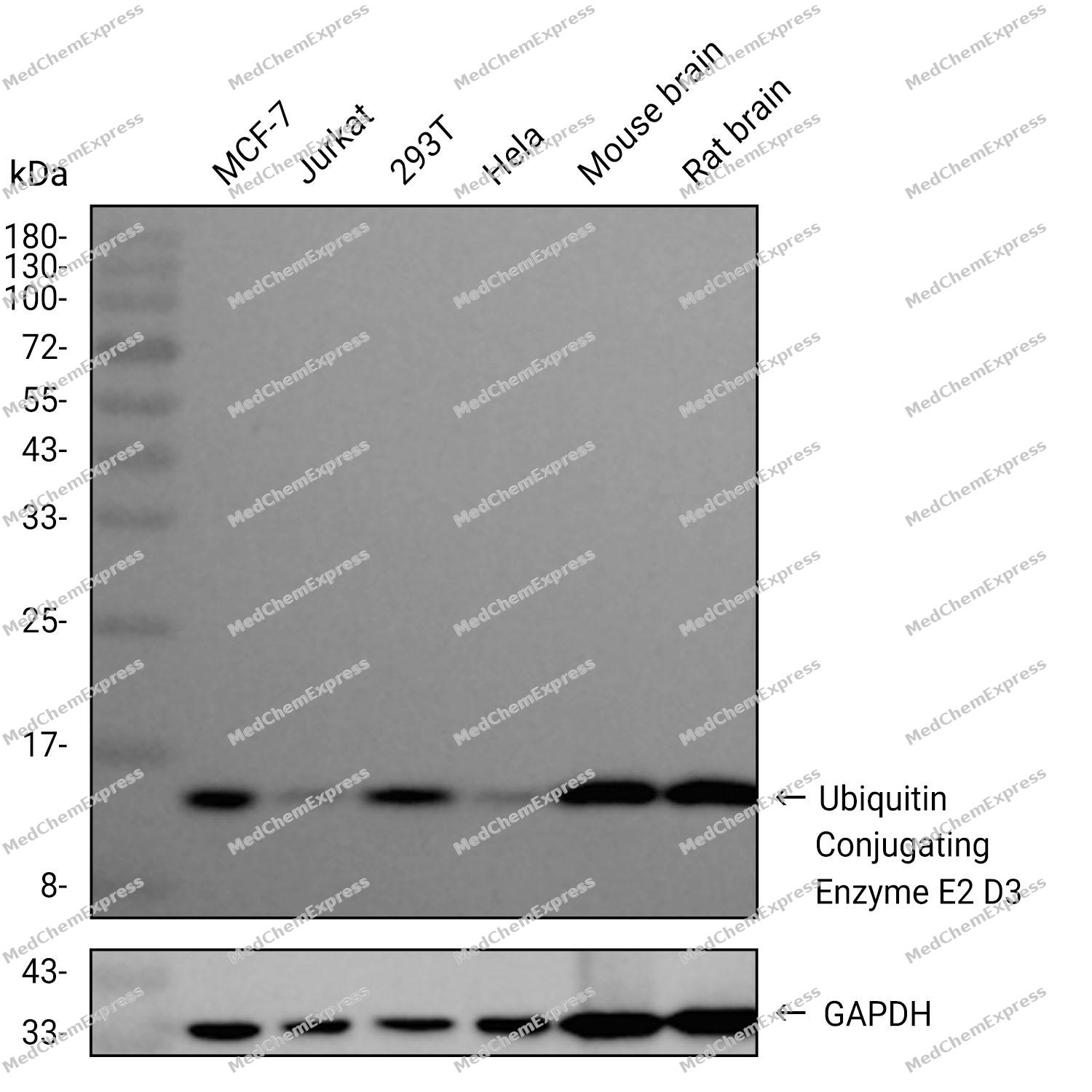
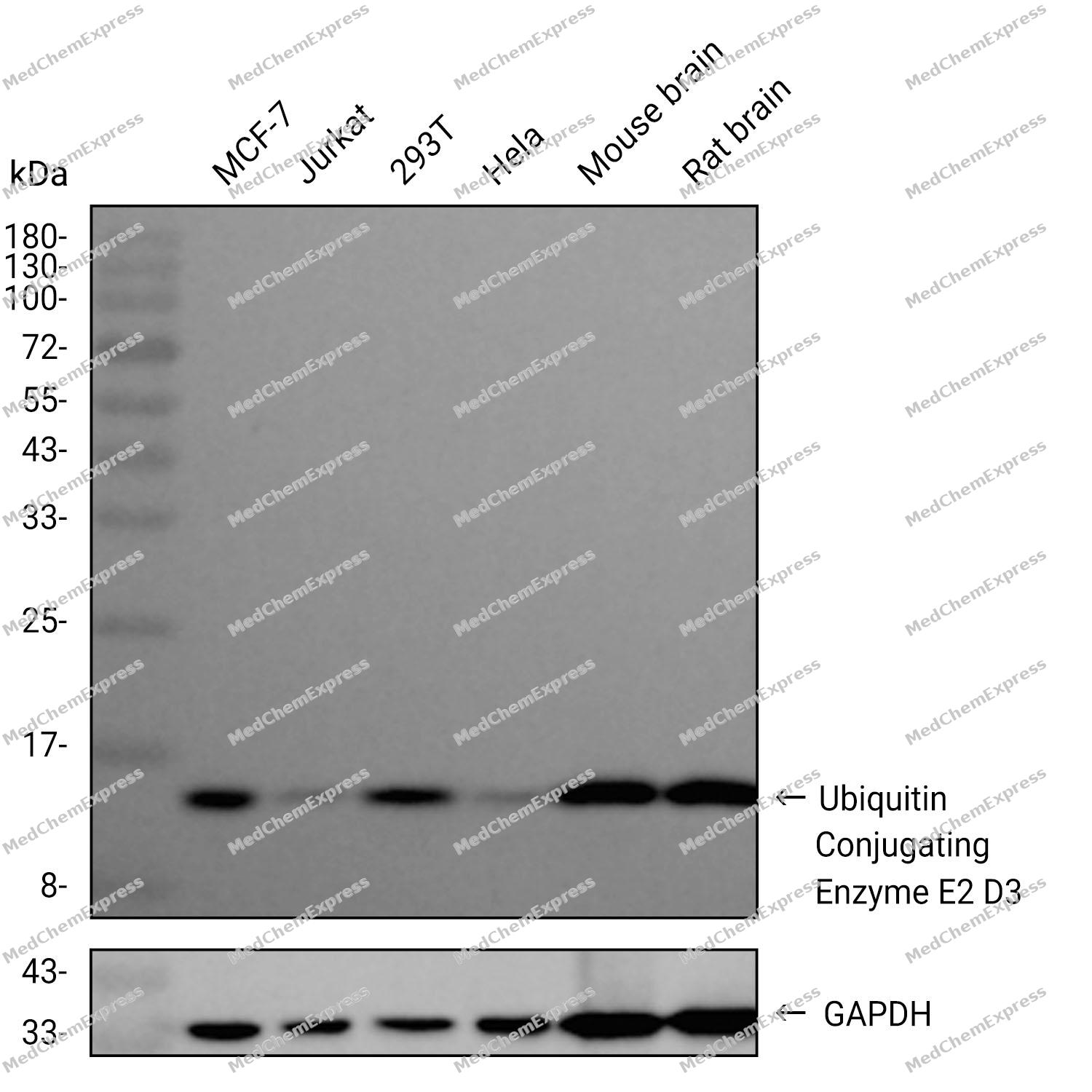 Western blot analysis was performed on extracts from MCF-7 (lane 1, 15 μg), Jurkat (lane 2, 15 μg), 293T (lane 3, 15 μg), Hela (lane 4, 15 μg), Mouse brain (lane 5, 15 μg), and Rat brain (lane 6, 15 μg) using Ubiquitin Conjugating Enzyme E2 D3 Rabbit mAb.Proteins were transferred to a PVDF membrane and blocked with 5% non-fat milk in TBST at 4°C overnight.The primary antibody (1:1000 dilution) and the loading control antibody (GAPDH, HY-P80137, 1:20000 dilution) were incubated in 5% non-fat milk in TBST for 1 hour at 37°C.Goat Anti-Rabbit IgG-HRP Secondary Antibody (1:20000 dilution) was then applied for 40 minutes at 37°C.
 -
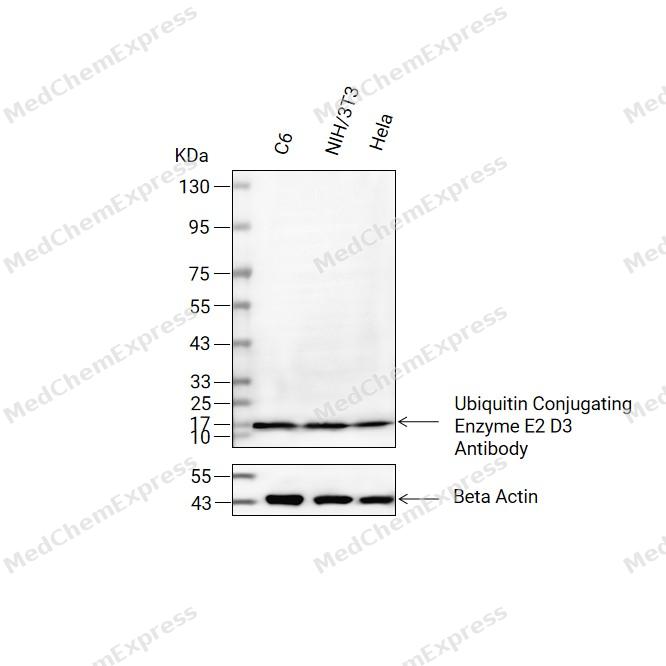 Western blot analysis of extracts from C6(lane 2(20ug) , NIH/3T3(lane 3(20ug) and Hela(lane 4(20ug) using Ubiquitin Conjugating Enzyme E2 D3 Antibody (HY-P82588) Rabbit mAb. Proteins were transferred to a PVDF membrane and blocked with 5% non-fat milk in TBST for 2 hour at room temperature. The primary antibody (1/1000) and Loading control antibody (Beta Actin, HY-P83730, 1/10000) was used in 5% non-fat milk in TBST at 4°C overnight. Goat Anti-Mouse/Rabbit IgG-HRP Secondary Antibody (1/10000) was used for 1 hour at room temperature.


Background
-
Function
UBE2D3 is an Accepts ubiquitin from the E1 complex and catalyzes its covalent attachment to other proteins. In vitro catalyzes 'Lys-11'-, as well as 'Lys-48'-linked polyubiquitination. Cooperates with the E2 CDC34 and the SCF(FBXW11) E3 ligase complex for the polyubiquitination of NFKBIA leading to its subsequent proteasomal degradation. Acts as an initiator E2, priming the phosphorylated NFKBIA target at positions 'Lys-21' and/or 'Lys-22' with a monoubiquitin. Ubiquitin chain elongation is then performed by CDC34, building ubiquitin chains from the UBE2D3-primed NFKBIA-linked ubiquitin. Also acts as an initiator E2, in conjunction with RNF8, for the priming of PCNA. Monoubiquitination of PCNA, and its subsequent polyubiquitination, are essential events in the operation of the DNA damage tolerance (DDT) pathway that is activated after DNA damage caused by UV or chemical agents during S-phase. Associates with the BRCA1/BARD1 E3 ligase complex to perform ubiquitination at DNA damage sites following ionizing radiation leading to DNA repair. Targets DAPK3 for ubiquitination which influences promyelocytic leukemia protein nuclear body (PML-NB) formation in the nucleus. In conjunction with the MDM2 and TOPORS E3 ligases, functions ubiquitination of p53/TP53. In conjunction with the CBL E3 ligase, targets EGFR for polyubiquitination at the plasma membrane as well as during its internalization and transport on endosomes. In conjunction with the STUB1 E3 quality control E3 ligase, ubiquitinates unfolded proteins to catalyze their immediate destruction. Together with RNF135, catalyzes the viral RNA-dependent 'Lys-63'-linked polyubiquitination of RIGI to activate the downstream signaling pathway that leads to interferon beta production. Together with ZNF598, catalyzes ubiquitination of 40S ribosomal proteins in response to ribosome collisions. In cooperation with the GATOR2 complex, catalyzes 'Lys-6'-linked ubiquitination of NPRL2[1][2][3][4][5][6][7][8][9][10][11][12][13][14][15][16][17][18].
-
Subcellular Localization
Cell membrane; Peripheral membrane protein; Endosome membrane; Peripheral membrane protein
-
Isoforms & Post-Translational Modification
P61077 has 3 isomers: P61077-1: 16687 Da (predicted); P61077-2: 16785 Da (predicted); P61077-3: 16893 Da (predicted).
Phosphorylated by AURKB -
Subunit
Interacts with SCF (SKP1-CUL1-F-box protein) E3 ubiquitin ligase complex; when Cullin is neddylated, the interaction between the E2 and the SCF complex is strengthened. Interacts with DAPK3. Interacts with BRCA1; the DNA damage checkpoint promotes the association with BRCA1 after ionizing radiation. Interacts non-covalently with ubiquitin. Interacts with E3 ubiquitin-protein ligase CBLC. Interacts with UBTD1 (PubMed:24211586). Interacts with RIGI and RNF135; involved in RIGI ubiquitination and activation (PubMed:28469175)
-
SwissProt ID
-
Synonyms
Ubiquitin Conjugating Enzyme E2 D3; UBE2D3; UBC4/5; UBCH5C; E2(17)KB3
-
Research Field
Epigenetics and Nuclear Signaling


Documentation
-
Data Sheet (232 KB)
-
SDS (252 KB)
- English - EN (252 KB)
- Français - FR (252 KB)
- Deutsch - DE (252 KB)
- Norwegian - NO (252 KB)
- Español - ES (252 KB)
- Swedish - SV (252 KB)
- Italian - IT (252 KB)
- Korean - KR (252 KB)
- Portuguese - PT (252 KB)
-
User Guide for Antibodies (1077 KB)

 Powered by Bioz
