



UFM1 Antibody (YA1577)
(Synonyms: Ubiquitin-fold modifier 1; C13orf20)Based on 1 publication(s) in Google Scholar
UFM1 Antibody (YA1577) is a Rabbit-derived and non-conjugated IgG monoclonal antibody, targeting to UFM1.
-
Host:
Rabbit
-
Isotype:
IgG
-
Application:
WB, IHC-P, IP
-
Reactivity :
Human, Mouse
-
Formulation:
Supplied in 50mM Tris-Glycine(pH 7.4), 0.15M NaCl, 40% Glycerol, 0.01% Sodium azide and 0.05% BSA
-
Conjugation:
Non-conjugated


To place orders, for customer services and technical support, please contact: MedChemExpress USA
Tel: 609-228-6898 E-mail: [email protected] [email protected]



Publications Citing Use of MedChemExpress (MCE) UFM1 Antibody (YA1577)
More

Applications
| Application |
WB

WB: Western Blot
|
IHC-P
IHC-P: Immunohistochemistry-Paraffin
|
IP
IP: Immunoprecipitation
|
|---|---|---|---|
| Dilution Ratio | 1:500-1:1000 | 1:50-1:100 | 1:20 |


Product Details
UFM1 Antibody (YA1577) is a Rabbit-derived and non-conjugated IgG monoclonal antibody, targeting to UFM1.
-
Host Rabbit

-
Clonality Recombinant,Monoclonal

-
Species ReactivityHuman, Mouse
-
Observed Molecular WeightObserved band size: 9 kDa
Note: Due to possible protein modifications or aggregation, the molecular weight should be confirmed by actual measurement, and the predicted value is for reference only.

-
Calculated Molecular Weight Predicted band size: 9 kDa

Entrez Gene: 51569 Human ; 67890 Mouse ;
SwissProt: P61960 Human ; P61961 Mouse ;
OMIM: 617899 Human
A synthetic peptide of human UFM1
Endogenous
Affinity Purified
Non-conjugated
Unmodified
IgG


Product Properties
-
Appearance
Solution
-
Formulation
Supplied in 50mM Tris-Glycine(pH 7.4), 0.15M NaCl, 40% Glycerol, 0.01% Sodium azide and 0.05% BSA
-
Concentration
Batch-dependent, Please check the COA for the concentration of each lot. Check Lot Concentration
-
Storage & Stability
Stored at -20°C for 1 year. Avoid repeated freeze / thaw cycles.
-
Shipping
Shipping with blue ice.


Publications (1)
-
Journal Impact Factor
-
Most Recent
-
J Clin Lab Anal
2025 Mar;39(6):e70004. PMID: 40059580


Verification Images
-
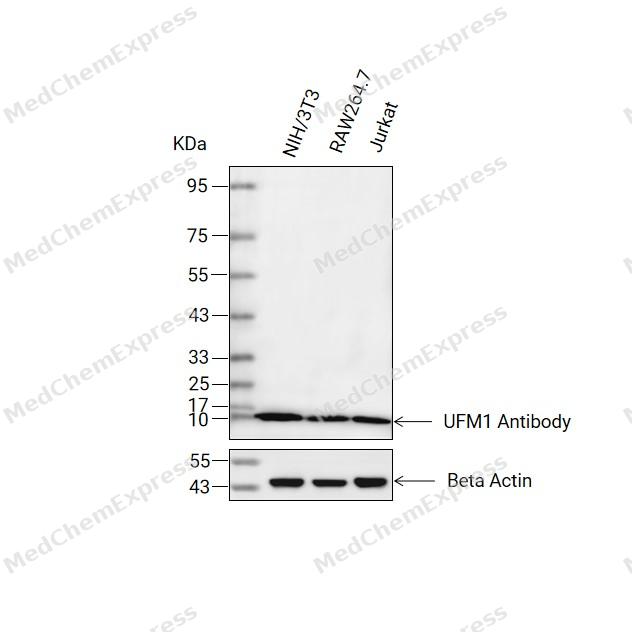 Western blot analysis of extracts from NIH/3T3(lane 2(20ug) , RAW264.7(lane 3(20ug) and Jurkat(lane 4(20ug) using UFM1 Antibody (HY-P81832) Rabbit mAb. Proteins were transferred to a PVDF membrane and blocked with 5% non-fat milk in TBST for 2 hour at room temperature. The primary antibody (1/1000) and Loading control antibody (Beta Actin, HY-P83730, 1/10000) was used in 5% non-fat milk in TBST at 4°C overnight. Goat Anti-Mouse/Rabbit IgG-HRP Secondary Antibody (1/10000) was used for 1 hour at room temperature.
 -
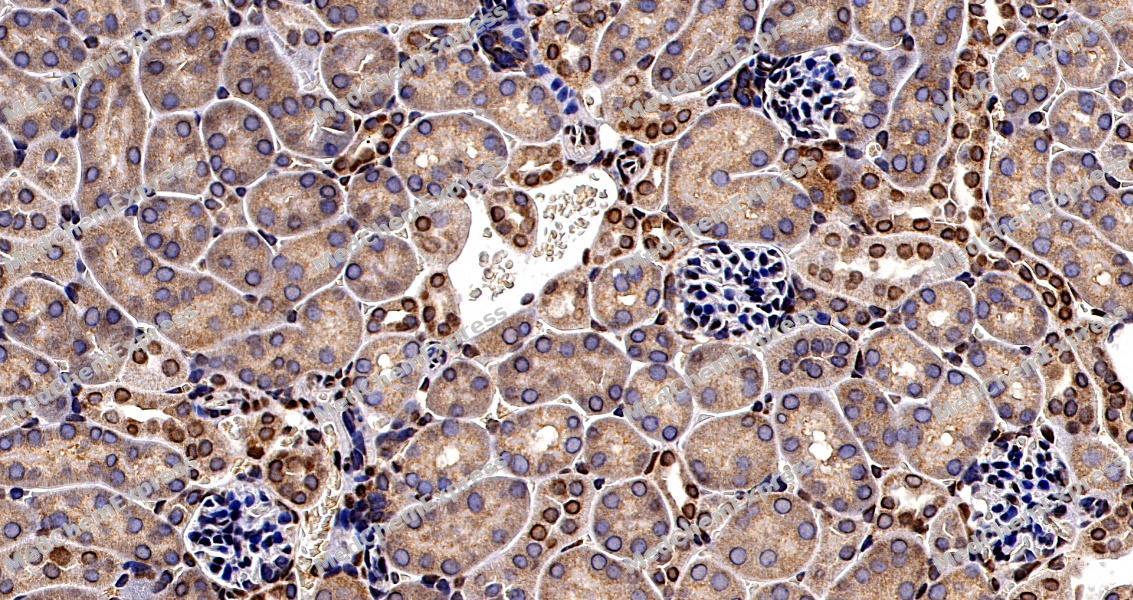 Immunohistochemical analysis of paraffin-embedded mouse kidney tissue using UFM1 Antibody. The section was pre-treated using heat mediated antigen retrieval with sodium citrate buffer (pH 6.0) for 8 minutes. The tissues were blocked in QuickBlock for 20 minutes at room temperature, washed with ddH2O and PBS, and then probed with the primary antibody at 1/100 dilution in 4℃ overnight. The detection was performed using an HRP conjugated compact polymer system. DAB was used as the chromogen. Tissues were counterstained with hematoxylin and mounted with DPX.
 -
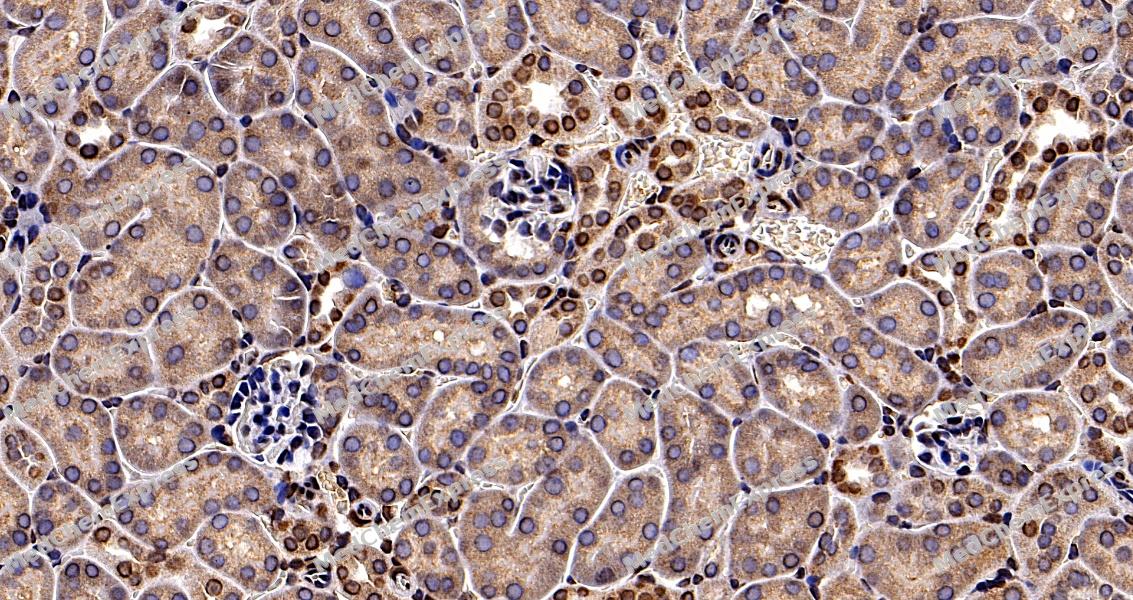 Immunohistochemical analysis of paraffin-embedded mouse kidney tissue using UFM1 Antibody. The section was pre-treated using heat mediated antigen retrieval with sodium citrate buffer (pH 6.0) for 8 minutes. The tissues were blocked in QuickBlock for 20 minutes at room temperature, washed with ddH2O and PBS, and then probed with the primary antibody at 1/100 dilution in 4℃ overnight. The detection was performed using an HRP conjugated compact polymer system. DAB was used as the chromogen. Tissues were counterstained with hematoxylin and mounted with DPX.


Background
-
Function
UFM1 is an Ubiquitin-like modifier which can be covalently attached via an isopeptide bond to lysine residues of substrate proteins as a monomer or a lysine-linked polymer. The so-called ufmylation, requires the UFM1-activating E1 enzyme UBA5, the UFM1-conjugating E2 enzyme UFC1, and the UFM1-ligase E3 enzyme UFL1. Ufmylation is involved in various processes, such as ribosome recycling, response to DNA damage, transcription or reticulophagy (also called ER-phagy) induced in response to endoplasmic reticulum stress[1][2][3][4][5][6][7][8][9].
-
Subcellular Localization
Nucleus; Cytoplasm
-
Expression
Induction:Up-regulated by thapsigargin -
Isoforms & Post-Translational Modification
P61960 has 2 isomers: P61960-1: 9118 Da (predicted); P61960-2: 10960 Da (predicted).
UFM1 precursor is cleaved by UFSP1, promoting its maturation: processing of the C-terminal Ser-Cys dipeptide is required to expose its C-terminal conserved Gly residue -
Subunit
Interacts with UBA5 (PubMed:26872069, PubMed:26929408, PubMed:27653677, PubMed:28360427, PubMed:29295865, PubMed:30412706). Interacts with UFC1 (PubMed:29868776)
-
SwissProt ID
-
Synonyms
Ubiquitin-fold modifier 1; C13orf20
-
Research Field
Cell Biology
Documentation
-
Data Sheet (262 KB)
-
SDS (251 KB)
- English - EN (251 KB)
- Français - FR (251 KB)
- Deutsch - DE (251 KB)
- Norwegian - NO (251 KB)
- Español - ES (251 KB)
- Swedish - SV (251 KB)
- Italian - IT (251 KB)
- Korean - KR (251 KB)
- Portuguese - PT (251 KB)
-
User Guide for Antibodies (1077 KB)
References
[1]. Komatsu M, et al. A novel protein-conjugating system for Ufm1, a ubiquitin-fold modifier. EMBO J. 2004 May 5;23(9):1977-86. [Content Brief]
[2]. Tatsumi K, et al. A novel type of E3 ligase for the Ufm1 conjugation system. J Biol Chem. 2010 Feb 19;285(8):5417-27. [Content Brief]
[3]. Oweis W, et al. Trans-Binding Mechanism of Ubiquitin-like Protein Activation Revealed by a UBA5-UFM1 Complex. Cell Rep. 2016 Sep 20;16(12):3113-3120. [Content Brief]
[4]. Nahorski MS, et al. Biallelic UFM1 and UFC1 mutations expand the essential role of ufmylation in brain development. Brain. 2018 Jul 1;141(7):1934-1945. [Content Brief]
[5]. Walczak CP, et al. Ribosomal protein RPL26 is the principal target of UFMylation. Proc Natl Acad Sci U S A. 2019 Jan 22;116(4):1299-1308. [Content Brief]
[6]. He C, et al. UFL1 ablation in T cells suppresses PD-1 UFMylation to enhance anti-tumor immunity. Mol Cell. 2024 Mar 21;84(6):1120-1138.e8. [Content Brief]
[7]. DaRosa PA, et al. UFM1 E3 ligase promotes recycling of 60S ribosomal subunits from the ER. Nature. 2024 Mar;627(8003):445-452. [Content Brief]
[8]. Yoo HM, et al. Modification of ASC1 by UFM1 is crucial for ERα transactivation and breast cancer development. Mol Cell. 2014 Oct 23;56(2):261-274. [Content Brief]
[9]. Liang JR, et al. A Genome-wide ER-phagy Screen Highlights Key Roles of Mitochondrial Metabolism and ER-Resident UFMylation. Cell. 2020 Mar 19;180(6):1160-1177.e20. [Content Brief]

 Powered by Bioz
