



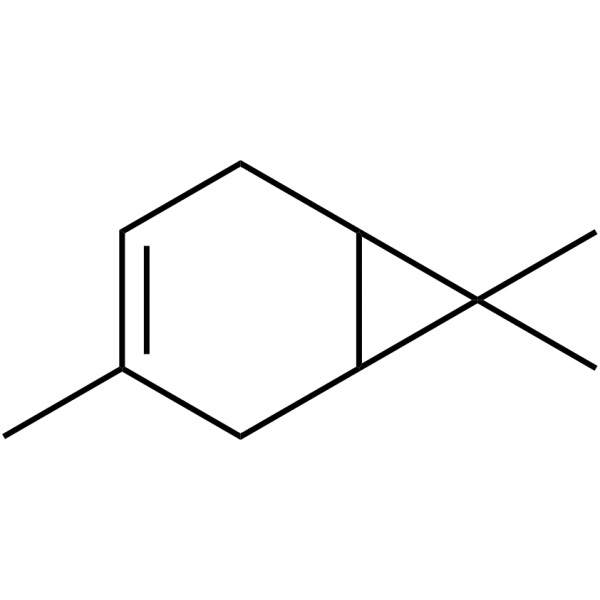
3-Carene

Based on 1 Customer Validation
3-Carene is a bicyclic monoterpene in essential oils extracted from pine trees. 3-Carene inhibits nociceptive stimulus-induced inflammatory infiltrates and COX-2 overexpression, and with antinociceptive effect. 3-Carene stimulates the activity and expression of alkaline phosphatase that is an early phase marker of osteoblastic differentiation.
Nur für Forschungszwecke. Wir verkaufen nicht an Patienten.
- Reinheit: 91.66%
- CAS. Nr.: 13466-78-9
- Formel: C10H16
- Molecular Weight:136.23
-
Speicherung:
-20°C, protect from light
* In solvent : -80°C, 6 months; -20°C, 1 month (protect from light)

To place orders, for customer services and technical support, please contact: MedChemExpress USA
Tel: 609-228-6898 E-mail: [email protected] [email protected]


-
 Biologische Aktivität
-
Chemical Information
-
Lösungsmittel & Löslichkeit
- Reinheit & Dokumentation
- Verweise
-
 Help & FAQs
-

Immunology/Inflammation Compound Library
HY-L007
-
Natural Product Library
HY-L021
-
Anti-Aging Compound Library
HY-L034
-
Medicine Food Homology Compound Library
HY-L055
-
Terpenoids Library
HY-L056
-
Traditional Chinese Medicine Active Compound Library
HY-L065
-
Food Additive Library
HY-L093
-
Food-Sourced Compound Library
HY-L094
-
Anti-inflammatory Traditional Chinese Medicine Active Compound Library
HY-L114
-
Plant-Sourced Natural Product Library
HY-L115
-
Human Metabolite Library
HY-L123
-
Osteogenesis Compound Library
HY-L131
-
Radioprotector Library
HY-L178
-
Bioactive Compound Library Max
HY-L181
-
MCE Bioactive Compound Library
HY-L001V
-
Natural Product Library Plus
HY-L021P
-
Natural Product and Natural Product-Like Compound Library
HY-L021M
-
Bioactive Compound Library
HY-L001
-
Tibetan Medicine Compound Library
HY-L191
-
PBCRBS Traditional Chinese Medicine Compound Library
HY-L193
-
Flavor Compound Library
HY-L202
-
High-Throughput Bioactive Compound Library
HY-L205
-
High-Throughput Natural Product Library
HY-L206
-
Ancient Chinese Classical Formulas Traditional Chinese Medicine Active Compound Library
HY-L209
-
Anti-Rheumatic Arthritis Compound Library
HY-L210
-
Mass Spectrometry Human Metabolite Library
HY-L215
-
Diarrhea-Related Traditional Chinese Medicine Active Compound Library
HY-L224
-
Mongolian Medicine Compound Library
HY-L238
-
Flavors and Fragrances Compound Library
HY-L242
-
Natural Product Diversity Scaffold Library
HY-L245
-
Mass Spectrometry Natural Product Library
HY-L262




Biologische Aktivität


Chemical Information
-
CAS. Nr. 13466-78-9
-
Appearance Liquid (Density: 0.8586 g/cm3)
-
Molecular Weight 136.23
-
Formel C10H16
-
Color Colorless to light yellow
-
SMILES
CC1(C)C2CC=C(C)CC12
-
Structure Classification
-
Initial Source
-
Versand
Room temperature in continental US; may vary elsewhere.
-
Speicherung
-20°C, protect from light
* In solvent : -80°C, 6 months; -20°C, 1 month (protect from light)


Lösungsmittel & Löslichkeit
DMSO : 100 mg/mL (734.05 mM; Need ultrasonic; Hygroscopic DMSO has a significant impact on the solubility of product, please use newly opened DMSO)
Please refer to the solubility information to select the appropriate solvent. Once prepared, please aliquot and store the solution to prevent product inactivation from repeated freeze-thaw cycles.
Storage method and period of stock solution: -80°C, 6 months; -20°C, 1 month (protect from light). When stored at -80°C, please use it within 6 months. When stored at -20°C, please use it within 1 month.
Please refer to the solubility information to select the appropriate solvent. Once prepared, please aliquot and store the solution to prevent product inactivation from repeated freeze-thaw cycles.
Storage method and period of stock solution: -80°C, 6 months; -20°C, 1 month (protect from light). When stored at -80°C, please use it within 6 months. When stored at -20°C, please use it within 1 month.
Konzentration (Stammlösung) × Volumen (Stammlösung) = Konzentration (Ziellösung) × Volumen (Ziellösung)
Select the appropriate dissolution method based on your experimental animal and administration route.
- For the following dissolution methods, please ensure to first prepare a clear stock solution using an In Vitro approach and then sequentially add co-solvents:
- To ensure reliable experimental results, the clarified stock solution can be appropriately stored based on storage conditions. As for the working solution for In Vivo experiments, it is recommended to prepare freshly and use it on the same day.
- The percentages shown for the solvents indicate their volumetric ratio in the final prepared solution. If precipitation or phase separation occurs during preparation, heat and/or sonication can be used to aid dissolution.
Add each solvent one by one: 10% DMSO 90% (20% SBE-β-CD in Saline)
Solubility: ≥ 2.5 mg/mL (18.35 mM); Clear solution
This protocol yields a clear solution of ≥ 2.5 mg/mL (saturation unknown).
Taking 1 mL working solution as an example, add 100 μL DMSO stock solution (25.0 mg/mL) to 900 μL 20% SBE-β-CD in Saline, and mix evenly.
Preparation of 20% SBE-β-CD in Saline (4°C, storage for one week): 2 g SBE-β-CD powder is dissolved in 10 mL Saline, completely dissolve until clear.
Please enter the basic information of animal experiments:
-
-
-
-
Recommended: Prepare an additional quantity of animals to account for potential losses during experiments.
Please enter your animal formula composition:
-
%DMSO +
Recommended: Keep the proportion of DMSO in working solution below 2% if your animal is weak.
-
%+
-
+%Tween-80 + +
-
%Saline +
The co-solvents required include: DMSO, . All of co-solvents are available by MedChemExpress (MCE). , Tween 80. All of co-solvents are available by MedChemExpress (MCE).
Working solution concentration: 0.22 mg/mL
Method for preparing stock solution: mg drug dissolved in μL DMSO. Stock solution concentration: mg/mL. * In solvent : -80°C, 6 months; -20°C, 1 month (protect from light)
1. Take μL DMSO stock solution;
2. Add μL .
μL , mix evenly;
3. Then add μL Tween 80, mix evenly;
4. Then add μL
Please ensure that the stock solution in the first step is dissolved to a clear state, and add co-solvents in sequence. You can use ultrasonic heating (ultrasonic cleaner, recommended frequency 20-40 kHz), vortexing, etc. to assist dissolution.


Reinheit & Dokumentation
-
Data Sheet (270 KB)
-
SDS (771 KB)
- English - EN (771 KB)
- Français - FR (771 KB)
- Deutsch - DE (771 KB)
- Norwegian - NO (771 KB)
- Español - ES (771 KB)
- Swedish - SV (771 KB)
- Italian - IT (771 KB)
- Korean - KR (771 KB)
- Portuguese - PT (771 KB)
-
Handling Instructions (2659 KB)
Verweise
[1]. Huang XL, e tal. Anti-inflammatory and antinociceptive effects of active ingredients in the essential oils from Gynura procumbens, a traditional medicine and a new and popular food material.J Ethnopharmacol. 2019 Jul 15;239:111916. [Content Brief]
[2]. Jeong JG, et al. Low concentration of 3-carene stimulates the differentiation of mouse osteoblastic MC3T3-E1 subclone 4 cells. Phytother Res. 2008 Jan;22(1):18-22. [Content Brief]


Complete Stock Solution Preparation Table
Please refer to the solubility information to select the appropriate solvent. Once prepared, please aliquot and store the solution to prevent product inactivation from repeated freeze-thaw cycles.
Storage method and period of stock solution: -80°C, 6 months; -20°C, 1 month (protect from light). When stored at -80°C, please use it within 6 months. When stored at -20°C, please use it within 1 month.
| Optional Solvent | Concentration Solvent Mass | 1 mg | 5 mg | 10 mg | 25 mg |
|---|---|---|---|---|---|
| DMSO | 1 mM | 7.3405 mL | 36.7026 mL | 73.4053 mL | 183.5132 mL |
| 5 mM | 1.4681 mL | 7.3405 mL | 14.6811 mL | 36.7026 mL | |
| 10 mM | 0.7341 mL | 3.6703 mL | 7.3405 mL | 18.3513 mL | |
| 15 mM | 0.4894 mL | 2.4468 mL | 4.8937 mL | 12.2342 mL | |
| 20 mM | 0.3670 mL | 1.8351 mL | 3.6703 mL | 9.1757 mL | |
| 25 mM | 0.2936 mL | 1.4681 mL | 2.9362 mL | 7.3405 mL | |
| 30 mM | 0.2447 mL | 1.2234 mL | 2.4468 mL | 6.1171 mL | |
| 40 mM | 0.1835 mL | 0.9176 mL | 1.8351 mL | 4.5878 mL | |
| 50 mM | 0.1468 mL | 0.7341 mL | 1.4681 mL | 3.6703 mL | |
| 60 mM | 0.1223 mL | 0.6117 mL | 1.2234 mL | 3.0586 mL | |
| 80 mM | 0.0918 mL | 0.4588 mL | 0.9176 mL | 2.2939 mL | |
| 100 mM | 0.0734 mL | 0.3670 mL | 0.7341 mL | 1.8351 mL |


3-Carene Related Classifications
HY-N6663 Related Classifications
 Powered by Bioz