



2,6-Diethylaniline

Based on 1 Customer Validation
2,6-Diethylaniline is an orally active toxic substance. 2,6-Diethylaniline serves as a monomer for the deposition of plasma-polymerized 2,6-diethylaniline films.
Nos produits utilisent uniquement pour la recherche. Nous ne vendons pas aux patients.
- CAS No.: 579-66-8
- Formule: C10H15N
- Masse moléculaire:149.24
-
Stockage:
RT, protect from light.
In solvent -80°C, 1 year , -20°C, 6 months


To place orders, for customer services and technical support, please contact: MedChemExpress USA
Tel: 609-228-6898 E-mail: [email protected] [email protected]


-
 Activité biologique
-
Chemical Information
- Pureté et documentation
- Références
-
 Help & FAQs


-
HY-Y1067
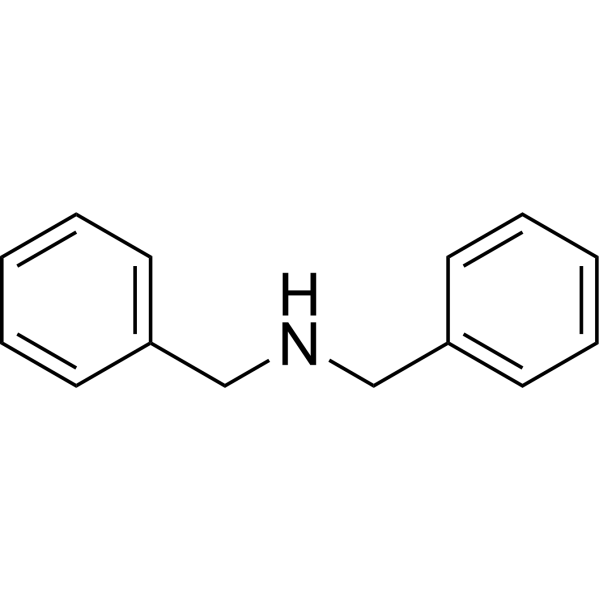
DibenzylamineBiochemical Reagent -

HY-W011696
Oleylamine, 80-90%Nanoparticle Modification Reagent -

HY-W032014
OctylamineBiochemical Assay Reagent -
HY-131113
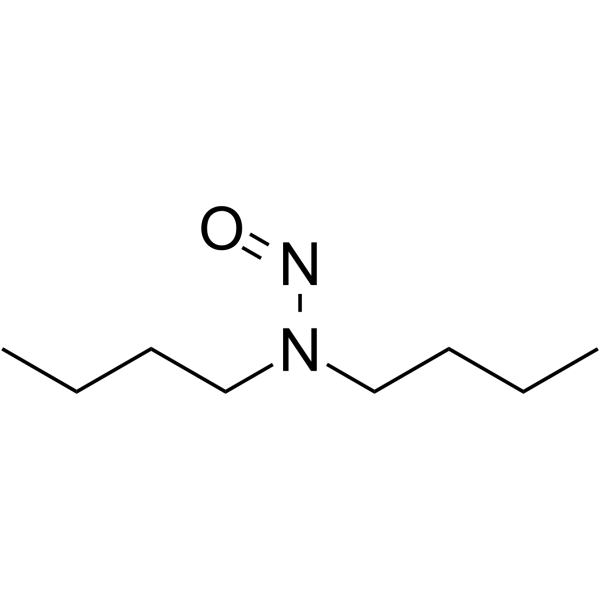
N-NitrosodibutylamineNitrosamine -
HY-B1315
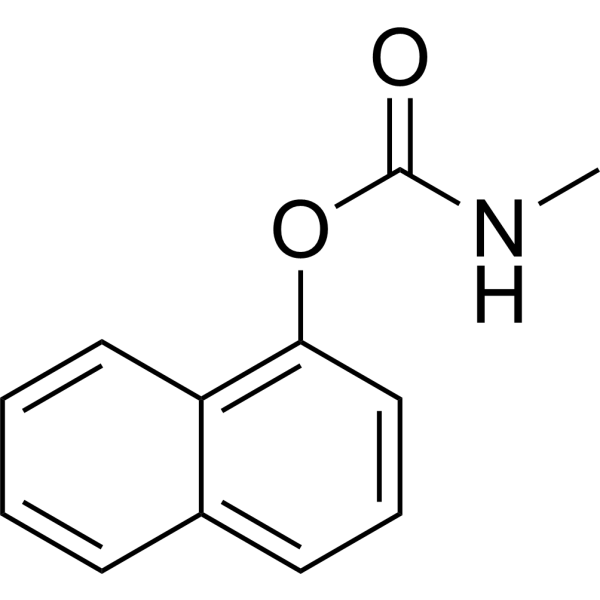
CarbarylInsecticide -

HY-B1315R
Carbaryl (Standard)Standard of Carbaryl -
HY-B0420A
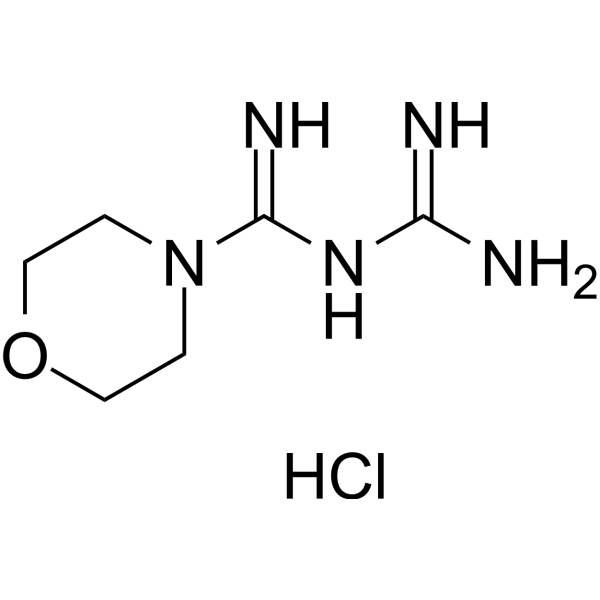
Moroxydine hydrochlorideBroad-spectrum Antiviral Agent -
HY-W016321
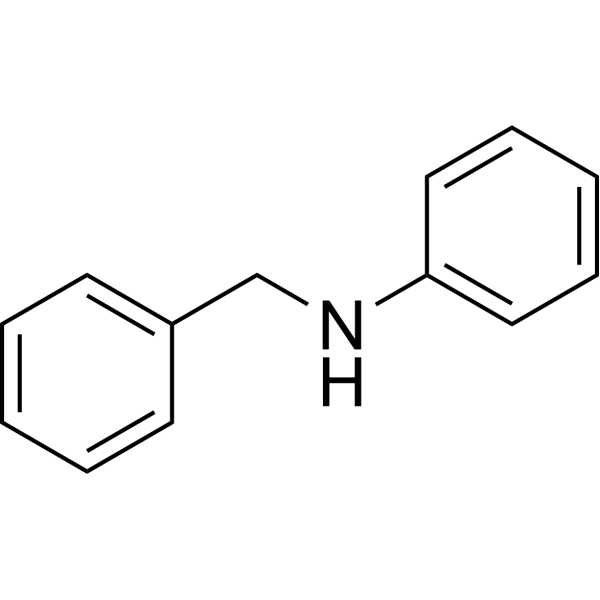
N-BenzylanilineN-alkylated Derivative


Activité biologique
Description
In Vitro
Plasma polymerized 2,6-diethylaniline films on glass substrates remain thermally stable at approximately 580 K; after heat treatment, the films undergo significant structural rearrangement, and their optical transition energies decrease (with direct transition energy as low as 2.73 eV and indirect transition energy as low as 1.26 eV); after 180 days of aging, only extremely minor changes occur in their structural and optical properties[2].
MedChemExpress (MCE) has not independently confirmed the accuracy of these methods. They are for reference only. .
In Vivo
MedChemExpress (MCE) has not independently confirmed the accuracy of these methods. They are for reference only.
-
Animal Model:specific strain not specified[1]
-
Dosage:Not specified
-
Administration:p.o.; single dose
-
Result:Observed an acute peroral LD50 value of 2.69 g/kg.
Calculated an LD50 value of 2.31 g/kg from the regression equation.


Chemical Information
-
CAS No. 579-66-8
-
Appearance Liquid (Density: 0.906 g/cm3)
-
Masse moléculaire 149.24
-
Formule C10H15N
-
Color Colorless to light yellow
-
SMILES
NC=1C(=CC=CC1CC)CC
-
Livraison
Room temperature in continental US; may vary elsewhere.
-
Stockage
RT, protect from light
In solvent -80°C 1 year -20°C 6 months


Pureté et documentation
-
Fiche technique (270 KB)
-
SDS (393 KB)
- English - EN (393 KB)
- Français - FR (393 KB)
- Deutsch - DE (393 KB)
- Norwegian - NO (393 KB)
- Español - ES (393 KB)
- Swedish - SV (393 KB)
- Italian - IT (393 KB)
- Korean - KR (393 KB)
- Portuguese - PT (393 KB)
-
Instruction de manipulation (2659 KB)
Références

Calculators
Concentration (start) × Volume (start) = Concentration (final) × Volume (final)


2,6-Diethylaniline Related Classifications
HY-W017455 Related Classifications
 Powered by Bioz