



Cipralisant

Based on 1 Customer Validation
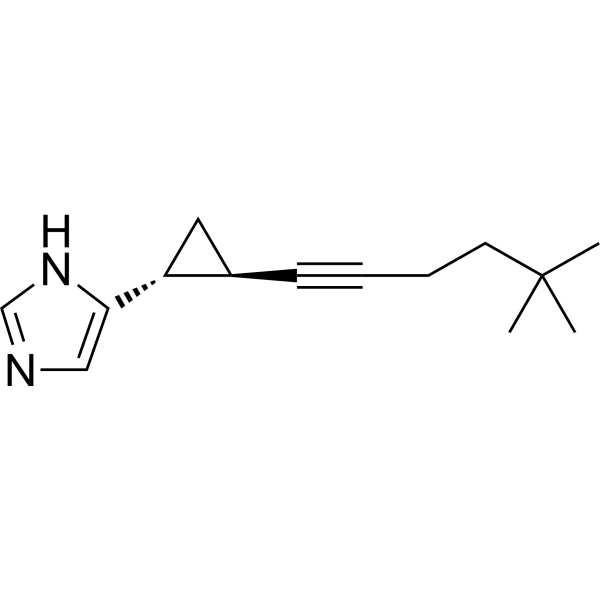
Cipralisant (GT-2331) is an orally active, low-toxicity, potent, selective, high affinity histamine H3 receptor full antagonist in vivo, and an agonist in vitro, with a pKi of 9.9 for histamine H3 receptor and a Ki of 0.47 nM for rat histamine H3 receptor. Cipralisant has the potential for attention-deficit hyperactivity disorder research. Cipralisant is a click chemistry reagent, it contains an Alkyne group and can undergo copper-catalyzed azide-alkyne cycloaddition (CuAAc) with molecules containing Azide groups.
Nos produits utilisent uniquement pour la recherche. Nous ne vendons pas aux patients.
- Pureté : 99.26%
- CAS No.: 213027-19-1
- Formule: C14H20N2
- Masse moléculaire:216.32
-
Stockage:Powder -20°C, 3 years , 4°C, 2 years ; In solvent -80°C, 6 months , -20°C, 1 month

To place orders, for customer services and technical support, please contact: MedChemExpress USA
Tel: 609-228-6898 E-mail: [email protected] [email protected]


-
 Activité biologique
-
Chemical Information
-
Solvant et solubilité
- Protocole
- Pureté et documentation
- Références
-
 Help & FAQs


Voir tous les produits spécifiques à Isoform Histamine Receptor
More

Activité biologique
Description
|
H3 receptor 9.9 (pKi) |
rat H3 receptor 0.47 nM (Ki) |
In Vitro
Cipralisant behaves as a full agonist on adenylyl cyclase inhibition. Cipralisant (HEK cells) potently inhibits forskolin-induced cAMP accumulation, showing that Cipralisant works as a potent full histamine H3 receptor agonist. Cipralisant increases the basal [35S]GTPγS binding activities in membranes from HEK cells expressing the rat histamine H3 receptor (EC50, 5.6 nM)[3].
MedChemExpress (MCE) has not independently confirmed the accuracy of these methods. They are for reference only.
In Vivo
Cipralisant (10 mg/kg; p.o.) completely blocks R-α-methylhistamine-induced drinking[3].
Cipralisant promotes wakefulness in the rat. Cipralisant potently and significantly improves performance in the repeated acquisition model, in line with its high affinity for the rat H3 receptor and good CNS penetration. Cipralisant does not appear to be as efficacious as 3 mg/kg ciproxifan at its maximally effective dose [2]. Cipralisant behaves as a partial agonist in a rat brain synaptosome model[3].
MedChemExpress (MCE) has not independently confirmed the accuracy of these methods. They are for reference only.
-
Animal Model:Male SHR pups (35–50 g)[2]
-
Dosage:0.3~30 mg/kg
-
Administration:S.c.
-
Result:Significantly enhanced performance of the SHR pups in a dose-related manner at 1 mg/kg.
-
Animal Model:Male Sprague-Dawley rats[3]
-
Dosage:10 and 30 mg/kg
-
Administration:P.o.
-
Result:Achieved greater brain exposure and water intake was monitored for 60 min after administration.


Chemical Information
-
CAS No. 213027-19-1
-
Appearance Solid
-
Masse moléculaire 216.32
-
Formule C14H20N2
-
Color White to off-white
-
SMILES
CC(C)(C)CCC#C[C@H]1[C@H](C2=CN=CN2)C1
-
Synonyms
GT-2331
-
Livraison
Room temperature in continental US; may vary elsewhere.
-
Stockage
Powder -20°C 3 years 4°C 2 years In solvent -80°C 6 months -20°C 1 month


Solvant et solubilité
In Vitro:
DMSO : 200 mg/mL (924.56 mM; Need ultrasonic; Hygroscopic DMSO has a significant impact on the solubility of product, please use newly opened DMSO)
Please refer to the solubility information to select the appropriate solvent. Once prepared, please aliquot and store the solution to prevent product inactivation from repeated freeze-thaw cycles.
Storage method and period of stock solution: -80°C, 6 months; -20°C, 1 month. When stored at -80°C, please use it within 6 months. When stored at -20°C, please use it within 1 month.
Please refer to the solubility information to select the appropriate solvent. Once prepared, please aliquot and store the solution to prevent product inactivation from repeated freeze-thaw cycles.
Storage method and period of stock solution: -80°C, 6 months; -20°C, 1 month. When stored at -80°C, please use it within 6 months. When stored at -20°C, please use it within 1 month.
Concentration (start) × Volume (start) = Concentration (final) × Volume (final)


Pureté et documentation
-
Fiche technique (271 KB)
-
SDS (393 KB)
- English - EN (393 KB)
- Français - FR (393 KB)
- Deutsch - DE (393 KB)
- Norwegian - NO (393 KB)
- Español - ES (393 KB)
- Swedish - SV (393 KB)
- Italian - IT (393 KB)
- Korean - KR (393 KB)
- Portuguese - PT (393 KB)
-
Instruction de manipulation (2659 KB)
Références
[1]. Raddatz R, et al. Histamine H3 antagonists for treatment of cognitive deficits in CNS diseases. Curr Top Med Chem. 2010;10(2):153-169. [Content Brief]
[2]. Fox GB, et al. Effects of histamine H(3) receptor ligands GT-2331 and ciproxifan in a repeated acquisition avoidance response in the spontaneously hypertensive rat pup. Behav Brain Res. 2002;131(1-2):151-161. [Content Brief]
[3]. Ito S, et al. Detailed pharmacological characterization of GT-2331 for the rat histamine H3 receptor. Eur J Pharmacol. 2006;529(1-3):40-46. [Content Brief]
[4]. Tedford CE, et al. High antagonist potency of GT-2227 and GT-2331, new histamine H3 receptor antagonists, in two functional models. Eur J Pharmacol. 1998;351(3):307-311. [Content Brief]


Complete Stock Solution Preparation Table
Please refer to the solubility information to select the appropriate solvent. Once prepared, please aliquot and store the solution to prevent product inactivation from repeated freeze-thaw cycles.
Storage method and period of stock solution: -80°C, 6 months; -20°C, 1 month. When stored at -80°C, please use it within 6 months. When stored at -20°C, please use it within 1 month.
| Optional Solvent | Concentration Solvent Mass | 1 mg | 5 mg | 10 mg | 25 mg |
|---|---|---|---|---|---|
| DMSO | 1 mM | 4.6228 mL | 23.1139 mL | 46.2278 mL | 115.5695 mL |
| 5 mM | 0.9246 mL | 4.6228 mL | 9.2456 mL | 23.1139 mL | |
| 10 mM | 0.4623 mL | 2.3114 mL | 4.6228 mL | 11.5570 mL | |
| 15 mM | 0.3082 mL | 1.5409 mL | 3.0819 mL | 7.7046 mL | |
| 20 mM | 0.2311 mL | 1.1557 mL | 2.3114 mL | 5.7785 mL | |
| 25 mM | 0.1849 mL | 0.9246 mL | 1.8491 mL | 4.6228 mL | |
| 30 mM | 0.1541 mL | 0.7705 mL | 1.5409 mL | 3.8523 mL | |
| 40 mM | 0.1156 mL | 0.5778 mL | 1.1557 mL | 2.8892 mL | |
| 50 mM | 0.0925 mL | 0.4623 mL | 0.9246 mL | 2.3114 mL | |
| 60 mM | 0.0770 mL | 0.3852 mL | 0.7705 mL | 1.9262 mL | |
| 80 mM | 0.0578 mL | 0.2889 mL | 0.5778 mL | 1.4446 mL | |
| 100 mM | 0.0462 mL | 0.2311 mL | 0.4623 mL | 1.1557 mL |


Cipralisant Related Classifications
HY-106993 Related Classifications
 Powered by Bioz