



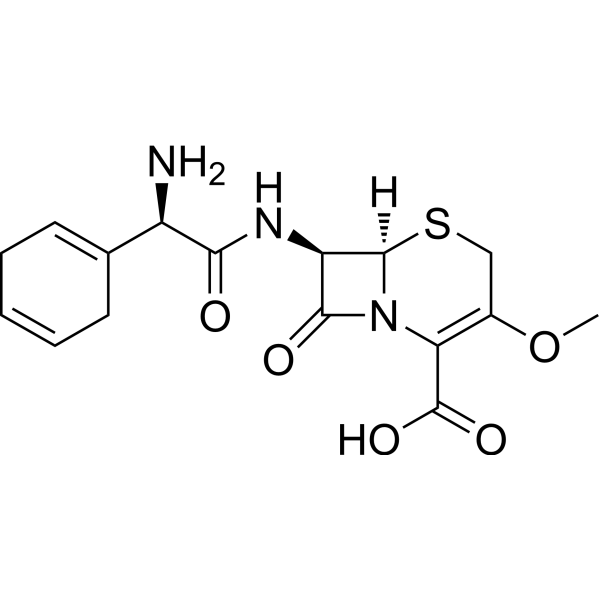
Cefroxadine
Cefroxadine (CGP 9000) is an orally active cephalosporin antibiotic. Cefroxadine is more effective than cephalexin against Escherichia coli and Klebsiella pneumoniae with MIC values of 3.13 and 1.56 μg/mL respectively with a concentration of 106 μg/mL. Cefroxadine can be used for the research of infection.
For research use only. We do not sell to patients.
- CAS No.: 51762-05-1
- Formula: C16H19N3O5S
- Molecular Weight:365.40
-
Storage:
Please store the product under the recommended conditions in the Certificate of Analysis.

To place orders, for customer services and technical support, please contact: MedChemExpress USA
Tel: 609-228-6898 E-mail: [email protected] [email protected]


-
 Biological Activity
-
Chemical Information
- Protocols
- Purity & Documentation
- References
-
 Help & FAQs


All Antibiotic Isoforms
More

Biological Activity
Description
IC50 & Target
|
β-lactam |
In Vitro
Cefroxadine (106-108 μg/mL; overnight) shows antibacterial activities against S. aureus, E. coli, S. typhi, S. paratyphi, S. schottmuelleri, K. apneumoniae and P. mirabilis with MIC values of 1.56, 3.31, 1.56, 1.56, 1.56, 1.56 and 6.25 μg/mL respectively with a concentration of 106 μg/mL[1]. Cefroxadine (104-108 μg/mL; overnight) shows antibacterial activities against 100 E. coli strains with MIC50 and MIC75 values of 4.8-11.5 μg/mL and 6-20 μg/mL, respectively[1].
MedChemExpress (MCE) has not independently confirmed the accuracy of these methods. They are for reference only.
In Vivo
MedChemExpress (MCE) has not independently confirmed the accuracy of these methods. They are for reference only.
-
Animal Model:Mice with E. coli ML4707 and K. pneumoniae GN6445 infection[1]
-
Dosage:0-30 mg/kg
-
Administration:Oral gavage; 0-30 mg/kg; 0 and 3 h after infection
-
Result:Showed a better effect than cephalexin in vivo with ED50 values of 21.4 and 10.9 mg/kg for E. coli ML4707 and K. pneumoniae GN6445 in vivo.


Chemical Information
-
CAS No. 51762-05-1
-
Molecular Weight 365.40
-
Formula C16H19N3O5S
-
SMILES
OC(C1=C(OC)CS[C@@]([C@@H]2NC([C@@H](C3=CCC=CC3)N)=O)([H])N1C2=O)=O
-
Synonyms
CGP 9000; Oraspor
-
Shipping
Room temperature in continental US; may vary elsewhere.
-
Storage
Please store the product under the recommended conditions in the Certificate of Analysis.


Purity & Documentation
References

Calculators
Concentration (start) × Volume (start) = Concentration (final) × Volume (final)


Cefroxadine Related Classifications
HY-107064 Related Classifications
 Powered by Bioz