



Inebilizumab
Based on 1 publication(s) in Google Scholar
Inebilizumab is an anti-CD19 monoclonal antibody (mAb) with enhanced antibody-dependent cell-mediated cytotoxicity against B cells. Inebilizumab can be used for multiple sclerosis and neuromyelitis optica research.
Nur für Forschungszwecke. Wir verkaufen nicht an Patienten.
- Reinheit: 99.00%
- CAS. Nr.: 1299440-37-1
- Molecular Weight:150 kDa
-
Speicherung:
Please store the product under the recommended conditions in the Certificate of Analysis.


To place orders, for customer services and technical support, please contact: MedChemExpress USA
Tel: 609-228-6898 E-mail: [email protected] [email protected]


-
 Biologische Aktivität
-
Chemical Information
- Reinheit & Dokumentation
- Verweise
-
 Help & FAQs










Publications Citing Use of MedChemExpress (MCE) Inebilizumab
More Customer Validation & Images

-
Flow Cytometry


Biologische Aktivität
Beschreibung
Isotype
Human IgG1 kappa
Recommend Isotype Controls
Species Reactivity
Human
IC50 & Target
CD19
In Vitro
Inebilizumab is derived from the mouse anti-human mAb HB12b, which had already shown impressive activity in depletion of B cells in transgenic mice carrying the human CD19 gene (hCD19 Tg)[1].
Inebilizumab potently depletes CD19-expressing B cells, including primary human B cells, B cell lines derived from multiple tumor types, and neoplastic B cells[1].
Inebilizumab demonstrates equal or better activity than Rituximab (HY-P9913) in depletion of human primary B cells in autologous ADCC assays and shows potent ADCC activity against human in vitro-differentiated and primary plasma cells[1].
MedChemExpress (MCE) has not independently confirmed the accuracy of these methods. They are for reference only.
In Vivo
MedChemExpress (MCE) has not independently confirmed the accuracy of these methods. They are for reference only.
-
Animal Model:huCD19/CD20 double Tg mice[2]
-
Dosage:0.5, 2, or 10 mg/kg
-
Administration:Tail vein injection, once
-
Result:Depleted B cells from blood and spleen, B-cell depletion in blood and spleen was maintained for more than 2 weeks after a single 10 mg/kg administration (better than Rituximab). Resulted in a substantial reduction (on average by 91.4% by day 3) in BM B220+muCD19+ B cells. Led to depletion of B cell by mouse macrophages.
Clinical Trial
| NCT Number | Sponsor | Condition | Start Date |
Phase

|
|---|---|---|---|---|
| NCT01329991 | Plexxikon| | 2011-05 | PHASE1 |
Gene ID
Accession
Conjugated
Unconjugated
Reconsititution
The product can be reconstituted/diluted with sterile PBS or saline.
Format
-
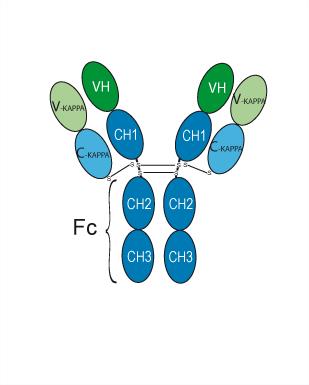
Human IgG1 kappa
Anwendung
ELISA, FACS, Functional assay
Verified Bioactivity
-
 Inebilizumab has a significant ADCC effect on CHOK1-hCD19 cells in a dose-dependent manner.The EC50 for this effect is 61.53 ng/mL.
 -
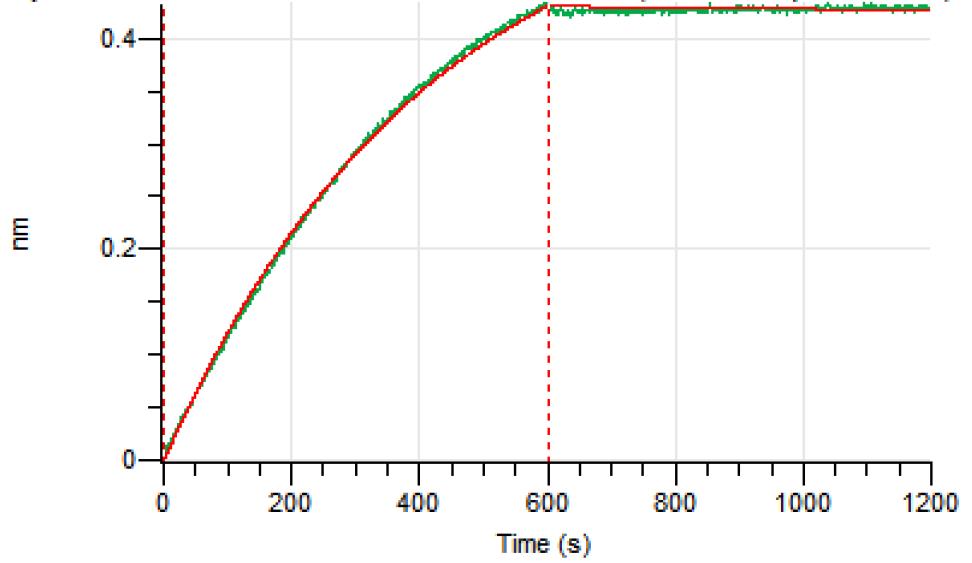 Loaded Inebilizumab on AHC2 biosensor, can bind CD19 Protein, Human (HEK293, His, HY-P74330) with an affinity constant of 1.240E-09 M as determined in BLI assay.


Chemical Information
-
CAS. Nr. 1299440-37-1
-
Appearance Liquid
-
Molecular Weight 150 kDa
-
Color Colorless to light yellow
-
SMILES
[Inebilizumab]
-
Synonyms
MEDI-551
-
Versand
Shipping with dry ice.
-
Formulation
Please refer to the lot-specific COA for specific buffer information.
-
Speicherung
Please store the product under the recommended conditions in the Certificate of Analysis.


Publications (1)
-
Journal Impact Factor
-
Most Recent
-
Acta Pharm Sin B
A rationally designed CD19 monoclonal antibody-triptolide conjugate for the treatment of systemic lupus erythematosus. [Abstract]2024 Oct;14(10):4560-4576. PMID: 39525579
Inebilizumab purchased from MedChemExpress. Usage Cited in: Acta Pharm Sin B. 2024 Oct;14(10):4560-4576. [Abstract]
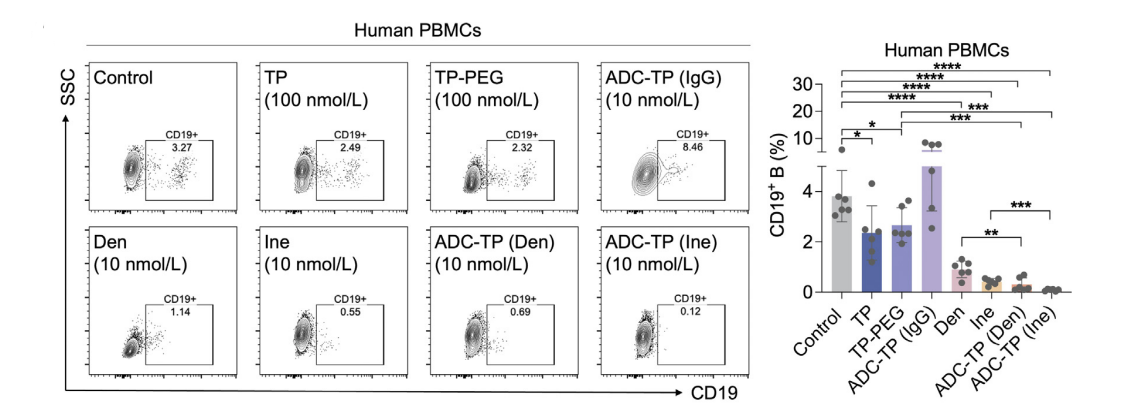
Human PBMCs were treated with 100 nmol/L TP, 100 nmol/L TP-PEG, 10 nmol/L ADC-TP (IgG), 10 nmol/L Den, 10 nmol/L Inebilizumab (Ine), 10 nmol/L ADC-TP (Den), and 10 nmol/L ADC-TP (Ine) for 48 h, the frequencies of CD19+ B cells were analyzed by flow cytometry.


Reinheit & Dokumentation
-
Data Sheet (261 KB)
-
SDS (251 KB)
- English - EN (251 KB)
- Français - FR (251 KB)
- Deutsch - DE (251 KB)
- Norwegian - NO (251 KB)
- Español - ES (251 KB)
- Swedish - SV (251 KB)
- Italian - IT (251 KB)
- Korean - KR (251 KB)
- Portuguese - PT (251 KB)
-
Inhibitory Antibodies User Guide (603 KB)
Verweise
[1]. Chen D, et al. Inebilizumab, a B Cell-Depleting Anti-CD19 Antibody for the Treatment of Autoimmune Neurological Diseases: Insights from Preclinical Studies. J Clin Med. 2016 Nov 24;5(12):107. [Content Brief]
[2]. Herbst R, et al. B-cell depletion in vitro and in vivo with an afucosylated anti-CD19 antibody. J Pharmacol Exp Ther. 2010 Oct;335(1):213-22. [Content Brief]

Calculators
Konzentration (Stammlösung) × Volumen (Stammlösung) = Konzentration (Ziellösung) × Volumen (Ziellösung)


Inebilizumab Related Classifications
HY-P99113 Related Classifications
 Powered by Bioz