



Myasthenia gravis
-
Myasthenia gravis (14)

- 1


- Molecular Weight: 142.12 kDa
Nipocalimab (M281) is a fully humanized, recombinant, and non-glycosylated IgG1 monoclonal antibody. Nipocalimab can bind to the IgG-binding site of FcRn with high affinity and inhibit the transplacental transfer of IgG. Nipocalimab can be used in the research of fetal and neonatal hemolytic disease, myasthenia gravis, and various IgG-mediated autoimmune diseases.

- Molecular Weight: 144.54 kDa
Belimumab (LymphoStat B) is a humanized IgG1λ monoclonal antibody against B-lymphocyte stimulator (BLyS) protein. Belimumab antagonizes BLyS activity in autoimmune diseases and B-lymphocyte malignancies. Belimumab can be used for systemic lupus erythematosus (SLE) research. The component ratio of this product is Active ingredient: Excipients = 1:1.0-1:1.2.

- Molecular Weight: 51.28 kDa
Efgartigimod alfa (ARGX-113) is a reversibility, humanized Fc receptor antagonist . Efgartigimod alfa is a anti FcRn monoclonal immunoglobulin G (IgG1) Fc fragment. Efgartigimod reduces serum levels of total IgG, including pathogenic autoantibodies, by blocking FcRn function without permanent impairment. Efgartigimod alfa can be used for generalised myasthenia gravis (gMG) and primary immune thrombocytopenia research.

- Molecular Weight: 150 kDa
Inebilizumab is an anti-CD19 monoclonal antibody (mAb) with enhanced antibody-dependent cell-mediated cytotoxicity against B cells. Inebilizumab can be used for multiple sclerosis and neuromyelitis optica research.
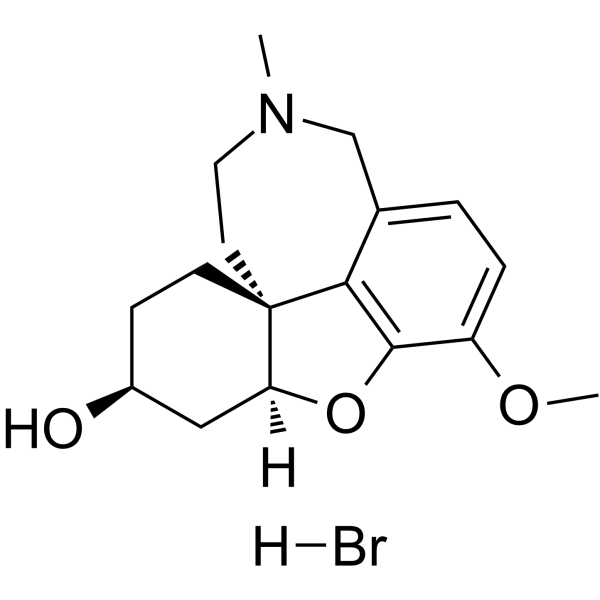
- Formula: C17H24BrNO3
- Molecular Weight: 370.28
Lycoramine hydrobromide is a blood-brain barrier-penetrating Acetylcholinesterase inhibitor and Galanthamine (HY-76299) derivative. Lycoramine hydrobromide induces Amyloid-beta plaque clearance. Lycoramine hydrobromide induces reversal of cognitive decline and memory improvement. Lycoramine hydrobromide can be used for research on Alzheimer's disease and myasthenia gravis.
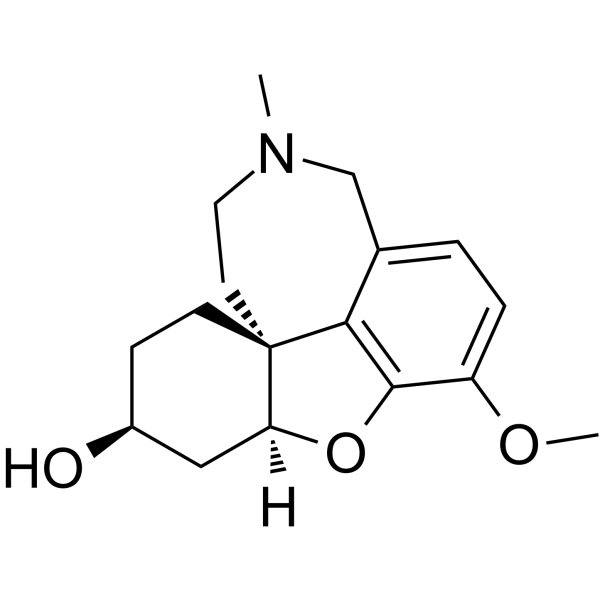
- Formula: C17H23NO3
- Molecular Weight: 289.38
Lycoramine is a blood-brain barrier-penetrating Acetylcholinesterase inhibitor and Galanthamine (HY-76299) derivative. Lycoramine induces Amyloid-beta plaque clearance. Lycoramine induces reversal of cognitive decline and memory improvement. Lycoramine can be used for research on Alzheimer's disease and myasthenia gravis.

- Formula: C26H17F4N3O4S2
- Molecular Weight: 575.55
AS3513678 is a positive allosteric modulator of skeletal muscle-type nicotinic acetylcholine receptor (m-nAChR). AS3513678 promotes acetylcholine (ACh) signaling via m-nAChR, shifts the ACh concentration-response curve to the left, and does not activate the receptor in the absence of ACh. AS3513678 can be used for research on myasthenia gravis and congenital myasthenic syndrome.

- Molecular Weight: 145.74 kDa
Empasiprubar (ARGX-117) is a humanized inhibitory monoclonal antibody targeting complement C2. Empasiprubar binds to the Sushi-2 domain of C2, preventing the formation of C3 pre convertase and inhibiting the activation of classical and lectin pathways upstream of C3 activation. Empasiprubar can prevent complement mediated autoimmune hemolytic anemia and antibody mediated organ transplant rejection. Empasiprubar can prevent neuroglial lymphoconjunctival injury in GM1 antibody mediated mouse models.

- Molecular Weight: 144.638 kDa
Claseprubart (DNTH103) is an inhibitor targeting C1s of the complement system and an inhibitor of the C1 component of the complement cascade. Claseprubart is in phase 2 clinical evaluation. Claseprubart has application potential in research related to multifocal motor neuropathy and generalized myasthenia gravis.
- Molecular Weight: 150 kDa
Anti-Human/Rat/Fish AChR Antibody (Mab35) is an anti-human/rat/fish AChR IgG1 monoclonal antibody. Anti-Human/Rat/Fish AChR Antibody (Mab35) can attack the AChR of neuromuscular junctions. Anti-Human/Rat/Fish AChR Antibody (Mab35) can be used for the construction of myasthenia gravis models.

- Formula: C27H22F3N5O7S2
- Molecular Weight: 649.62
AS3580239 is a positive allosteric modulator of skeletal muscle-type nicotinic acetylcholine receptor (m-nAChR). AS3580239 promotes acetylcholine (ACh) signaling via m-nAChR, causing a leftward shift of the ACh concentration-response curve. AS3580239 enhances electrically stimulated isometric contraction of the extensor digitorum longus (EDL) muscle. AS3580239 improves neurotransmission and enhances muscle strength. AS3580239 can be used for research on myasthenia gravis.

- Formula: C27H26N6O4
- Molecular Weight: 498.53
Sotrastaurin (AEB071) acetate is a selective, orally active PKC inhibitor. Sotrastaurin acetate inactivates NF-κB by inhibiting PKC α, β, θ, γ subtypes, thereby reducing the transcription levels of immune response-related genes. Sotrastaurin acetate effectively inhibits alloreactive T cell proliferation, conventional T cell activation, as well as the production of pro-inflammatory cytokines and B lymphocytes. Sotrastaurin acetate also maintains the functional and phenotypic stability of regulatory T cells, enhances Foxp3 expression and restores the balance of helper T lymphocytes. Sotrastaurin acetate can prolong the survival time of allografts, and alleviate inflammatory responses and myasthenic symptoms by reducing anti-AChR antibody levels. Sotrastaurin acetate is widely used in studies related to kidney transplantation, psoriasis and myasthenia gravis.

- Formula: C24H16F3N5O5S2
- Molecular Weight: 575.54
AS3566987 is a positive allosteric modulator of the skeletal muscle-type nicotinic acetylcholine receptor (m-nAChR). AS3566987 promotes acetylcholine signaling via the skeletal muscle-type nicotinic acetylcholine receptor, and receptor activation requires the involvement of acetylcholine. AS3566987 can be used in the research of neuromuscular diseases (including myasthenia gravis and congenital myasthenic syndrome).
- 1



