



CGS 15943

Based on 1 Customer Validation
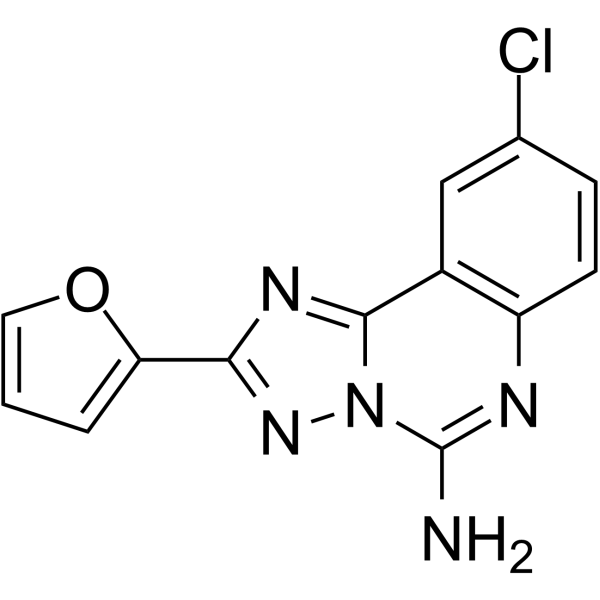
CGS 15943 is an orally bioavailable non-xanthine Adenosine Receptor antagonist. Its Ki for human A1, A2A, A2B, and A3 Adenosine Receptors are 3.5, 4.2, 16, and 50 nM in transfected CHO cells, respectively. .
For research use only. We do not sell to patients.
- Purity: 99.55%
- CAS No.: 104615-18-1
- Formula: C13H8ClN5O
- Molecular Weight:285.69
-
Storage:Powder -20°C, 3 years , 4°C, 2 years ; In solvent -80°C, 2 years , -20°C, 1 year

To place orders, for customer services and technical support, please contact: MedChemExpress USA
Tel: 609-228-6898 E-mail: [email protected] [email protected]


-
 Biological Activity
-
Chemical Information
-
Solvent & Solubility
- Purity & Documentation
- References
-
 Help & FAQs
-

GPCR/G Protein Compound Library
HY-L006
-
Immunology/Inflammation Compound Library
HY-L007
-
Kinase Inhibitor Library
HY-L009
-
PI3K/Akt/mTOR Compound Library
HY-L015
-
Stem Cell Signaling Compound Library
HY-L017
-
Anti-Cancer Compound Library
HY-L025
-
Autophagy Compound Library
HY-L029
-
Small Molecule Immuno-Oncology Compound Library
HY-L031
-
Anti-Aging Compound Library
HY-L034
-
Differentiation Inducing Compound Library
HY-L038
-
Oxygen Sensing Compound Library
HY-L045
-
Glycolysis Compound Library
HY-L058
-
Cytoskeleton Compound Library
HY-L060
-
Orally Active Compound Library
HY-L061
-
Neurotransmitter Receptor Compound Library
HY-L062
-
Anti-Breast Cancer Compound Library
HY-L074
-
Anti-Lung Cancer Compound Library
HY-L075
-
Anti-Pancreatic Cancer Compound Library
HY-L077
-
Anti-Blood Cancer Compound Library
HY-L079
-
Anti-Cancer Metabolism Compound Library
HY-L083
-
Anti-Parkinson's Disease Compound Library
HY-L085
-
Neurodegenerative Disease-related Compound Library
HY-L086
-
Anti-Obesity Compound Library
HY-L087
-
Angiogenesis-Related Compound Library
HY-L088
-
Glucose Metabolism Compound Library
HY-L092
-
Anti-Liver Cancer Compound Library
HY-L101
-
Anti-Colorectal Cancer Compound Library
HY-L103
-
Human Metabolite Library
HY-L123
-
Anti-Prostate Cancer Compound Library
HY-L124
-
Anti-Pulmonary Fibrosis Compound Library
HY-L125
-
Cancer Stem Cells Compound Library
HY-L135
-
Heterocyclic Compound Library
HY-L138
-
Pain-Related Compound Library
HY-L139
-
Membrane Protein-targeted Compound Library
HY-L149
-
Membrane Receptor-targeted Compound Library
HY-L150
-
Highly Selective Inhibitors Library
HY-L158
-
Anti-Hematopathy Compound Library
HY-L171
-
Anti-Ovarian Cancer Compound Library
HY-L173
-
Multi-Target Compound Library
HY-L176
-
Bioactive Compound Library Max
HY-L181
-
MCE Bioactive Compound Library
HY-L001V
-
Bioactive Compound Library
HY-L001
-
Anti-Fibrosis Compound Library
HY-L185
-
Anti-Brain Cancer Compound Library
HY-L188
-
Cell Proliferation Compound Library
HY-L201
-
High-Throughput Bioactive Compound Library
HY-L205
-
Anti-Rheumatic Arthritis Compound Library
HY-L210
-
Mass Spectrometry Human Metabolite Library
HY-L215
-
Posttranslational Modification Library
HY-L226
-
Lactylation Compound Library
HY-L249


All Adenosine Receptor Isoforms
More

Biological Activity
|
p110γ 1.1 μM (IC50) |
p110δ 8.47 μM (IC50) |
adenosine A1 receptor 3.5 nM (Ki) |
adenosine A2A receptor 4.2 nM (Ki) |
adenosine A2B receptor 16 nM (Ki) |
adenosine A3 receptor 50 nM (Ki) |
|
Cell Line

|
Type | Value | Description | References |
|---|---|---|---|---|
| CHO | IC50 |
1.2 μM
Compound: 1a
|
Inhibition of 50 uM 5`-(N-ethylcarboxamido)adenosine induced cAMP production in CHO cell line expressing human Adenosine A2B receptor
Inhibition of 50 uM 5`-(N-ethylcarboxamido)adenosine induced cAMP production in CHO cell line expressing human Adenosine A2B receptor
|
[PMID: 9667972] |
| CHO | IC50 |
406 nM
Compound: CGS-15943
|
Inhibition of cAMP accumulation in CHO cells expressing human adenosine A3 receptor
Inhibition of cAMP accumulation in CHO cells expressing human adenosine A3 receptor
|
[PMID: 11123985] |
CGS 15943 inhibits the kinase activity of the class IB PI3K isoform p110γ with an IC50 of 1.1 μM and shows slight inhibition on p110δ with an IC50 of 8.47 μM[3]. CGS 15943 (0-20 μM; 72 hours) inhibits growth of HLF and SK-Hep-1 cells, as well as HepG2 and PLC-PRF-5 cells[3]. CGS 15943 (0-20 μM; 24 hours) reduces the phosphorylation of Akt at its residues Ser473 and Thr308 in HLF and Sk-Hep-1 cells[3].
MedChemExpress (MCE) has not independently confirmed the accuracy of these methods. They are for reference only.
-
Cell Line:HLF, SK-Hep-1, HepG2 and PLC-PRF-5 cells
-
Concentration:0 μM; 1 μM; 5 μM; 10 μM; 20 μM
-
Incubation Time:24 hours
-
Result:Inhibited growth of four distinct HCC cell lines.
-
Cell Line:HLF and Sk-Hep-1 cells
-
Concentration:0 μM; 1 μM; 5 μM; 10 μM; 20 μM
-
Incubation Time:24 hours
-
Result:Inhibited the PI3K/Akt pathway in HLF and Sk-Hep-1 cells


Chemical Information
-
CAS No. 104615-18-1
-
Appearance Solid
-
Molecular Weight 285.69
-
Formula C13H8ClN5O
-
Color White to off-white
-
SMILES
NC1=NC2=C(C=C(Cl)C=C2)C3=NC(C4=CC=CO4)=NN13
-
Shipping
Room temperature in continental US; may vary elsewhere.
-
Storage
Powder -20°C 3 years 4°C 2 years In solvent -80°C 2 years -20°C 1 year


Solvent & Solubility
DMSO : 12.22 mg/mL (42.77 mM; Need ultrasonic; Hygroscopic DMSO has a significant impact on the solubility of product, please use newly opened DMSO)
Please refer to the solubility information to select the appropriate solvent. Once prepared, please aliquot and store the solution to prevent product inactivation from repeated freeze-thaw cycles.
Storage method and period of stock solution: -80°C, 2 years; -20°C, 1 year. When stored at -80°C, please use it within 2 years. When stored at -20°C, please use it within 1 year.
Please refer to the solubility information to select the appropriate solvent. Once prepared, please aliquot and store the solution to prevent product inactivation from repeated freeze-thaw cycles.
Storage method and period of stock solution: -80°C, 2 years; -20°C, 1 year. When stored at -80°C, please use it within 2 years. When stored at -20°C, please use it within 1 year.
Concentration (start) × Volume (start) = Concentration (final) × Volume (final)
Select the appropriate dissolution method based on your experimental animal and administration route.
- For the following dissolution methods, please ensure to first prepare a clear stock solution using an In Vitro approach and then sequentially add co-solvents:
- To ensure reliable experimental results, the clarified stock solution can be appropriately stored based on storage conditions. As for the working solution for In Vivo experiments, it is recommended to prepare freshly and use it on the same day.
- The percentages shown for the solvents indicate their volumetric ratio in the final prepared solution. If precipitation or phase separation occurs during preparation, heat and/or sonication can be used to aid dissolution.
Add each solvent one by one: 10% DMSO 40% PEG300 5% Tween-80 45% Saline
Solubility: 1.22 mg/mL (4.27 mM); Suspended solution; Need ultrasonic
This protocol yields a suspended solution of 1.22 mg/mL. Suspended solution can be used for oral and intraperitoneal injection.
Taking 1 mL working solution as an example, add 100 μL DMSO stock solution (12.2 mg/mL) to 400 μL PEG300, and mix evenly; then add 50 μL Tween-80 and mix evenly; then add 450 μL Saline to adjust the volume to 1 mL.
Preparation of Saline: Dissolve 0.9 g sodium chloride in ddH₂O and dilute to 100 mL to obtain a clear Saline solution.
Add each solvent one by one: 10% DMSO 90% (20% SBE-β-CD in Saline)
Solubility: 1.22 mg/mL (4.27 mM); Suspended solution; Need ultrasonic
This protocol yields a suspended solution of 1.22 mg/mL. Suspended solution can be used for oral and intraperitoneal injection.
Taking 1 mL working solution as an example, add 100 μL DMSO stock solution (12.2 mg/mL) to 900 μL 20% SBE-β-CD in Saline, and mix evenly.
Preparation of 20% SBE-β-CD in Saline (4°C, storage for one week): 2 g SBE-β-CD powder is dissolved in 10 mL Saline, completely dissolve until clear.
Please enter the basic information of animal experiments:
-
-
-
-
Recommended: Prepare an additional quantity of animals to account for potential losses during experiments.
Please enter your animal formula composition:
-
%DMSO +
Recommended: Keep the proportion of DMSO in working solution below 2% if your animal is weak.
-
%+
-
+%Tween-80 + +
-
%Saline +
The co-solvents required include: DMSO, . All of co-solvents are available by MedChemExpress (MCE). , Tween 80. All of co-solvents are available by MedChemExpress (MCE).
Working solution concentration: 0.22 mg/mL
Method for preparing stock solution: mg drug dissolved in μL DMSO. Stock solution concentration: mg/mL.
1. Take μL DMSO stock solution;
2. Add μL .
μL , mix evenly;
3. Then add μL Tween 80, mix evenly;
4. Then add μL
Please ensure that the stock solution in the first step is dissolved to a clear state, and add co-solvents in sequence. You can use ultrasonic heating (ultrasonic cleaner, recommended frequency 20-40 kHz), vortexing, etc. to assist dissolution.


Purity & Documentation
-
Data Sheet (279 KB)
-
SDS (396 KB)
- English - EN (396 KB)
- Français - FR (396 KB)
- Deutsch - DE (396 KB)
- Norwegian - NO (396 KB)
- Español - ES (396 KB)
- Swedish - SV (396 KB)
- Italian - IT (396 KB)
- Korean - KR (396 KB)
- Portuguese - PT (396 KB)
-
Handling Instructions (2659 KB)
References
[1]. Gao Y, et al. CGS 15943, an adenosine A2 receptor antagonist, reduces cerebral ischemic injury in the Mongolian gerbil. Life Sci. 1994;55(3):PL61-5. [Content Brief]
[2]. Klotz KN, et al. Adenosine receptors and their ligands. Naunyn Schmiedebergs Arch Pharmacol. 2000 Nov;362(4-5):382-91. [Content Brief]
[3]. Edling CE, et al. Caffeine and the analog CGS 15943 inhibit cancer cell growth by targeting the phosphoinositide 3-kinase/Akt pathway. Cancer Biol Ther. 2014 May;15(5):524-32. [Content Brief]


Complete Stock Solution Preparation Table
Please refer to the solubility information to select the appropriate solvent. Once prepared, please aliquot and store the solution to prevent product inactivation from repeated freeze-thaw cycles.
Storage method and period of stock solution: -80°C, 2 years; -20°C, 1 year. When stored at -80°C, please use it within 2 years. When stored at -20°C, please use it within 1 year.
| Optional Solvent | Concentration Solvent Mass | 1 mg | 5 mg | 10 mg | 25 mg |
|---|---|---|---|---|---|
| DMSO | 1 mM | 3.5003 mL | 17.5015 mL | 35.0030 mL | 87.5074 mL |
| 5 mM | 0.7001 mL | 3.5003 mL | 7.0006 mL | 17.5015 mL | |
| 10 mM | 0.3500 mL | 1.7501 mL | 3.5003 mL | 8.7507 mL | |
| 15 mM | 0.2334 mL | 1.1668 mL | 2.3335 mL | 5.8338 mL | |
| 20 mM | 0.1750 mL | 0.8751 mL | 1.7501 mL | 4.3754 mL | |
| 25 mM | 0.1400 mL | 0.7001 mL | 1.4001 mL | 3.5003 mL | |
| 30 mM | 0.1167 mL | 0.5834 mL | 1.1668 mL | 2.9169 mL | |
| 40 mM | 0.0875 mL | 0.4375 mL | 0.8751 mL | 2.1877 mL |


CGS 15943 Related Classifications
HY-100678 Related Classifications
 Powered by Bioz